
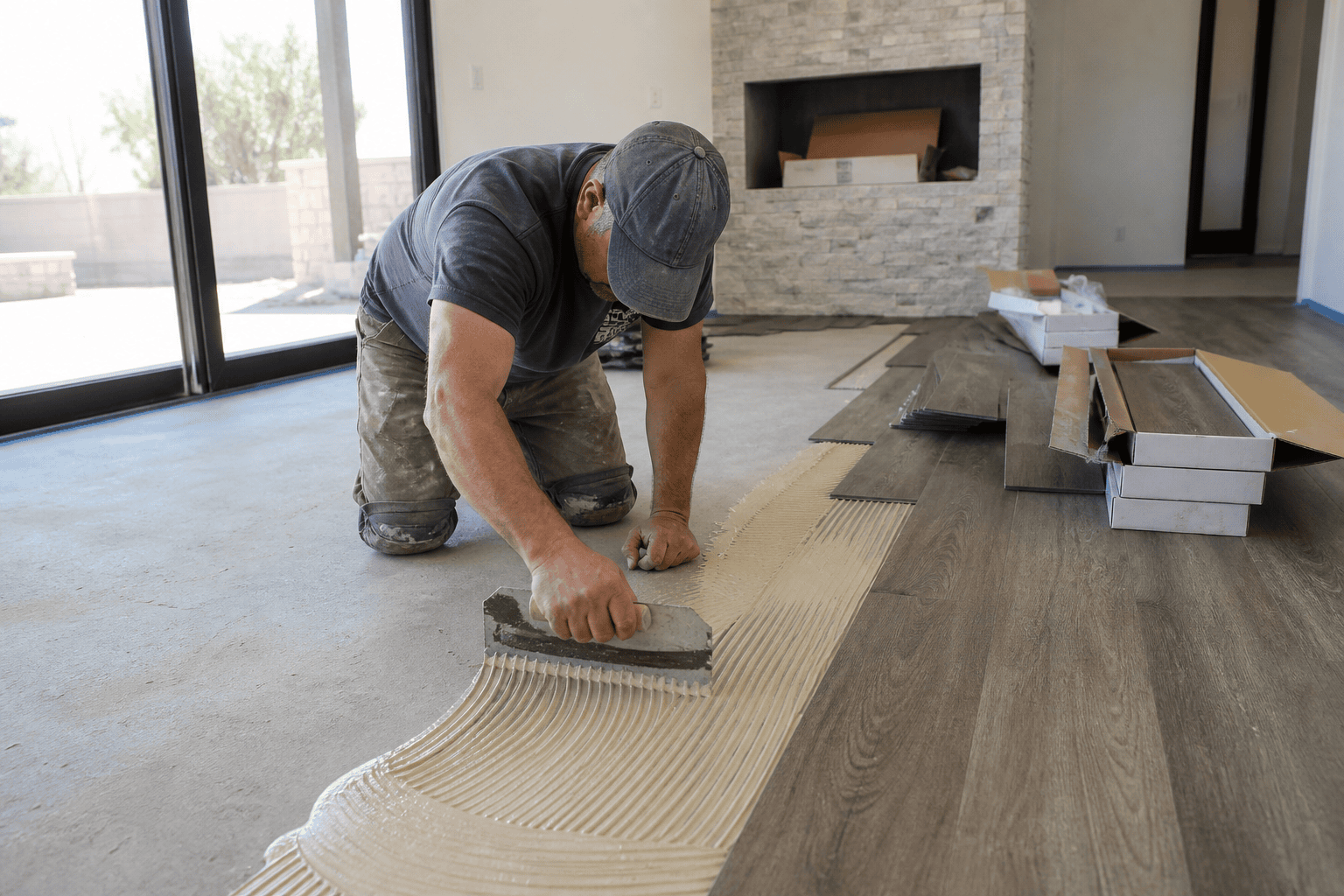
Flooring Contractor Insurance: Hardwood, LVP, and the Class Split
A flooring crew can put a click-lock LVP job and a sand-and-finish hardwood job on the same invoice, but the two jobs don’t belong to the same insurance class. Nevada puts wooden flooring on a carpentry card and floor coverings on a separate finishing card, and wood dust and finish fumes raise a pollution question that a resilient-floor policy was never priced to answer. Flooring contractor insurance has to account for that split, because the trade looks like one product and behaves like two or three risks depending on what’s going down that week. This guide is for crews who install LVP, carpet, and hardwood and then get asked to set ceramic tile — the coverage stack, the hardwood-versus-LVP class split, damage to the floor you’re installing, moisture and adhesive claims, and the licensing rules in Nevada, California, Arizona, and Utah.
Who Needs Flooring and Floor Covering Coverage?
Floor covering shops and hardwood finishers both need this coverage, along with LVP and vinyl crews, carpet layers, and sand-and-finish specialists. Tile setters should take a second look at their license, since ceramic tile sits on its own card in California and Nevada. A crew that bids both wood and resilient flooring needs a policy that names both. A crew that bids tile needs a license that names tile. For the coverage every trade needs regardless of specialty, see our contractor insurance explained guide, and for crews running the whole site, our general contractor insurance guide.
Work that grows past the floor itself usually belongs to a different guide. A punch list after the floor is in is closer to handyman contractor insurance territory once it’s more than incidental repair. Painting the baseboards after a floor job falls under painting contractor insurance. Resetting the landscaping after a patio door replacement belongs with landscaping contractor insurance.
What Coverage Does a Flooring Business Need?
Most flooring operations run on five core policies. General liability sits at the base and responds when the work injures someone else or damages their property — a homeowner who slips on a loose plank, or a kneeler that scars a wall nobody hired you to touch. Workers compensation covers an installer who’s cut, strained, or hurt on a ladder. Commercial auto covers the vans hauling rolls and cartons between jobs. Inland marine, often sold as a tools-and-equipment floater, covers saws, kneelers, sanders, and leftover material wherever they travel. A business owners policy can bundle general liability with property coverage for a shop or warehouse.
Two more become worth a look as the business grows. A commercial umbrella stacks extra limits above general liability and auto, and general contractors and builders increasingly want $2 million or more before they’ll let a crew on site. Professional liability responds to claims about the work itself — a moisture test that got skipped, a finish that doesn’t match spec — the kind of dispute general liability treats as a workmanship issue and steps away from. Groups like the National Wood Flooring Association publish the moisture and installation standards underwriters read closely once a book of business starts looking like hardwood.
Which Policy Pays Which Flooring Claim?
Mapping real claims to the policy that responds makes coverage decisions a lot more concrete. Here’s how the losses we see most often in this trade tend to sort out.
| The claim | The policy that responds |
|---|---|
| Homeowner slips on a loose plank or wet adhesive | General liability |
| Installer is cut, strained, or hurt on a ladder | Workers compensation |
| Sander or kneeler stolen from the van overnight | Inland marine tools and equipment |
| Van hits a parked car between installs | Commercial auto |
| LVP cups months after a damp slab was covered | Completed operations on general liability, if the damage is to other property |
| The floor just installed fails and the owner wants a redo | Often excluded as your work or property in your care |
| Owner says the moisture test or finish missed spec | Professional liability, or the contractor’s own pocket |
| Sanding dust or finish fumes damage adjacent rooms or HVAC | Often a pollution argument on standard general liability |
Two of those rows deserve more explanation than a table can give. Damage to the floor being installed often falls outside general liability entirely, while water damage to the drywall in the next room is usually a different, covered claim. We walk through both below.
How Flooring Contractor Insurance Treats Hardwood Differently From LVP
Plenty of agencies sell flooring contractor insurance as a single product, but hardwood sand-and-finish work sits in a different class than click-lock LVP. Carriers price wood dust, stain, and finish fumes as a pollution exposure, and a resilient-floor policy written for vinyl and carpet was never built to contemplate that dust. Bid a refinish under an LVP class and two things can break at once: the license may not authorize the wood work, and the policy class may leave the sanding job outside the grant of coverage.
Nevada makes the split visible right on the license. C-16 Finishing Floors, under NAC 624.330, covers fabrics, carpet, polyurethane, and other floor coverings, but it excludes ceramic tile and marble. Wooden flooring sits under C-3b Finish Carpentry, per NAC 624.210, which covers the install, repair, and finishing of wooden flooring and millwork. Tile is a third card entirely, C-20. A crew that only clicks LVP can stay in C-16, but a crew sanding and coating oak needs C-3b — tell your agent about the largest hardwood job on the board, and do it before a loss reveals the mismatch, not after.
California folds wood and resilient flooring into one C-15 Flooring and Floor Covering class, which still excludes ceramic tile — that work is C-54. C-15 is not on the Contractors State License Board’s mandatory workers compensation list, so a solo C-15 can still file a no-employee exemption today, though hiring anyone ends that exemption immediately, and an RME-qualified license can’t claim it at all. The classes currently on that mandatory list are C-8 concrete, C-20 HVAC, C-22 asbestos, C-39 roofing, and C-61/D-49 tree service. Universal workers compensation for the remaining classes is still scheduled for January 1, 2028 — plenty of pages online still print 2026, and that date is outdated.
How Do Licensing Rules Differ in Nevada, California, Arizona, and Utah?
Each of the four states we serve licenses flooring as its own trade, and some split wood, resilient, and tile even further. Here’s the short version.
| State | Flooring class | Tile or wood split | Bond or insurance rule |
|---|---|---|---|
| Nevada | C-16 finishing floors for coverings | C-3b wooden flooring; C-20 tiling | Bond $1,000–$500,000; license carries a monetary limit; workers comp required for employees |
| California | C-15 Flooring and Floor Covering | C-54 ceramic and mosaic tile | $25,000 contractor bond; C-15 can still file a no-employee exemption; universal workers comp starts January 1, 2028 |
| Arizona | R-8, C-8, or CR-8 Floor Covering | One floor covering class includes wood, vinyl, carpet, and floor tile | Bonds scale with class and volume; license required at $1,000 or any permit; workers comp required at one employee |
| Utah | S220 Carpentry and Flooring | S220 includes laminate, tile, wood, sanding, and finishing | Licensed classes carry $1 million per occurrence / $2 million aggregate since June 25, 2026; workers comp or a Labor Commission waiver required |
A couple of labels are worth double-checking. Arizona’s C-8 is Floor Covering, while California’s C-8 is Concrete — different trades entirely despite the shared code. Nevada’s C-16 covers floor coverings but excludes ceramic tile and marble. California raised its licensing threshold from $500 to $1,000 back in January 2025, and older pages still quote the lower figure. The C-15/C-54 bond is $25,000 under Business and Professions Code 7071.6, and every Nevada license also carries its own monetary limit — a crew licensed at $250,000 can’t legally take on a $900,000 hotel corridor job.
What Arizona and Utah Require Before You Install
Arizona’s Registrar of Contractors licenses flooring as R-8 residential, C-8 commercial, or CR-8 dual Floor Covering, and those classes cover carpet, floor tile, wood, linoleum, vinyl, asphalt, rubber, and concrete coatings all under one scope, as published in the Arizona Administrative Code. Licensing kicks in at $1,000 in labor and materials, or any job requiring a permit. Specialty bonds scale with volume: commercial specialty bonds run from $2,500 to $50,000, and residential specialty bonds sit at $4,250 or $7,500, with residential license holders also paying into the Residential Contractors Recovery Fund.
Utah folds flooring into S220 Carpentry and Flooring, a scope that includes laminate, tile, cement, wood, and synthetic wood, plus the sanding, staining, and finishing of new and existing floors. S220 is a specialty license reached through a 25-hour pre-license course from an approved provider. Since June 25, 2026, Utah has required $1 million per occurrence and $2 million aggregate in general liability for every contractor classification, with the Division of Professional Licensing named as certificate holder. Older pages, and even a few 2026 application PDFs, still print the long-dead $100,000/$300,000 figures or an outdated $1 million/$3 million aggregate — the currently adopted floor is $1 million per occurrence and $2 million aggregate, and we match certificates to that current division floor rather than to what an old form still prints. Utah Code Title 58 Chapter 55, the Construction Trades Licensing Act, is the statute underneath that specialty class.
Why Completed Operations, Moisture, and the Floor Itself Still Matter
LVP that cups in October from a July install is a completed operations question. Standard general liability is built to respond to injury or damage that happens during the policy period, including damage that shows up after the crew has already left — but some inexpensive flooring policies restrict that grant, so it’s worth asking where completed operations lives on a given policy and whether its aggregate is shared with the rest of the coverage or stands on its own.
It’s easy to assume general liability covers property damage across the board, but the part that decides who pays for a redo is more specific than that. General liability typically excludes damage to the particular part of the property being worked on, along with property in the contractor’s care, custody, or control — and the floor being installed usually sits right in that gap. A gouge in a plank just clicked into place is often a job cost the contractor absorbs, while water that ruins the drywall in the next room is more likely a covered property damage claim. That distinction catches people off guard more than almost anything else in this trade, which is why photographing the subfloor before starting and writing down the moisture reading matters — it keeps the invoice lined up with what the policy actually covers.
Moisture and adhesive create a similar quiet limit. A wet slab under LVP turns into a workmanship fight the moment the click-lock fails, and hardwood that cups because nobody tested the slab ends up in the same fight. Sanding dust and finish fumes add a pollution wrinkle on top, since standard general liability often treats airborne dust and solvent fumes as a pollution event rather than ordinary property damage. Flagging on-site sanding and coating work to an agent ahead of time is a lot easier than discovering the gap through a neighbor’s HVAC claim.
How Much Does Flooring Contractor Insurance Cost?
Price follows the class, the deductible, and the payroll — not a national average pulled from a comparison site. A solo LVP crew prices very differently from a shop that sands hardwood and sets tile. General liability deductibles for flooring work typically start around $5,000, and $10,000 or higher becomes common once revenue grows or more people are riding in the van; a few-thousand-dollar callback usually sits comfortably inside that deductible. The real insurance problem is the class and the hardwood split, not the size of any one job.
The lines around general liability move the total bill more than the GL number alone. Tools and equipment coverage, commercial auto, and workers compensation are the pieces that tend to surprise people, and on-site sanding, tile work, or adding a helper to payroll all shift the classification. It’s worth shopping the language and the classification rather than chasing a monthly teaser from an online marketplace. Request a quote and we’ll price the work actually on the board — and for a larger remodel that puts a structure at risk during construction, builders risk insurance may also be worth adding.
Questions to Ask Before You Bind
Walk through these with an agent before the first certificate goes out.
- What class did the carrier assign — resilient, hardwood, tile, or more than one?
- If sanding and finishing happen on site, does the file reflect that exposure?
- What happens to coverage when an LVP job picks up a hardwood refinish?
- Does completed operations stay active after the crew leaves the site?
- How does the policy treat damage to the floor just installed?
- Are sanders, kneelers, and leftover rolls scheduled on inland marine?
- Can the carrier issue the additional insured wording general contractors actually ask for?
What Do General Contractors and Builders Require?
A certificate of insurance is evidence of coverage, not coverage itself. Most general contractors and builders want $1 million per occurrence and $2 million aggregate, plus additional insured status, a waiver of subrogation, and primary and noncontributory wording — and the endorsement behind that wording actually has to exist on the policy. A certificate promising language the policy doesn’t have is a problem waiting for a claim to expose it, which is why reviewing the contract language and placing the endorsements a job actually requires matters as much as the limits themselves.
Local crews can start with the city-specific pages: Henderson crews should see Henderson flooring contractor insurance, Lehi and Utah County crews can check Lehi flooring contractor insurance, San Diego County crews have San Diego flooring contractor insurance, and Valley crews can look at Phoenix flooring contractor insurance.
Push Back: I Only Click LVP, So Why Carry All of This?
This question comes up often and deserves a straight answer. Residential LVP work can feel low-risk, but the exposure math tells a different story — one slip on wet adhesive can generate a four-figure claim, and one helper injury can generate a six-figure one. Beyond the raw risk, insurance functions as a sales tool in this trade: general contractors, builders, and plenty of homeowners require a certificate before work starts. Utah requires general liability just to hold an S220 license, and in California, a C-15 card needs workers compensation the moment there’s help on the crew. Solo operators generally need less coverage than a ten-person crew, but less isn’t the same as none.
Frequently Asked Questions
Do I need workers compensation if I work alone?
Nevada, Arizona, and Utah require it once employees are on the payroll, and Utah also wants a Labor Commission waiver when there aren’t any. California’s C-15 class isn’t on the mandatory-regardless list, so a solo C-15 can still file an exemption until January 1, 2028, unless the qualifier is an RME — hiring anyone ends that exemption right away.
Does general liability cover the floor I just installed?
Usually not the floor itself. General liability typically excludes damage to the particular part of the property being worked on, along with property in the contractor’s care, custody, or control. Water damage to the room next door is a different, usually covered claim; redoing your own planks is often a job cost.
Does a C-15 or C-16 license cover ceramic tile?
No. California’s C-15 excludes ceramic tile, which falls under C-54. Nevada’s C-16 excludes ceramic tile and marble, which sit under C-20. Utah’s S220 includes tile inside its carpentry and flooring scope, and Arizona’s R-8, C-8, and CR-8 include floor tile inside Floor Covering. The license needs to match the state before bidding tile.
Is a homeowners policy enough?
No. Homeowners policies exclude business activity, so a claim from paid work on someone else’s floor won’t find coverage there, and a van used between installs falls outside a personal auto policy once the carrier sees business use.
Can I get coverage with a prior claim?
Almost always, though the market that fits may look different. This is where an independent agency earns its keep — we can move a risk between standard carriers and specialty markets until the fit and the price both work.
How is this different from general contractor insurance?
A general contractor answers for the whole site and for the finished building after handover. A flooring program is built specifically for coverings, wood, and finish work in a tighter class, and adding hardwood sanding or tile means the class has to move with it. Our general contractor guide covers additional insured pairing and per-project aggregates for that broader role.
Ready to Compare Options?
Flooring work rewards a clean moisture reading and an honest class. We shop your operation across a broad carrier lineup, match the policy language to the jobs you actually take, and pair general liability with the completed operations, tools, and certificate wording this trade demands. If an LVP book is growing into hardwood, we’ll say so before the certificate goes out. Request a quote and tell us about the work on your board — we help businesses with their insurance needs all the time.
Hang-and-tape work after the flooring punch list is its own class split — see our drywall contractor insurance guide. And since Utah’s S220 covers carpentry, flooring, and attached metal welding on one card, our welding contractor insurance guide breaks down the structural-versus-ornamental split.


