
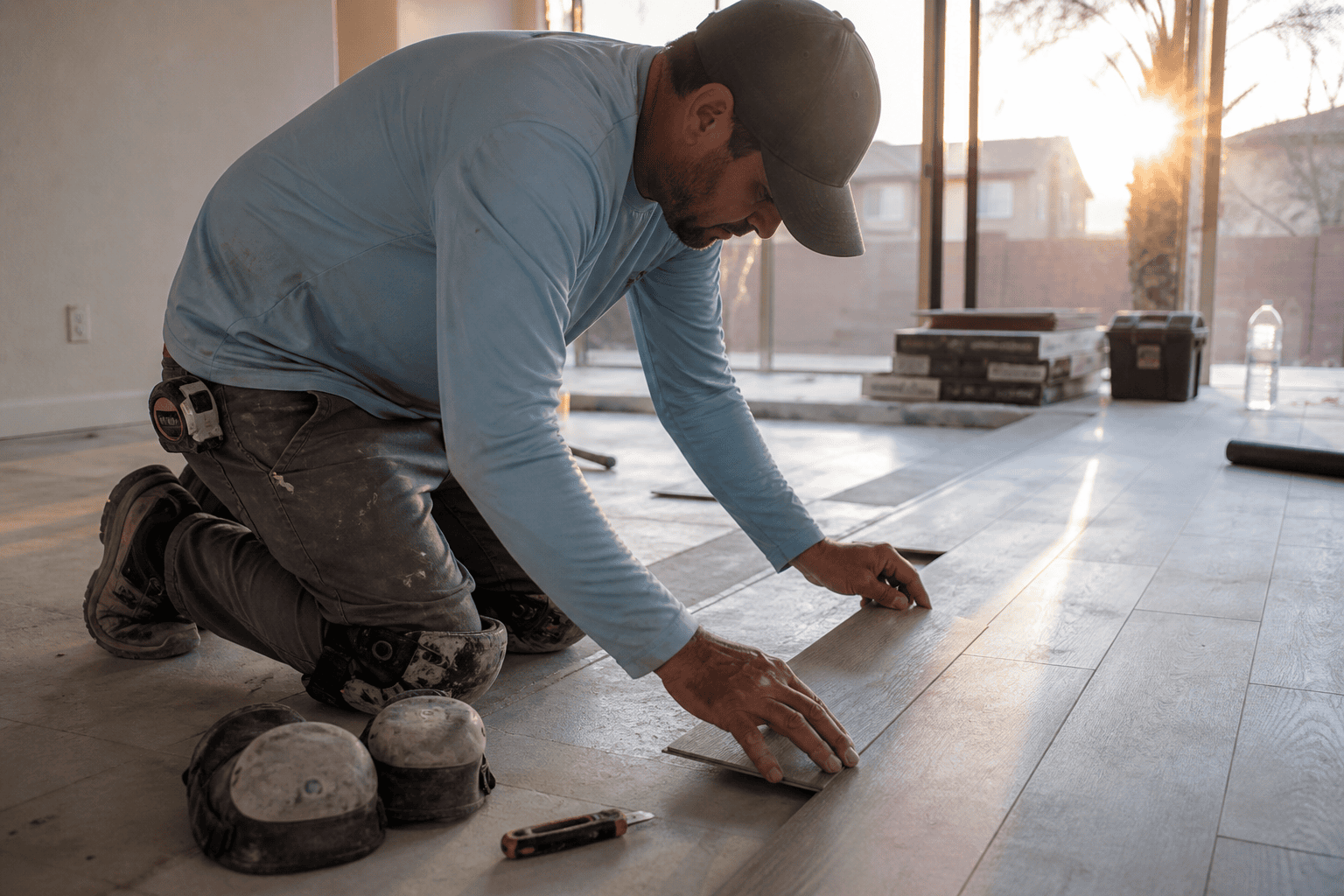
If you install floors in the Valley, you already know the two things that decide your season. The first is the thermometer, because adhesive behaves differently on a July slab than it does in January. The second is the certificate request, because Queen Creek, Gilbert, and Chandler HOAs will not let a crew on site without one. Phoenix flooring contractor insurance has to work for both. This guide covers the coverage a Phoenix floor covering company actually needs. It also covers what the Arizona Registrar of Contractors requires to hold the license, and where Valley weather turns a routine install into a claim.
The Coverage a Phoenix Flooring Company Carries
A flooring contractor is a trade contractor who preps a surface and installs or repairs carpet, vinyl, wood, tile, or coatings on top of it. Your risk sits in three places. There are the people doing the kneeling and cutting, the finished room you can damage while you work, and the vans and tools that move between jobs. The core program looks like this.
| Coverage | What it does for a Phoenix flooring contractor |
|---|---|
| General liability | Pays for bodily injury or property damage you cause to others, and funds your defense. Property managers and HOAs ask for this certificate first. |
| Workers compensation | Required in Arizona once you have an employee. Covers medical care and lost wages for a crew member hurt on the job. |
| Commercial auto | Covers the vans and trucks hauling cartons and equipment on the 202, the 101, and the 60. A personal auto policy usually excludes business use. |
| Inland marine (tools and equipment) | Covers sanders, seaming irons, moisture meters, and material in transit or staged on site. |
| Installation floater | Covers the flooring material itself from delivery until the job is accepted, which general liability does not do. |
| Commercial umbrella | Adds limits above general liability and auto when a GC or HOA contract asks for more than your primary policy carries. |
You can read how each of these fits together across all four of our states in the main flooring contractor insurance guide. The rest of this page covers what changes when the job site is in Maricopa or Pinal County.
Arizona’s Floor Covering License and What It Requires
The Arizona Registrar of Contractors licenses flooring under the Floor Covering classification: R-8 for residential work, C-8 for commercial work, and CR-8 for both. The ROC license classification page defines the scope. It covers surface prep plus installing or repairing carpet, floor tile, wood, linoleum, vinyl, asphalt, rubber, and concrete coatings. One note for contractors who came from California: the numbering does not carry over. C-8 is concrete in California and floor covering in Arizona, so use the Arizona scope when you fill out an application.
Ceramic, stone, and porcelain tile carry their own Arizona classification (48). If your crews set porcelain plank alongside LVP, confirm with the ROC whether your work requires both cards. Insurance applications tend to ask the same question, and the answer affects your rate.
The qualifying party needs two years of documented experience in the trade, plus the trade exam and the Arizona Statutes and Rules exam. Any job at or above $1,000 in labor and materials, or any job that needs a permit, requires the license. Breaking a large corridor into several contracts under that figure does not create an exemption.
Arizona floor covering license bonds
The ROC sets license bond amounts by classification and by the annual volume you expect to write in Arizona. The ROC bond schedule currently reads as follows for specialty contractors.
| License | Contemplated annual Arizona volume | Bond amount |
|---|---|---|
| R-8 residential | Under $375,000 | $4,250 |
| R-8 residential | $375,000 or more | $7,500 |
| C-8 commercial | $150,000 or less | $2,500 |
| C-8 commercial | $150,001 to $500,000 | $7,000 |
| C-8 commercial | $500,001 to $1 million | $17,500 |
| C-8 commercial | $1 million to $5 million | $25,000 |
| C-8 commercial | $5 million to $10 million | $37,500 |
| C-8 commercial | Over $10 million | $50,000 |
| CR-8 dual | Both schedules apply | Residential plus commercial amount |
Residential license holders also pay into the Residential Contractors’ Recovery Fund, or post a $200,000 bond instead. Crossing a volume tier without raising the bond can put the license at risk. Tell your agent when a big HOA contract moves you up a band. We can place the bond and the insurance program together through our surety bond desk.
One thing the ROC does not require is general liability insurance. The state asks for a bond, and for residential work the Recovery Fund, but the liability policy is a business decision. In practice the decision is made for you. No property manager in the East Valley will release a purchase order without a liability certificate, and most want $1 million per occurrence at minimum.
Workers Compensation Starts With Your First Employee
Arizona requires workers compensation as soon as you regularly hire one worker in your business, whether that worker is full time, part time, or a family member. The Industrial Commission of Arizona administers the program. The employer pays the entire premium, and Arizona law forbids deducting any part of it from wages.
Flooring payroll usually rates in a floor covering installation class for carpet, vinyl, and resilient work. Hardwood installation and sanding tends to rate in a carpentry class, and ceramic tile in its own tile class. The rates differ, so the split matters. A crew that only clicks LVP and a crew that sands and finishes oak are different exposures to the carrier. Keep the payroll for each separated in your books, and describe both on the application. A premium audit will find the mix either way, and it is far cheaper to have it right on day one.
Independent installers are the other audit trap. If the ICA decides a “1099 installer” was really your employee, you owe the premium and the penalty. Ask every sub for a current workers compensation certificate before they set foot on a job, and keep the copies.
The Claims Phoenix Weather Writes
Heat is the first one. A glue-down install that starts after mid-morning in July can skin over before the plank seats. The callback arrives a month later as a hollow spot or a lifted seam. General liability treats a bad install as your workmanship, not as an accident, so the policy will not pay to redo the floor. Most Phoenix crews already run summer schedules that start before dawn. Tell your agent that you do, because underwriters ask.
Monsoon moisture is the second. From June through September the Valley slab gains moisture from below. Vapor that pushes through the concrete can fail an adhesive or cup a hardwood floor months later. The claim that follows depends on what got wet. Damage to the floor you installed usually falls in the workmanship gap. Damage to the finished room next door, or to the unit below in a Tempe condo, is property damage that general liability is built to cover. Photograph the slab before you start and keep your moisture test readings. Then confirm the policy’s care, custody, or control language will not strand a claim on the room you were working in.
Certificates, Additional Insureds, and East Valley HOA Work
HOA boards from Queen Creek through Gilbert and San Tan Valley write LVP and vinyl wet rooms into the same spec book. They hand the same certificate request to every bidder. The request usually asks for three things. It wants general liability at a stated limit, the HOA or management company named as additional insured, and a waiver of subrogation on workers compensation. The first is a limit question, the second is an endorsement, and the third is a form your carrier attaches.
The limit is where contractors get caught. Many Valley property managers now ask for $2 million per occurrence on commercial and multifamily work. If your policy carries $1 million, a commercial umbrella closes that gap without rewriting the primary policy. Our advice on limits is simple: carry more than the largest contract you plan to sign requires. A higher limit costs a little more in premium and never costs you a job.
Phoenix Flooring Contractor Insurance Built Around Your Work Mix
The right Phoenix flooring contractor insurance program starts with an honest description of what you actually install. A production crew clicking LVP in Cadence at Gateway rates differently from a shop that sands and refinishes wood in Arcadia. Both differ from a commercial installer setting sheet vinyl in a Mesa clinic. The application should name every material you touch, every vehicle you run, and the largest limit any contract requires.
Here is what we look at when we build a program for a Phoenix floor covering company:
| Question | Why it matters |
|---|---|
| Which materials do you install, and what share of revenue is each? | Sets the liability and workers comp classifications. |
| Do you do residential, commercial, or both? | Matches the policy to your R-8, C-8, or CR-8 license. |
| Do you subcontract any installation? | Determines whether uninsured sub payroll lands on your audit. |
| How much material do you stage on site at once? | Sizes the installation floater. |
| What limit does your largest HOA or GC contract require? | Sizes the general liability and umbrella. |
| How many vans and trucks, and who drives them? | Builds the commercial auto policy and driver list. |
Frequently Asked Questions
Does the Arizona ROC require insurance to get a C-8 or R-8 license?
The ROC requires a license bond scaled to your classification and expected volume. Residential licensees also pay into the Recovery Fund. General liability is not a licensing requirement, but nearly every property manager and general contractor in the Valley requires it before you start work.
Does workers compensation cover my installers if they are 1099?
Only if they are true independent contractors under Arizona law. If the Industrial Commission finds that a 1099 installer worked as your employee, you owe the premium. Collect a workers compensation certificate from every sub.
Will general liability pay to replace a floor that failed from heat or slab moisture?
Usually not. Damage to your own work is a workmanship issue, and the standard policy excludes it. Damage that your install causes to other property, such as a neighboring finished room, is the kind of claim general liability is designed to pay.
Do I need both a residential and a commercial license to bid HOA common areas?
HOA clubhouses and common areas are generally treated as commercial work. Many Valley flooring companies hold the CR-8 dual license for exactly this reason. Confirm the scope with the ROC before you bid.
Get an Arizona Quote
Western Pacific Insurance is licensed in Arizona and writes flooring contractors across the Valley, from Buckeye to San Tan Valley. We shop your program across multiple carriers and confirm the classification matches your real mix of vinyl, wood, and tile. We also read the completed operations and care, custody, or control language before you bind. Start with an Arizona quote request, or visit our Arizona insurance page to see everything we write in the state.


