
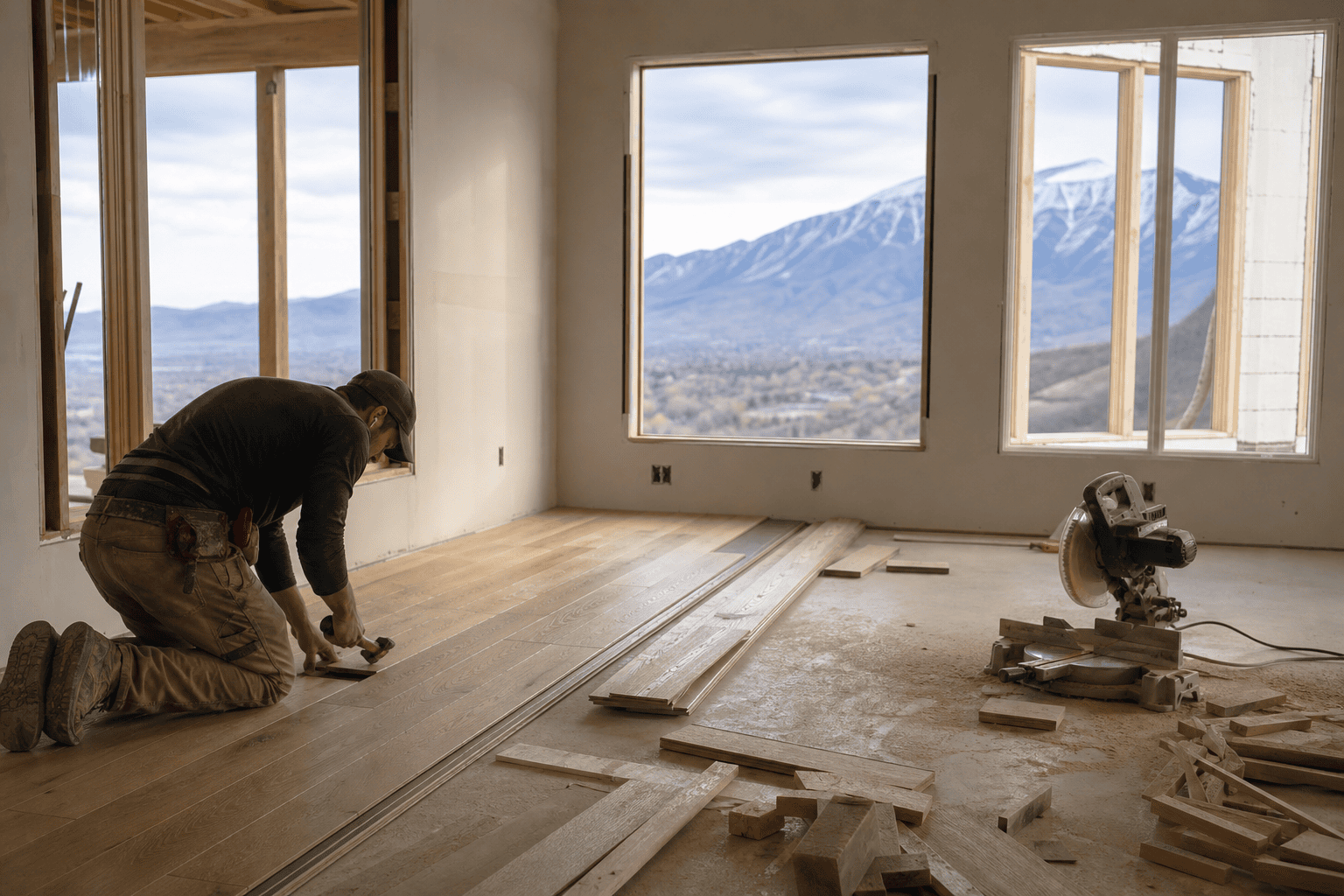
A Lehi flooring contractor installs and finishes floors under Utah’s S220 Carpentry and Flooring license. That license now comes with a real insurance requirement attached. Your general liability has to sit at or above the state floor, and the Division of Professional Licensing has to appear on the certificate. The builders filling lots on Traverse Mountain and Pioneer Crossing want to see it before you set a single plank. This guide covers what Lehi flooring contractor insurance should include, what the S220 license asks for, and where the gaps show up on new-build and commercial work.
What Lehi Flooring Contractor Insurance Should Include
Start with the coverages the state and your customers require, then add the ones that protect the business itself. Here is the stack most flooring contractors in Utah County end up carrying.
| Coverage | What it does for a flooring contractor | Who asks for it |
|---|---|---|
| General liability | Pays for injury or property damage you cause on a job, such as a homeowner tripping over stacked cartons or a stain spill ruining a cabinet base | Utah DOPL for the S220 license; every builder and property manager |
| Workers compensation | Covers medical bills and lost wages when an installer gets hurt | Utah, once you have employees |
| Commercial auto | Covers the vans hauling material between lots and job sites | Utah, for any vehicle the business owns or uses |
| Inland marine (tools and equipment) | Replaces sanders, saws, and materials stolen from a truck or a garage | Your lender, or your own balance sheet |
| Installation floater | Covers flooring material after delivery and before the builder accepts the work | Often the builder’s contract |
| Professional liability (contractors E&O) | Responds to workmanship and moisture-test disputes that general liability excludes | Nobody requires it, but it is the coverage that pays on a rejected floor |
| Commercial umbrella | Adds limits above general liability and auto for larger builder and commercial contracts | Many commercial GCs and property managers |
Carrying more than the minimum never creates a problem. Carrying less becomes one the day a builder’s prequalification form or a state renewal lands on your desk.
Utah’s S220 License Now Carries a Hard General Liability Floor
Utah folds flooring into the S220 Carpentry and Flooring classification. The scope covers laminate, tile, cement, wood, and synthetic wood floors. It also includes sanding, staining, and finishing of new and existing floors. The Utah Construction Trades Licensing Act is the statute behind it, and S220 is a specialty license rather than a general building license.
Since June 25, 2026, every Utah contractor classification has to carry general liability of around $1 million per occurrence and $2 million aggregate. DOPL has to appear on the certificate as the certificate holder. That is a large jump from the old $100,000 and $300,000 minimums, and plenty of pages online still print the old numbers. A few 2026 application PDFs and older copies of the state’s own pages still show $1 million and $3 million. That was the figure floated before the final rule. The current adopted floor is $1 million and $2 million, and DOPL’s live specialty contractor page prints exactly that. If your policy still sits at the old limits, your next license renewal has a problem waiting inside it.
The rest of the license path is manageable. Specialty contractors complete a 25-hour pre-licensure course from an approved provider, register the business with the Division of Corporations, and submit the general liability certificate. Confirm current course hours and fees with DOPL before you apply. Those details change more often than the classification itself.
Workers Compensation and the Waiver Question
Utah requires workers compensation as soon as you have an employee, and DOPL wants a certificate showing it. A one-person operation with no employees has a second option. It can file a workers compensation coverage waiver through the Utah Labor Commission, and DOPL accepts that waiver in place of a policy.
Read the fine print on that waiver, though. It provides no coverage at all. It simply tells the builder who hires you that you have given up any claim to benefits under their policy. A solo installer who tears a shoulder lifting a pallet of tile has nothing to fall back on. Some owners keep the waiver and add an occupational accident or disability policy instead. Others buy a small workers compensation policy that covers themselves. Either way, know which one you hold before you need it.
New-Build Packages on Traverse Mountain and Pioneer Crossing
Builders along Traverse Mountain and Pioneer Crossing sell flooring with the house. A buyer picks LVP for the great room and vinyl for the wet rooms from a finish board. Your crew installs it on a builder calendar across a dozen lots. Then a sand-and-finish oak upgrade lands on the same street, and the same crew is running a drum sander next to freshly painted baseboard.
Two things follow from that. First, your S220 license covers both jobs, but your insurance class has to name the sanding and finishing work. A policy rated for vinyl and laminate installation can leave a hardwood refinish claim outside what the carrier agreed to cover. Tell your agent about every kind of floor you touch, even the ones you only do a few times a year.
Second, new construction raises the workmanship stakes. A builder who rejects a moisture reading, a cupped plank, or a finish that never cured through a Wasatch winter is filing a contract dispute over your own work. General liability excludes that. Professional liability, sometimes sold as contractors errors and omissions, is the coverage that responds to tear-out and reinstall costs. Our flooring contractor insurance guide walks through where that line falls in more detail.
An installation floater fills a third gap. Flooring material delivered to a lot and staged in the garage belongs to you until the builder accepts the work. If it walks off overnight or gets soaked by a plumbing leak upstairs, your general liability does not replace it. Multi-lot work where cartons and sanders move between houses every week is exactly where that floater earns its premium.
Commercial Vinyl Near Thanksgiving Point
The office campuses and mixed-use corridors around Thanksgiving Point and the wider Silicon Slopes bring a different book of work. Commercial vinyl and carpet tile jobs run larger than a house. The general contractors and property managers behind them also read certificates more carefully than a home builder does.
Expect to see three things in their contracts: additional insured status for ongoing and completed operations, primary and noncontributory wording, and a waiver of subrogation. Those are endorsements on your policy, so a carrier has to agree to each one in writing before a certificate can honestly show them. Commercial GCs also tend to ask for limits above the state floor, which is where a commercial umbrella comes in. A residential LVP class and a commercial corridor class do not price the same. Tell your agent which book you bid before the quote gets built.
Certificates Win the Builder Book
The general contractors building this corridor prequalify their floor crews before the first draw. Bids die quietly when a certificate shows the wrong limits, a lapsed policy, or a missing endorsement. Keeping your certificate current at or above the state floor, with the builder named correctly, is free market positioning. Our general contractor insurance guide explains what those GCs are checking for and why. Western Pacific Insurance turns certificate requests around same day for contractor clients. A Friday afternoon bid does not have to wait until Monday.
Get a Lehi Quote
Western Pacific Insurance is an independent agency serving flooring contractors across Utah County and the Wasatch Front. We shop multiple carriers and match your S220 classification to the work you actually do, whether that is builder packages, hardwood refinishing, or commercial corridors. Start with a Utah quote request or call (801) 955-3755. You can also visit our Utah insurance page to see everything we write in the state.


