
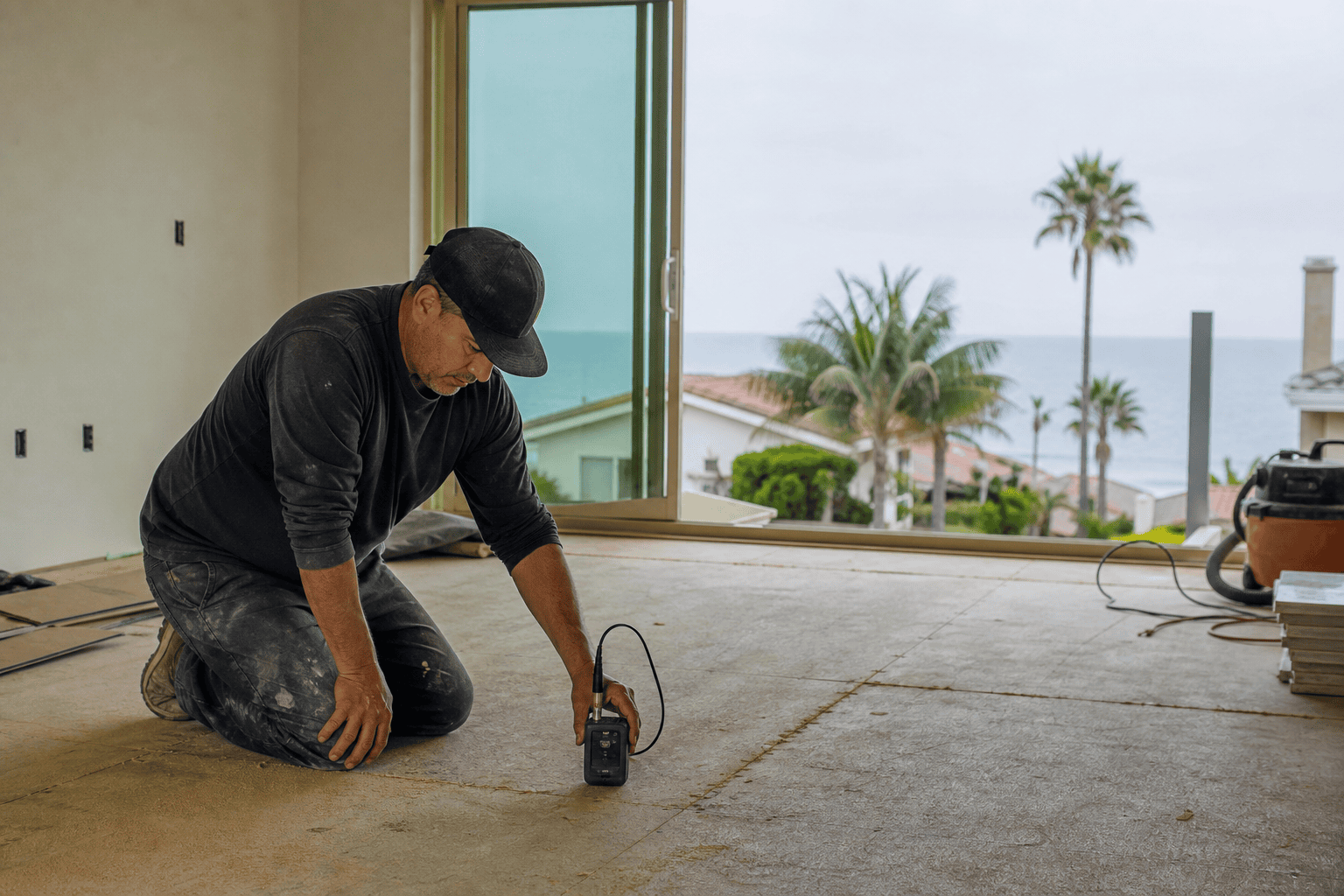
A San Diego flooring contractor installs carpet, luxury vinyl plank, sheet vinyl, laminate, and hardwood, and usually sands and finishes wood on site. In California, that work falls under the C-15 Flooring and Floor Covering license. The insurance program behind that license rests on four policies. Those are general liability, workers compensation, commercial auto, and inland marine for the tools and material that ride between jobs. San Diego flooring contractor insurance also has to account for something inland contractors never think about. The marine layer, the salt air, and the slab-on-grade construction across most of the county put moisture at the center of almost every flooring claim.
What a San Diego Flooring Crew Actually Carries
Most of your general contractors and property managers will ask for the same core stack. The difference between a clean submission and a rejected one is usually how the policies are classified and how the limits are set.
| Coverage | What it does for a C-15 contractor | What to watch |
|---|---|---|
| General liability | Pays for injury or property damage you cause to others, including a client’s home | Class code must match the work you bid; your own defective installation is excluded |
| Workers compensation | Covers employee injuries; required by the CSLB once you have any employee | Hardwood and carpet crews rate under different California class codes |
| Commercial auto | Covers the van and trailer on the road | Tools and flooring stock are not covered inside the vehicle |
| Inland marine | Covers sanders, edgers, moisture meters, and job-site inventory anywhere | Schedule the expensive equipment; blanket limits are often too low |
| Contractors E&O | Can respond to workmanship and installation disputes that general liability declines | Not every carrier offers it; ask before you assume you have it |
Think of general liability as the policy that pays for the other person’s property and the client’s injury. It does not pay to tear out and replace your own cupped hardwood. That gap is where most flooring contractors get surprised, and it is the reason the coastal moisture section below matters.
California’s C-15 License and What It Includes
The Contractors State License Board defines a C-15 contractor as one who prepares any surface for flooring and installs carpet, resilient sheet goods, resilient tile, and wood floors, including finishing and repair. The classification text on the CSLB licensing classifications page is explicit about one exclusion. Ceramic tile is not C-15 work. Tile belongs to the C-54 classification, and that split shows up in your insurance file as well as your license.
As of this writing, a C-15 applicant needs four years of journey-level experience within the last ten. The applicant must also pass the law and business exam plus the trade exam and post a $25,000 contractor bond. The threshold that requires a license moved from $500 to $1,000 in combined labor and materials on January 1, 2025. Some websites still print the old $500 figure. If you operate as an LLC, the CSLB also requires a $100,000 LLC employee bond and at least $1 million in liability insurance. That liability minimum applies to licenses with five or fewer personnel, and larger firms need more. Verify the current numbers on the CSLB site before you renew, since the Board updates these requirements periodically.
Workers Compensation and the C-15 Exemption
Here is the rule that trips up more San Diego flooring companies than any other. California requires a handful of specialty classifications to carry workers compensation even with zero employees. Today that list is C-8 concrete, C-20 HVAC, C-22 asbestos abatement, C-39 roofing, and D-49 tree service. C-15 is not on it. A solo flooring installer with no employees can still file the exemption certificate with the CSLB.
Two things change that picture. The first is hiring anyone, even a part-time helper. Once you have an employee, the CSLB requires a workers compensation policy on file regardless of classification. The second is the calendar. SB 216 originally set January 1, 2026 as the date every licensee would need coverage. SB 1455 pushed that universal deadline to January 1, 2028. Plenty of articles still print 2026, and that date is no longer correct. Plan for 2028, but do not use the delay as a reason to run helpers without coverage today.
On the rating side, California carriers typically place hardwood installation and finishing under class 5436 and carpet, vinyl, and resilient work under class 9521. A crew that does both should expect payroll split across both codes. Lumping everything under the cheaper code invites an audit adjustment at year end.
Coastal Moisture: Where San Diego Flooring Claims Come From
Point Loma, Ocean Beach, La Jolla, and Pacific Beach sit in the marine layer for weeks at a time. Hardwood that was not acclimated to that humidity cups after installation. Rigid-core LVP that went down over a slab nobody tested lifts at the seams when vapor pushes up from below. Most of the county is slab-on-grade, and coastal slabs hold moisture longer than anything inland.
These callbacks are workmanship disputes, not accidents, and general liability treats them that way. The “your work” exclusion removes the cost of your own defective installation from the policy. If moisture damage spreads to the client’s baseboards, cabinets, or belongings, that resulting damage may still be covered. The floor itself usually is not. A contractors errors and omissions endorsement or a standalone professional policy is what responds to the installation dispute, and it is worth asking for on every renewal.
The best defense is a paper trail. Run an in-slab relative humidity test under ASTM F2170 or a calcium chloride test under ASTM F1869 before you install, photograph the readings, and keep them with the invoice. The Resilient Floor Covering Institute publishes the installation standards underwriters lean on when a vinyl claim lands. A documented test that met the manufacturer’s spec turns a workmanship argument into a materials or site-conditions argument, and that changes who pays.
Tile, Subfloor Repair, and Work That Drifts Out of C-15
A whole-house remodel in Mission Hills or North Park rarely stays inside one classification. The client wants the shower floor tiled while you are there. The subfloor under the old carpet has rot and needs sistered joists. Each of those jobs sits outside C-15 and prices like a different trade to an underwriter. Tile is C-54 work with its own class code, and structural subfloor repair can require a permit even though a straight flooring replacement usually does not.
Permits matter for insurance as much as for the inspector. In unincorporated communities like Alpine, Ramona, and Lakeside, permits run through San Diego County Planning and Development Services rather than a city building department. Any job that needs an inspection should be described on your application so the carrier can classify it correctly. The same goes for on-site sanding and finishing. Some general liability forms carry a total pollution exclusion that can sweep in fumes from finishes and adhesives. Confirm how your policy treats that exposure before you bid an occupied home. Our flooring contractor insurance guide walks through the full coverage stack in more detail.
Certificates for San Diego General Contractors
Commercial and multifamily work in Mission Valley, Kearny Mesa, and Sorrento Valley starts with a certificate of insurance. General contractors there want additional insured status, primary and noncontributory wording, and a waiver of subrogation before the first pallet of material arrives. A certificate alone does not grant those rights. The endorsements have to sit on the policy, and the GC’s review will check for them.
Two things fail that review more than anything else. The first is a C-15 licensee with employees and no workers compensation on file with the CSLB. Their compliance team pulls your license record and sees the exemption sitting there. The second is a liability limit below the contract requirement. Limits should only ever move upward, and a $1 million per occurrence policy with a $2 million aggregate is the floor most San Diego GCs expect. Our general contractor insurance guide explains what the GC’s side of that exhibit is trying to accomplish. Bring the insurance exhibit to us before you sign the subcontract, and we will match the endorsements to the contract language.
Get San Diego Flooring Contractor Insurance
Western Pacific Insurance is licensed in California and writes coverage for flooring contractors across San Diego County, from the coast to the East County. As an independent agency, we shop your operation across multiple carriers rather than one. We match the class codes to the work you actually perform and check the CSLB workers compensation record before we bind. Start with a California quote request, or visit our California insurance page to see everything we write in the state.


