
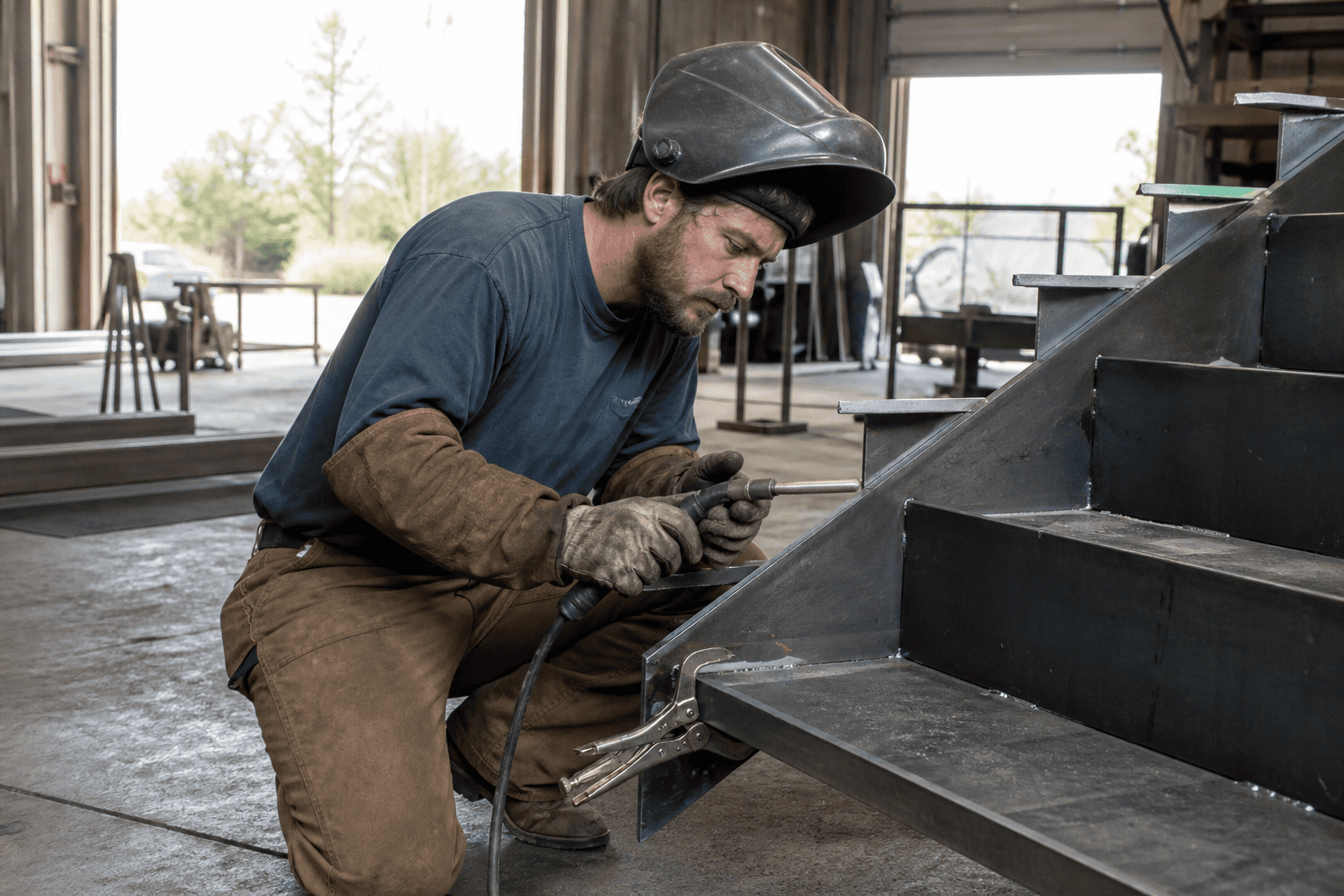
Welding contractors join, cut, and fabricate metal for a living, and the work takes many forms. One shop builds gates and balcony rails. Another erects structural steel for commercial buildings, and a third runs a mobile rig that repairs equipment in the field. Welding contractor insurance is the group of policies that protects all three. It includes general liability, workers compensation, commercial auto, and coverage for tools and equipment, with an umbrella on top when contracts call for higher limits.
The details matter more in this trade than in most. Carriers classify structural steel differently from ornamental metal, and state licensing boards draw the same line. General liability also treats a fire you start next door very differently from damage to the piece you’re welding. This guide walks through the coverage, the gaps, and the license rules in Nevada, California, Arizona, and Utah.
Who Needs a Welding Insurance Program?
This guide is for anyone who gets paid to weld on someone else’s property or project. That includes field welders, ornamental iron shops, mobile repair rigs, and fabricators who install what they build. It also includes structural steel erectors, who should read the licensing sections closely. Several states put steel erection and welding on separate licenses.
How you describe your work to your agent shapes the policy you end up with. If you bid both structural beams and ornamental rails, the policy needs to reflect both. If you only fabricate in the shop and never install, say so, because carriers rate shop-only fabrication differently from field work.
For the policies every trade shares, start with contractor insurance explained. If you run the whole job site and hire the subs, see our general contractor insurance guide.
What Coverage Does a Welding Business Need?
Most welding businesses build their program on five policies.
General liability is the foundation. It pays when your work injures someone outside your company or damages someone else’s property. The classic welding claim is a spark that lands in stored material in the next bay and starts a fire. So does a slag burn on a finished floor you were never hired to touch.
Workers compensation pays medical bills and lost wages when an employee gets hurt on the job. For welders that usually means burns, arc flash to the eyes, and lifting injuries.
Commercial auto covers the trucks and mobile rigs that carry your machines and cylinders from job to job. Personal auto policies generally exclude business use, so a work truck belongs on a commercial policy.
Inland marine, often sold as a tools and equipment floater, covers your welders, positioners, and stored steel wherever they go. A property policy stops at the shop door, and this coverage picks up from there.
A business owners policy can bundle general liability with property coverage, which helps if you own or lease a shop.
Two more policies matter as you grow. A commercial umbrella adds limits above your general liability and auto policies. Many general contractors now ask for $2 million or more before they let a welding sub on site, and an umbrella is a common way to get there. Professional liability responds when the claim is about the work itself, such as a weld that doesn’t meet the specification. General liability tends to treat that as a workmanship dispute and may not respond.
Underwriters also care about how you qualify your welders. The American Welding Society publishes the certification and procedure standards carriers look for, and documented qualifications help most as your work moves toward structural steel.
Which Policy Pays Which Welding Claim?
Coverage gets easier to understand when you match real claims to the policy that responds. These are the losses that come up most often in this trade.
| The claim | The policy that responds |
|---|---|
| Spark or slag ignites stored material in the next bay | General liability |
| Welder is burned, flashed, or hurt on a lift | Workers compensation |
| Welder or positioner stolen from the rig overnight | Inland marine (tools and equipment) |
| Mobile rig hits a parked car between jobs | Commercial auto |
| Weld fails months after you leave a finished frame | Completed operations on the general liability policy, if the damage is to other property |
| The piece you just welded fails and the owner wants a redo | Often excluded as your work or as property in your care |
| Owner says the weld missed the spec or the procedure | Professional liability, or your own pocket |
| Hot work on an occupied floor damages tenant contents | General liability, if the fire or smoke reaches other property |
Most of those rows are straightforward. The completed operations row and the redo row come with conditions, and both get their own section below.
Why Do Carriers Treat Structural and Ornamental Welding Differently?
Many insurance websites describe welding coverage as a single product, but carriers don’t underwrite it that way. Structural steel erection is its own classification, with its own rates and its own list of carriers willing to write it. Ornamental work such as gates and railings sits in a separate class. Welding inside occupied buildings adds a fire exposure that underwriters price on top of either one.
The risk shows up when a business grows. Say your policy was written for an ornamental shop, and then you take on a structural frame. Your license may not authorize the erection work, which is the first problem. The second is that many contractor policies carry a classification limitation endorsement, especially in the surplus lines market. That endorsement restricts coverage to the operations listed on the policy. A structural job that was never disclosed gives the carrier a reason to question the claim.
The fix is simple. Tell your agent about the largest and most complex job you take on, along with your typical one. Then update the policy before you bid work outside your current class, while it’s still an easy change to make.
What Does General Liability Leave Out for Welders?
General liability covers a lot, but three areas deserve a closer look before you buy.
The piece you’re welding
General liability typically excludes damage to the particular part of property you’re working on. It also excludes property in your care, custody, or control. The beam or rail under your torch sits squarely in that gap. If you burn through it, the repair is usually a cost of doing the job. If a spark from the same weld ruins the tenant’s inventory in the next suite, that’s damage to other property, and general liability is designed to respond. One job can produce both outcomes, which is why this exclusion surprises people.
Completed operations
A weld you make in July can crack in October. Coverage for damage that shows up after you finish a job is called completed operations, and it’s part of a standard general liability policy. Some low-cost welding policies restrict it or remove it. Before you bind, ask where completed operations coverage sits in the policy. You should also ask whether it has its own aggregate limit or shares one with the rest of the policy. The policy in force when the damage happens is the one that responds, so continuous coverage matters even after a job closes out.
Hot work in occupied buildings
Welding on a live floor puts sparks near tenant stock, insulation, and finished surfaces. Carriers treat that as a meaningful fire exposure, and some policies attach conditions or exclusions to it. If you weld inside occupied buildings, make sure your agent and your application both say so. Good habits help here too. Photograph the area before you start and follow a written hot work procedure. It also helps to describe the work on your invoices the same way your policy describes it.
How Do Licensing Rules Differ in Nevada, California, Arizona, and Utah?
Each of the four states we serve licenses welding inside a steel or metal family, and most of them separate structural work from ornamental work. This table is the short version, and the sections that follow explain each state.
| State | Welding or steel class | Structural or ornamental split | Bond or insurance rule |
|---|---|---|---|
| Nevada | No standalone welding license; C-14b includes connected welding | C-14c ornamental metal; A-14 steel erection and industrial machinery | Bond $1,000 to $500,000; monetary limit; workers comp for employees; no board GL mandate |
| California | C-60 Welding | C-51 structural steel; C-23 ornamental metal | $25,000 bond; sole proprietor C-60 has no GL mandate; LLC $1 million aggregate; no-employee exemption still open; universal workers comp January 1, 2028 |
| Arizona | R-56, C-56, or CR-56 Welding | A-11 and R-17 steel and aluminum erection; R-24, C-24, and CR-24 ornamental metals | Bonds scale with volume; license at $1,000 or any permit; no registrar GL mandate; workers comp at one employee |
| Utah | S220 Carpentry and Flooring, including steel and member welding | Old S320 now sits in S220; unattached personal-property welding needs no license | Specialty bond $15,000; around $1 million / $2 million GL; workers comp or a Labor Commission waiver |
Nevada: No Welding License, Two Steel Subclasses
Nevada surprises a lot of welders, because the State Contractors Board doesn’t issue a standalone welding license. The board authorizes welding through its steel classifications instead, and the one you hold determines what you can legally bid.
Structural work falls under C-14b Structural Steel, a subclass of C-14 Steel Reinforcing and Erection. Under NAC 624.310, C-14b covers fabricating and erecting structural steel shapes and plates used as structural members or tanks. It includes the riveting, welding, and rigging connected to that work. Ornamental work falls under C-14c Ornamental Metal. That subclass covers assembling, casting, cutting, shaping, fabricating, and installing metals for architectural treatment, ornamental decoration, or the security of structures.
A few neighboring classifications are easy to confuse with these. Reinforcing steel is C-14a, and sheet metal is a separate C-13 license, so a C-14c license doesn’t cover either one. A contractor holding the full C-14 can perform the work of its subclasses. A C-14c rail shop, on the other hand, can’t step into C-14b erection work. General engineering contractors also have A-14 Steel Erection and Industrial Machinery, which includes related welding and rigging.
Nevada attaches a monetary limit to every license as well. If your limit is $250,000, you can’t take a $900,000 steel package unless the board approves an increase. License bonds range from $1,000 to $500,000, and workers compensation is mandatory once you have employees. The board doesn’t set a general liability minimum, although most of the contracts you sign will.
California: C-60 Is a Dedicated Welding License
California is the only one of the four states with a dedicated welding license. Title 16, Section 832.60 of the California Code of Regulations defines the C-60 Welding classification. It covers contractors who permanently attach, join, and fabricate metals using gases and electrical energy. Structural steel erection is a separate C-51 license and ornamental metal is C-23, so the same dividing line exists here too.
Workers compensation is where California gets confusing. The Contractors State License Board requires a handful of classifications to carry it even with no employees. That list is C-8 concrete, C-20 HVAC, C-22 asbestos abatement, C-39 roofing, and C-61/D-49 tree service, and C-60 isn’t on it. A solo C-60 contractor can still file an exemption today. The exemption ends the moment you hire anyone, and a license qualified by an RME can’t claim it at all. Every classification will need workers compensation starting January 1, 2028. Many websites still show 2026, which was the deadline before the legislature moved it.
Two other numbers changed recently. California raised the threshold for needing a license from $500 to $1,000 in January 2025, and plenty of pages still print the old figure. The contractor bond is $25,000 under Business and Professions Code 7071.6. LLCs must also carry at least $1 million in liability insurance.
One caution applies if you work across state lines, because classification numbers don’t travel. C-60 means welding in California, but Arizona uses C-60 for finish carpentry and licenses welding as C-56.
Arizona: Separate Licenses for Welding, Erection, and Ornamental Metals
Arizona’s Registrar of Contractors licenses welding directly. The classification is R-56 for residential work, C-56 for commercial, and CR-56 for both. Steel erection is separate, with A-11 on the commercial side, R-17 on the residential side, and CR-17 for dual. Those licenses include field layout, cutting, assembly, and erection by welding, bolting, or riveting. Ornamental metals have their own classifications as well, which are R-24, C-24, and CR-24. They cover gates, guard rails, wrought iron, shutters, and grilles, but they don’t extend to fire escapes or stairs.
You need an Arizona license once a job reaches $1,000 in combined labor and materials, or whenever the job requires a permit. The registrar doesn’t require general liability insurance. Workers compensation is mandatory as soon as you have one employee.
License bonds scale with your annual volume. Commercial specialty bonds run from $2,500 to $50,000, and the residential specialty bond is $4,250 for contractors under $375,000 in volume. Residential license holders also pay into the Residential Contractors’ Recovery Fund or post a $200,000 recovery bond instead.
Utah: Welding Lives Inside the S220 License
Utah takes the opposite approach from California and folds welding into a broad specialty license. S220 Carpentry and Flooring includes metal and steel structures, sheet metal, metal structural studs, bearing walls, and reinforcing bars. Its scope covers erecting the shapes and plates used in structures, including riveting, welding, and rigging. The older S320 steel erection classification now maps to S220. Applicants complete a 25-hour pre-license course from an approved provider, and specialty license bonds start at $15,000. Welding on personal property that isn’t attached to a structure doesn’t require a contractor license.
Utah is also the only one of the four states that requires general liability insurance to hold the license. On April 29, 2026, the Construction Services Commission lowered the required aggregate from $3 million to $2 million under Filing 57949. The specialty contractor pages now list around $1 million per occurrence and $2 million aggregate. Your certificate should name the Division of Professional Licensing as certificate holder. Many older pages still print the pre-April-2026 minimums of $100,000 and $300,000, and some 2026 application PDFs still show $1 million and $3 million.
Treat the state’s number as a floor. There’s no penalty for carrying more than the minimum, and the general contractors you work for will often ask for higher limits anyway. A policy with a $3 million aggregate, or an umbrella above it, satisfies every version of the form. Utah also requires workers compensation, or a waiver from the Labor Commission if you have no employees.
How Much Does Welding Contractor Insurance Cost?
There’s no reliable national average for this trade, because the price depends on what you weld and where you weld it. Carriers look at your classification, payroll, revenue, claims history, and deductible. A solo shop building residential railings will see a very different number from a crew that erects steel and welds on occupied floors.
Deductibles run higher for welders than for many trades. We usually start a welding general liability quote at a $5,000 deductible, and $10,000 or more is common once revenue grows or you add employees. A callback of a few thousand dollars will usually fall inside that deductible. The policy is there for the fire, the injury, and the failed connection, which are the losses that can close a business.
General liability is also only part of the bill. Workers compensation, commercial auto, and tools and equipment coverage often move the total more than the liability premium does. Those are the lines that catch new owners off guard. Occupied hot work, structural erection, and adding a helper to payroll all change your classification and your price. When you compare quotes, read the classification and the exclusions as carefully as the premium, because a cheap policy that excludes your real work is no bargain.
Request a quote and we’ll price the work you actually do. If you’re welding on a project where the structure itself is at risk during construction, the job may also need builders risk insurance.
What Do General Contractors and Builders Require?
If you work as a subcontractor, the contract sets your insurance requirements as much as the state does. Most general contractors and builders ask for $1 million per occurrence and $2 million aggregate in general liability. They’ll also want additional insured status, a waiver of subrogation, and primary and noncontributory wording.
Keep in mind that a certificate of insurance only summarizes the policy and can’t change it. Suppose the certificate promises additional insured status, but the policy has no endorsement granting it. That certificate won’t help anyone when a claim arrives. The endorsements most contracts call for are CG 20 10 for ongoing operations and CG 20 37 for completed operations. Many also ask for CG 25 03, which gives each project its own aggregate limit. We read the contract language first, and then we place the endorsements the job actually requires.
Questions to Ask Before You Bind
These seven questions will tell you whether a policy fits your work. Go through them with your agent before the first certificate goes out.
- What class did the carrier assign: structural steel, ornamental metal, process welding, or more than one?
- If you weld on occupied floors, does the file show that hot work?
- What happens to coverage when a rail job adds a structural beam?
- Does completed operations coverage stay in place after you leave the site?
- How does the policy treat damage to the piece you just welded?
- Are your machines, positioners, and stored steel scheduled on inland marine?
- Can the carrier issue the additional insured wording general contractors actually ask for?
“I Only Weld Rails. Do I Really Need All of This?”
It’s a fair question, especially for a one-person shop doing residential ornamental work. The risk feels small when the jobs are small. A single spark in a finished garage can still produce a four-figure claim, though, and one serious burn to a helper can run into six figures.
Insurance also works as a sales tool in this trade. General contractors, builders, and many homeowners ask for a certificate of insurance before you start. Utah requires general liability to hold the S220 license at all, and California requires workers compensation the moment a C-60 contractor hires help. A solo operator usually needs less coverage than a ten-person crew and pays less for it. Going without coverage is the one option that tends to cost more in the end.
Frequently Asked Questions
Do I need workers compensation if I work alone?
Nevada, Arizona, and Utah require workers compensation once you have employees, and Utah asks for a Labor Commission waiver when you have none. In California, a solo C-60 contractor can still file an exemption until January 1, 2028, unless an RME qualifies the license. Some general contractors require proof of workers compensation from every sub, whatever the state allows.
Does general liability cover the piece I just welded?
Usually it doesn’t. General liability typically excludes damage to the particular part you’re working on, so redoing your own weld is often a job cost. A spark that damages the next suite is a separate claim, and the policy is designed to respond to that one.
Does an ornamental license cover structural steel?
In Nevada it doesn’t. Ornamental metal is C-14c, while structural steel with connected welding is C-14b. California separates C-23 ornamental metal from C-51 structural steel and C-60 welding. Arizona separates C-24 ornamental metals from A-11 steel erection and C-56 welding. Utah’s S220 is broader and covers both. Wherever you work, bid structural jobs only when your license matches them.
Is a homeowners policy enough if I weld from home?
Homeowners policies exclude business activity, so paid work on someone else’s steel won’t find coverage there. The same goes for your truck. Personal auto carriers can deny a claim once they see the vehicle was in business use.
Can I get coverage with a prior claim?
Almost always, although the carrier options may change. As an independent agency, we can move your account between standard carriers and specialty markets until both the fit and the price work.
How is this different from general contractor insurance?
A general contractor answers for the whole site, including the subs and the finished project. A welding program is built around a narrower set of classes: structural steel, ornamental metal, and process welding. If you add erection work or occupied hot work, the classification needs to move with you. Our general contractor insurance guide explains how additional insured requirements work from the other side of the contract.
Ready to Compare Options?
Western Pacific Insurance is an independent agency, so we can take your operation to a broad lineup of carriers and find the ones that want welding risks. We look at the jobs you actually take. Then we match the classification, the completed operations coverage, the tools floater, and the certificate wording to that work. If your railing business is growing into structural steel, we’ll tell you before the certificate goes out. We help businesses with their insurance needs all the time. Request a quote and tell us about your work.
We also have local guides for the markets we serve: Henderson welding contractor insurance, Lehi welding contractor insurance, San Diego welding contractor insurance, and Phoenix welding contractor insurance.
Welding rarely happens alone on a project. If your company handles other scopes too, each one has its own guide: concrete, excavation, drywall, painting, flooring, landscaping, and handyman work.


