
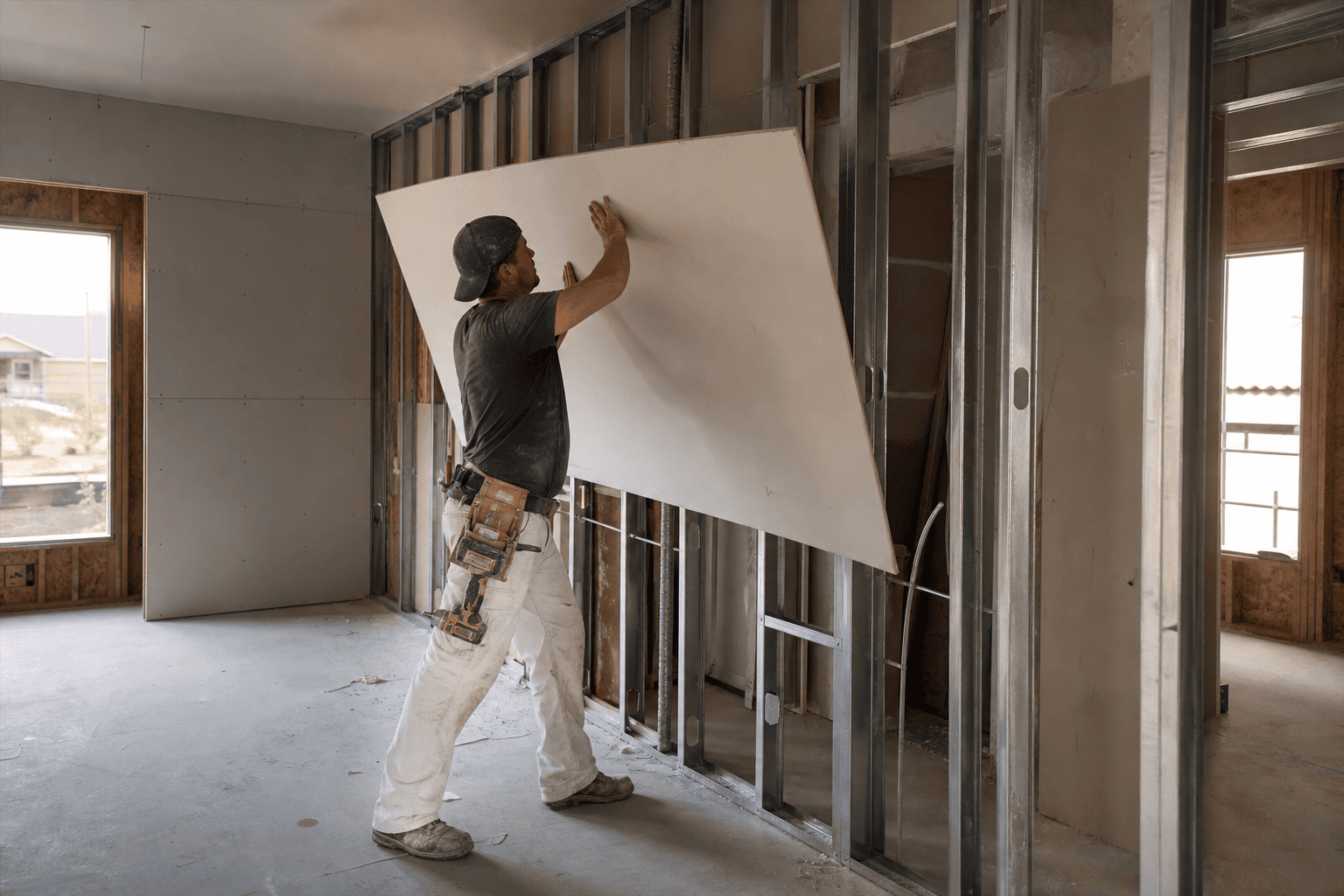
A drywall contractor hangs gypsum board, tapes and finishes the seams, and often sprays texture before the painter arrives. To an underwriter, those are not one job. Hanging board is a lifting and fastening exposure. Taping, sanding, and texture add finish work, airborne dust, and callbacks that show up months after you leave. Drywall contractor insurance has to cover all of it, and it only does that when the classification on the file matches the scope on your bids. This guide walks through the coverage a drywall business needs, the claims each policy responds to, and the hang versus tape split that trips up so many quotes. It closes with the licensing and insurance rules in Nevada, California, Arizona, and Utah.
Who Needs Drywall Contractor Insurance?
Anyone paid to hang, tape, finish, or texture gypsum board needs this coverage. That includes a solo residential hang crew and a shop that frames metal studs and hangs acoustical ceilings on commercial jobs. Texture-only shops need it too. Plaster, lath, and EIFS crews share much of the same equipment, but plaster is a separate license class in California and Arizona. When a skim coat lands on your bid, the policy and the license both need a second look.
Drywall touches other trades constantly, and the classification follows the work. If you also paint, see our painting contractor insurance guide. If you run whole sites and sub out the hang, see our general contractor insurance guide. Metal stud framing that is welded instead of screwed reads as welding to an underwriter. See our welding contractor insurance guide before that scope lands on your card. A punch list that has grown past incidental repair belongs in our handyman contractor insurance guide. For the baseline stack every trade carries, start with contractor insurance explained.
What Coverage Does a Drywall Business Need?
Most drywall operations run on five core policies, and the first four show up on nearly every certificate a general contractor asks for.
General liability responds when your work injures someone else or damages property you were not hired to touch. A homeowner who slips on wet joint compound lands here, and so does a sheet that scars a finished tub on its way to the wall. Workers compensation covers a hanger who is cut, strained, or hurt on stilts, and it is the first thing a builder checks before your crew steps on site. Commercial auto covers the vans that haul board and mud between jobs. A personal auto policy drops business use as soon as the carrier learns about it. Inland marine, usually written as a tools and equipment floater, covers lifts, stilts, screw guns, and leftover sheets. It follows them wherever they sit, including the van overnight. A business owners policy can bundle general liability with property coverage if you keep a shop or a warehouse.
Two more lines earn their place as you grow. A commercial umbrella adds limits above general liability and auto. Many general contractors now ask for $2 million or more before they let a sub on site. Professional liability responds to claims about the work itself. Think of a texture that misses the spec, or a Level 5 finish that shows every joint under raking light. General liability treats those as workmanship disputes and steps aside. The Association of the Wall and Ceiling Industry publishes the finish standards that underwriters and expert witnesses reach for when that argument starts.
Which Policy Pays Which Drywall Claim?
Coverage questions get easier when you map real claims to the policy that responds. The table below covers the losses we see most often in this trade.
| The claim | The policy that responds |
|---|---|
| Homeowner slips on wet joint compound or a loose sheet | General liability |
| Hanger is cut, strained, or hurt on stilts | Workers compensation |
| Lift or screw gun stolen from the van overnight | Inland marine tools and equipment |
| Van hits a parked car between hangs | Commercial auto |
| Tape cracks months after you leave a finished room | Completed operations on general liability, if the damage is to other property |
| The board you just hung fails and the owner wants a redo | Often excluded as your work or property in your care |
| Owner says the texture or the Level 5 skim missed the spec | Professional liability, or your own pocket |
| Joint compound dust fouls adjacent rooms or the HVAC system | Often a pollution exclusion argument on standard general liability |
Two rows in that table surprise more drywall contractors than any other part of the program. Damage to the board you are hanging usually sits outside general liability, and sanding dust can trigger the pollution exclusion. Both get their own section below.
How Drywall Contractor Insurance Treats Hang Work Differently From Tape
Carriers classify hang work differently from tape, sand, and texture. Hanging board is a lifting and fastening exposure. Finishing adds joint compound, sanding, and airborne dust, plus the callbacks that arrive when tape cracks or a seam ghosts through the paint. A policy classified for hang only was priced for the first exposure and not the second. When you bid a Level 5 skim on that policy, the finish work may sit outside what the carrier priced. In some states it also sits outside what your license allows.
Nevada makes the split visible on the license itself. The Nevada State Contractors Board puts drywall on three different license families. C-3e Drywall sits under C-3 Carpentry, and NAC 624.210 covers installation, taping, and finishing of gypsum wallboard, along with sheathing, acoustical tile, and non-structural metal studs. C-4e Drywall sits under C-4 Painting and Decorating, and NAC 624.220 describes it as hang and coat work. A C-4c license is taping and finishing only, and C-4a is paint. C-17c Drywall sits under C-17 Lathing and Plastering with the same hang and coat language, while C-17b is plaster. Tell your agent the largest finish job you take so the class and the license both fit it.
Some standard carriers also treat drywall as a class they would rather not write. That is why a quote from a single-carrier agent can come back thin or declined. An independent agency can move the risk between standard markets and specialty programs until the class, the price, and the endorsements all line up.
California Puts Hang, Tape, and Texture on One C-9 Card
California folds hang, tape, and texture into a single C-9 Drywall classification through the Contractors State License Board. C-9 still excludes plaster, lath, EIFS, and stucco, which fall under C-35, and insulation and acoustical work sit on C-2. The C-9 bond is $25,000 under Business and Professions Code 7071.6, and an LLC licensee also needs $1 million in aggregate liability coverage. California raised its licensing threshold from $500 to $1,000 in January 2025, so a small patch job can now sit under it. Any job that needs a permit still requires the license.
Workers compensation is where the calendar matters. C-9 is not on the CSLB’s list of classes that must carry workers compensation regardless of employees. That list today is C-8 concrete, C-20 HVAC, C-22 asbestos, C-39 roofing, and C-61/D-49 tree service. A solo C-9 can still file a no-employee exemption, but hiring anyone ends it, and a license qualified by a responsible managing employee cannot claim it at all. The universal workers compensation requirement for every classification now starts January 1, 2028. Plenty of pages still print 2026, and that date is wrong.
How Do Licensing Rules Differ in Nevada, California, Arizona, and Utah?
Each of the four states we serve licenses drywall as its own trade, and some also split hang, tape, plaster, and paint. The table is the short version.
| State | Drywall class | Tape, paint, or plaster split | Bond or insurance rule |
|---|---|---|---|
| Nevada | C-3e carpentry drywall; C-4e painting drywall; C-17c lathing drywall | C-4c tape only; C-4a paint; C-17b plaster | Bond $1,000 to $500,000; license carries a monetary limit; workers comp for employees; board does not require general liability |
| California | C-9 Drywall | C-35 plaster and lath; C-2 insulation and acoustical | $25,000 contractor bond; sole proprietor C-9 has no general liability mandate; LLC needs $1 million aggregate; solo C-9 can still file a no-employee exemption; universal workers comp January 1, 2028 |
| Arizona | R-10, C-10, or CR-10 Drywall | R-36 and C-36 plaster and EIFS | Bonds scale with class and volume; license at $1,000 or any permit; registrar does not require general liability; workers comp at one employee |
| Utah | S270 Drywall, Paint, and Plastering | S270 includes drywall, paint, plaster, and insulation | Specialty bond minimum $15,000; general liability around $1 million per occurrence and $2 million aggregate for every classification; workers comp or a Labor Commission waiver |
Watch the letter-and-number labels when you read across states, because they do not line up. Arizona C-8 is floor covering and California C-8 is concrete. Arizona C-9 is concrete and California C-9 is drywall, while Arizona’s drywall class is C-10. Each Nevada license also carries a monetary limit, so a crew licensed at $250,000 cannot take a $900,000 hotel corridor job without raising it first.
What Arizona and Utah Require Before You Hang
Arizona’s Registrar of Contractors licenses drywall as R-10 residential, C-10 commercial, or CR-10 dual. The scope covers gypsum wallboard, ceiling grid, movable partitions, tape and texture, and non-load-bearing steel framing. Plaster and EIFS sit on R-36 and C-36. The registrar does not require general liability, and the license threshold is $1,000 in labor and materials or any job that needs a permit. Bonds scale with class and volume. Commercial specialty bonds run from $2,500 to $50,000, and the residential specialty bond is $4,250 for contractors under $375,000 in annual volume. Residential license holders also pay into the Residential Contractors Recovery Fund or post a $200,000 recovery bond. Workers compensation applies at the first employee.
Utah takes the opposite approach and folds drywall, paint, plaster, and insulation into one S270 Drywall, Paint, and Plastering license under the Division of Professional Licensing. The scope includes gypsum board, non-bearing partitions, ceiling grid, insulating media, stucco, plaster, and paints. The path runs through a 25-hour pre-license course, and the specialty bond minimum is $15,000. In 2026 Utah also set a general liability floor for every contractor classification at around $1 million per occurrence and $2 million aggregate. The division must appear as certificate holder. Older pages still print the long-dead $100,000 and $300,000 minimums, and some 2026 application PDFs print $1 million and $3 million. Treat the higher figure as the safe target. Nothing on the license side penalizes you for carrying more, and a certificate that comes in above the floor never gets bounced. Workers compensation applies once you have employees, and a Labor Commission waiver covers you when you do not.
Completed Operations, Dust, and the Board Itself
The tape that cracks in October from a July hang is a completed operations claim. Standard general liability responds to damage that happens during the policy period, including damage that shows up after you leave. Some inexpensive drywall programs restrict that grant or cap it, though. Ask where completed operations lives before you bind, and ask whether its aggregate is shared with the rest of the policy or stands on its own.
General liability also excludes damage to the particular part of the property you are working on and to property in your care, custody, or control. The board you are hanging sits squarely in that gap. A gouged sheet you just set is usually a job cost, while water that ruins the room next door is more likely a covered property damage claim. Photograph the room before you start, and write the finish level on the invoice so it matches the class on the policy.
Joint compound dust adds a quieter limit. Sanding a Level 4 or Level 5 finish puts fine respirable dust into the air. Many standard general liability forms treat airborne dust as a pollution event. A neighbor whose HVAC fills with sanding dust may find the claim denied on that ground. If you tape and sand on site, make sure the file shows it. Then ask whether a pollution endorsement or a separate contractors pollution policy fits the work.
How Much Does Drywall Contractor Insurance Cost?
Price follows the classification, the payroll, the deductible, and the states you work in. It does not follow a national average on a comparison site. A solo hang crew prices differently from a shop that tapes, textures, and sands, and a helper on payroll moves the workers compensation bill more than anything else. We usually start a drywall general liability deductible at $5,000. A $10,000 deductible or higher becomes common once revenue grows or a crew rides in the van. A callback of a few thousand dollars usually sits inside that deductible anyway. The real question at quote time is the class, not the size of any one job.
The stack around general liability tends to move the total more than the general liability number alone. Tools and equipment, commercial auto, and workers compensation are the lines that surprise people. Shop the classification and the policy language rather than a monthly teaser from an online marketplace. A cheap hang-only quote costs the most on the first finish claim. Request a quote and we will price the work you actually do. A larger remodel that puts a structure at risk during construction may also need builders risk insurance.
Questions to Ask Before You Bind
Walk through these with your agent before the first certificate goes out.
- What class did the carrier assign: hang, tape, texture, or more than one?
- If you tape and sand on site, does the file show that exposure?
- What happens to coverage when a hang job adds a plaster skim?
- Does completed operations stay on after you leave the site, and does it have its own aggregate?
- How does the policy treat damage to the board you just hung?
- Are lifts, stilts, and leftover sheets scheduled on inland marine?
- Can the carrier issue the additional insured wording general contractors actually ask for?
What General Contractors and Builders Require
A certificate of insurance is evidence of coverage, not coverage itself. Most general contractors and builders want $1 million per occurrence and $2 million aggregate. They also want to be named as additional insured, with a waiver of subrogation and primary and noncontributory wording. Each of those items has to exist as an endorsement on the policy. A certificate that promises wording the policy does not carry is a problem waiting for a claim. Ongoing operations typically use CG 20 10, and completed operations typically use CG 20 37. Many larger jobs also ask for CG 25 03, the per-project aggregate. We review the contract language and place the endorsements the job actually requires.
Local crews can start with the city guides that sit under this one. Henderson crews, see Henderson drywall contractor insurance. Lehi and Utah County crews, see Lehi drywall contractor insurance. San Diego County crews, see San Diego drywall contractor insurance. Valley crews, see Phoenix drywall contractor insurance.
Push Back: I Only Hang Board, So Why Carry All of This?
Residential hang crews ask this often, and it deserves a straight answer. The risk feels small when you never touch a finish coat, but the exposure math says otherwise. One slip on wet mud can produce a four-figure claim, and one helper injury can produce a six-figure one. Insurance is also a sales tool in this trade. General contractors, builders, and many homeowners require a certificate before you start. Utah requires general liability just to hold S270, and California requires workers compensation the moment you have help. A solo operator usually needs a smaller program than a ten-person crew, not no program at all.
Frequently Asked Questions
Do I need workers compensation if I work alone?
Nevada, Arizona, and Utah require it once you have employees, and Utah wants a Labor Commission waiver on file when you do not. In California, a solo C-9 can still file an exemption until January 1, 2028, unless the license is qualified by a responsible managing employee.
Does general liability cover the board I just hung?
Usually not for damage to that board. General liability typically excludes the part of the property you are working on, so the redo of your own sheets is often a job cost. Water that ruins the next room is a different claim and is more likely covered.
Does a hang-only card cover tape and texture?
Not in Nevada. Hang and coat cards there are C-4e and C-17c, taping and finishing only is C-4c, and carpentry C-3e covers install, tape, and finish. California C-9 and Arizona C-10 include tape and texture. Utah S270 adds paint, plaster, and insulation on top. Bid finish work only when the card matches the state.
Is a homeowners policy enough?
No. Homeowners policies exclude business activity, so paid work on someone else’s wall will not find a home there. The van between hangs also sits outside personal auto once the carrier sees business use.
Can I get coverage with a prior claim?
Almost always, though the market may change. We can move a risk between standard carriers and specialty markets until the fit and the price both work.
How is this different from general contractor insurance?
A general contractor answers for the whole site after handover, so that program is built around subcontractor exposure and per-project aggregates. A drywall program is built for hang, tape, and texture in a tighter class. Add plaster or paint and the class has to move with it.
Ready to Compare Options?
Drywall work rewards a clean finish level and an honest classification. We shop your operation across a broad carrier lineup and match the policy language to the jobs you actually take. That means pairing general liability with the completed operations, tools, and certificate wording this trade demands. If a hang book is growing into tape and texture, we will say so before the certificate goes out. Request a quote and tell us about the work on your board, or start with the page for the state where you hang: Nevada, Arizona, California, or Utah.


