
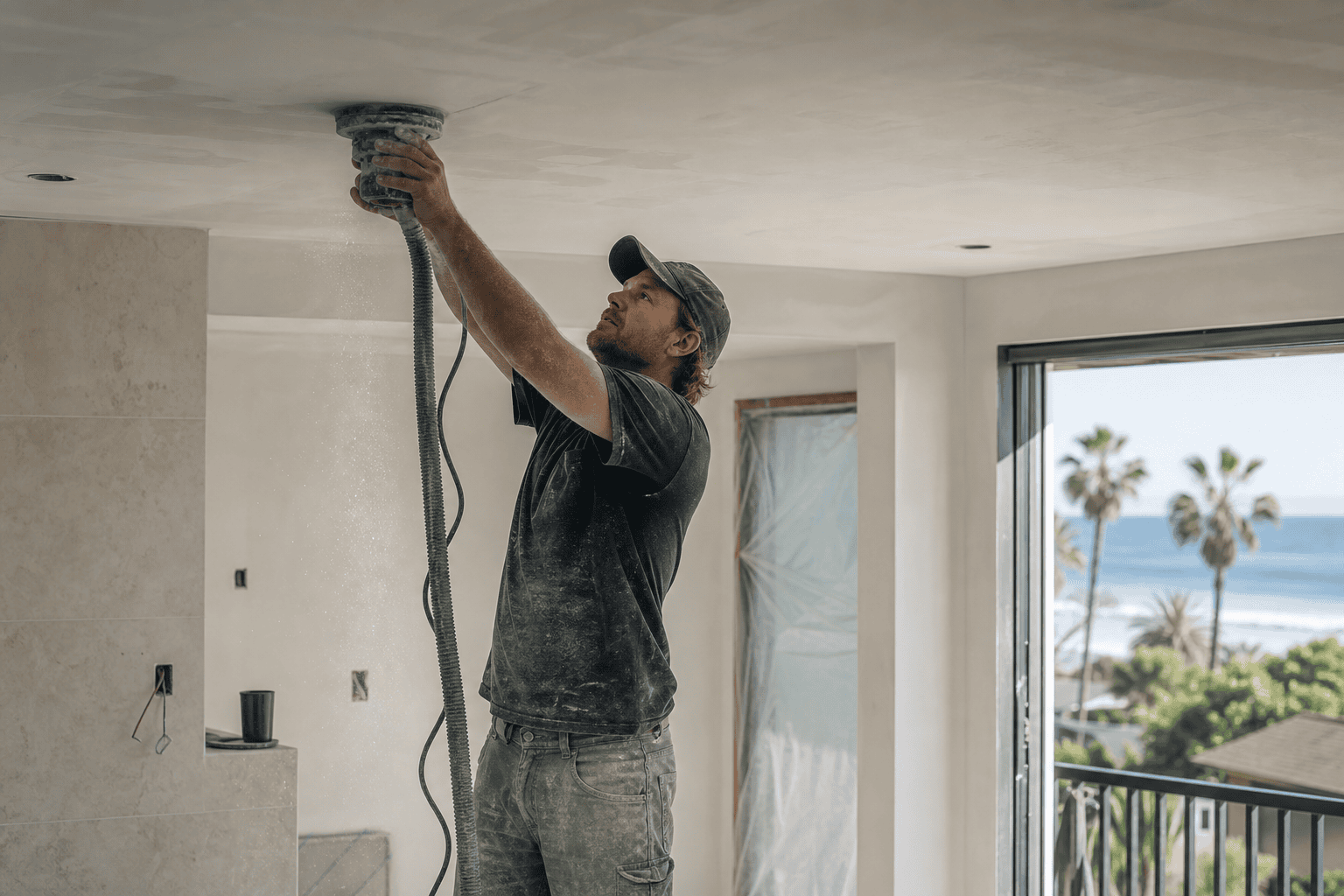
A San Diego drywall contractor hangs gypsum board, tapes the joints, and finishes the surface for paint. Under a California C-9 license, that scope also takes in nonstructural metal framing and texture. It does not take in plaster, lath, stucco, or insulation. Your insurance has to follow that same line. The work you actually perform decides how a carrier classifies and prices every policy you carry.
Most drywall contractors in San Diego County need four policies to operate and to pass a general contractor’s certificate review. Those are general liability, workers compensation once you have employees, commercial auto for the van, and inland marine for the tools and lifts. Contractors errors and omissions and an umbrella round out the program for crews working coastal remodels and hillside jobs in the unincorporated County. This guide walks through each one. It starts with the workers comp rule that catches more C-9 crews than any other.
What a C-9 License Covers, and Why Underwriters Care
The Contractors State License Board defines a C-9 drywall contractor as one who lays out and installs gypsum wallboard and wallboard assemblies. That definition includes nonstructural metal framing, plus the taping and texturing that finishes the joints. Plaster, lath, and stucco belong to the C-35 classification. Insulation and acoustical work belong to C-2. The line between those classes matters to your insurance for a simple reason. Workers comp and general liability both price by the operation, not by the license on your truck.
| License class | What the license covers | California workers comp class |
|---|---|---|
| C-9 Drywall | Gypsum wallboard, nonstructural metal framing, taping, texturing | 5446 / 5447 Wallboard Installation |
| C-35 Lathing and Plastering | Lath, plaster, veneer plaster, stucco, and most EIFS | 5484 / 5485 Plastering or Stucco Work |
| C-2 Insulation and Acoustical | Insulation and acoustical materials | Varies by operation |
Two details from the WCIRB classification are worth knowing before you bind. First, wallboard taping and texturing sit inside the wallboard class even when a separate finishing company performs them. Second, veneer plaster applied over installed wallboard gets classified separately as plastering. Say your crew skims a Mission Hills remodel with veneer plaster on a policy rated only for hang and tape. The year end audit will move that payroll, and the premium moves with it. The 5446 and 5447 split is a wage threshold that the WCIRB adjusts periodically. Keep payroll records that show each finisher’s hourly rate. Our drywall contractor insurance guide covers the class split in more depth if you work across several trades.
The C-9 Workers Comp Rule Most San Diego Hang Crews Get Backward
California Labor Code section 3700 requires workers compensation the moment you have an employee. That part is not new and it has no exceptions for small crews. The confusion sits in a different place. The Contractors State License Board maintains a short list of classifications that must carry workers comp even with no employees at all. That list is C-8 Concrete, C-20 HVAC, C-22 Asbestos Abatement, C-39 Roofing, and D-49 Tree Service. C-9 Drywall is not on that list.
That means a true solo C-9 can still file the no employee exemption with CSLB today. Senate Bill 216 originally set January 1, 2026 as the date every licensee would need a policy regardless of employees. Senate Bill 1455 moved that date to January 1, 2028. It also directed the board to build a process for verifying who actually qualifies for the exemption. Plenty of pages online still print 2026. That date is wrong for a C-9. Confirm the current rule on cslb.ca.gov before each renewal. The verification process may change what paperwork the board asks for before 2028.
The exemption only holds if you truly have no employees. A helper who carries sheets on a Saturday job is an employee under California law. So is an unlicensed sub. Labor Code section 2750.5 presumes anyone doing work that requires a license is your employee unless they hold their own license. A C-9 with a two-person tape crew and an exemption on file is exposed on two fronts. The board can suspend the license, and an injury on site lands on the business with no policy behind it. The safer reading is the one carriers use: if anyone else works on your jobs, carry the policy.
California C-9 License Requirements and the Threshold That Changed
To hold a C-9, an applicant needs four years of journey level experience within the last ten. The applicant also passes both the law and business exam and the C-9 trade exam, then files a $25,000 contractor license bond. The threshold for needing a license moved from $500 to $1,000 in labor and materials combined on January 1, 2025 under Assembly Bill 2622. Many websites still print the old $500 figure.
The board does not require general liability for a sole proprietor C-9. A drywall contractor organized as an LLC is different. Business and Professions Code section 7071.19 requires an LLC licensee to carry liability insurance. The minimum starts at $1 million in aggregate for a company with five or fewer members. The LLC also files a separate $100,000 surety bond that protects employees. Confirm the current figures with CSLB before you form the entity, because the bond and insurance requirements have changed before. The practical requirement is broader than the legal one. No general contractor in Mission Valley or Kearny Mesa will let your crew hang a sheet without a general liability certificate, regardless of how the state classifies your entity.
The Coverages a San Diego Drywall Contractor Needs
| Coverage | What it does for a C-9 | What to check before binding |
|---|---|---|
| General liability | Pays for bodily injury and property damage your operations cause to others, including completed work that later damages other property | Class code (ISO 92338 for drywall or wallboard installation), dust and silica exclusions, fungi and mold exclusion, subcontractor conditions |
| Workers compensation | Medical care and wage replacement for injured employees; required with any employee | Class 5446 / 5447, veneer plaster separately rated, exemption status on file with CSLB |
| Commercial auto | The van, the trailer, and the liability from hauling 12-foot sheets across the county | Hired and non-owned auto if employees drive personal trucks to jobs |
| Inland marine | Lifts, texture rigs, stilts, scaffold, and hand tools once they leave the vehicle | Scheduled versus blanket limits, theft from an unattended job site |
| Contractors E&O | Can respond to rework and callbacks that general liability excludes as your own work | Forms vary widely; some exclude the exact workmanship claims you want covered |
| Umbrella | Adds limits above general liability and auto when a GC’s exhibit asks for more | Confirm it sits over both policies and follows the additional insured wording |
| License bond | The $25,000 CSLB bond that keeps the license active | This protects the public, not you; it is not a substitute for liability coverage |
Coastal Moisture, Callbacks, and the Gap in General Liability
Tape pops in Point Loma when the marine layer keeps a house damp for a week after the second coat. A rushed skim over wet mud in an Ocean Beach garage conversion cracks the same way. Both are workmanship disputes, and general liability is not built for them. Every standard general liability form excludes damage to your own work. General liability does respond when your work damages something else, such as a failed ceiling texture that lands on new flooring. Contractors errors and omissions can pick up the rework itself, but forms vary widely, so read the exclusions first.
Moisture creates a second problem. Nearly every general liability policy carries a fungi and bacteria exclusion. Hang board over damp framing in a coastal remodel and a later mold claim falls to you with no coverage behind it. Take moisture readings before you hang and put them in the job file. Photograph the finish level against the Gypsum Association standards that underwriters and expert witnesses both read. That file is the difference between a dispute you win and one you settle.
Joint compound dust deserves its own question. Sanding produces fine dust, and some compounds contain crystalline silica. Some general liability forms carry a silica or dust exclusion, and others push airborne dust into the pollution exclusion. Ask your agent to show you where dust sits on the policy before the first sanding day.
Equipment rounds out the list. A drywall lift or texture sprayer sits on your commercial auto policy only while it rides in the van. The moment it comes off the truck at a Ramona job, it needs inland marine coverage. Theft from an open job site is the loss most crews discover they never covered.
Hillside Jobs, County Permits, and What General Contractors Require
A state license does not replace a building permit. Unincorporated communities such as Alpine, Lakeside, and Ramona pull permits through San Diego County Planning and Development Services rather than the City of San Diego. Inspections follow a different schedule there. Confirm the jurisdiction before you bid. A permitted job also signals your insurer. A class that only covers hang and tape will not match a job that needed a framing inspection.
Certificates win the commercial book. General contractors in Mission Valley and Kearny Mesa typically require several things before a sub starts. They want additional insured status for both ongoing and completed operations, primary and noncontributory wording, and a waiver of subrogation on general liability and workers compensation. They also want a workers comp certificate rather than an exemption letter. A C-9 with employees and no workers comp on file will fail that review before the first sheet arrives.
Treat the limits in a GC’s insurance exhibit as a floor, not a target. There is no risk in carrying more liability coverage than the contract requires. There is real risk in carrying less. A single ceiling failure with an injury underneath it can run through a $1 million occurrence limit before the defense bills are paid. Bring the insurance exhibit to your agent before you sign, and place the endorsements the job actually names.
Get a San Diego Drywall Contractor Insurance Quote
Western Pacific Insurance is licensed in California and places coverage for drywall contractors throughout San Diego County. We shop your operation across multiple carriers and confirm the C-9 workers compensation status on file with CSLB before you bind. We also build the wallboard class into the policy so the audit matches the work. Start with a California quote request, or visit our California insurance page to see everything we write in the state. For coverage specifics, see our general liability insurance page. For project bonds beyond the license bond, our surety bonds page covers what a public job in the County will ask for.


