
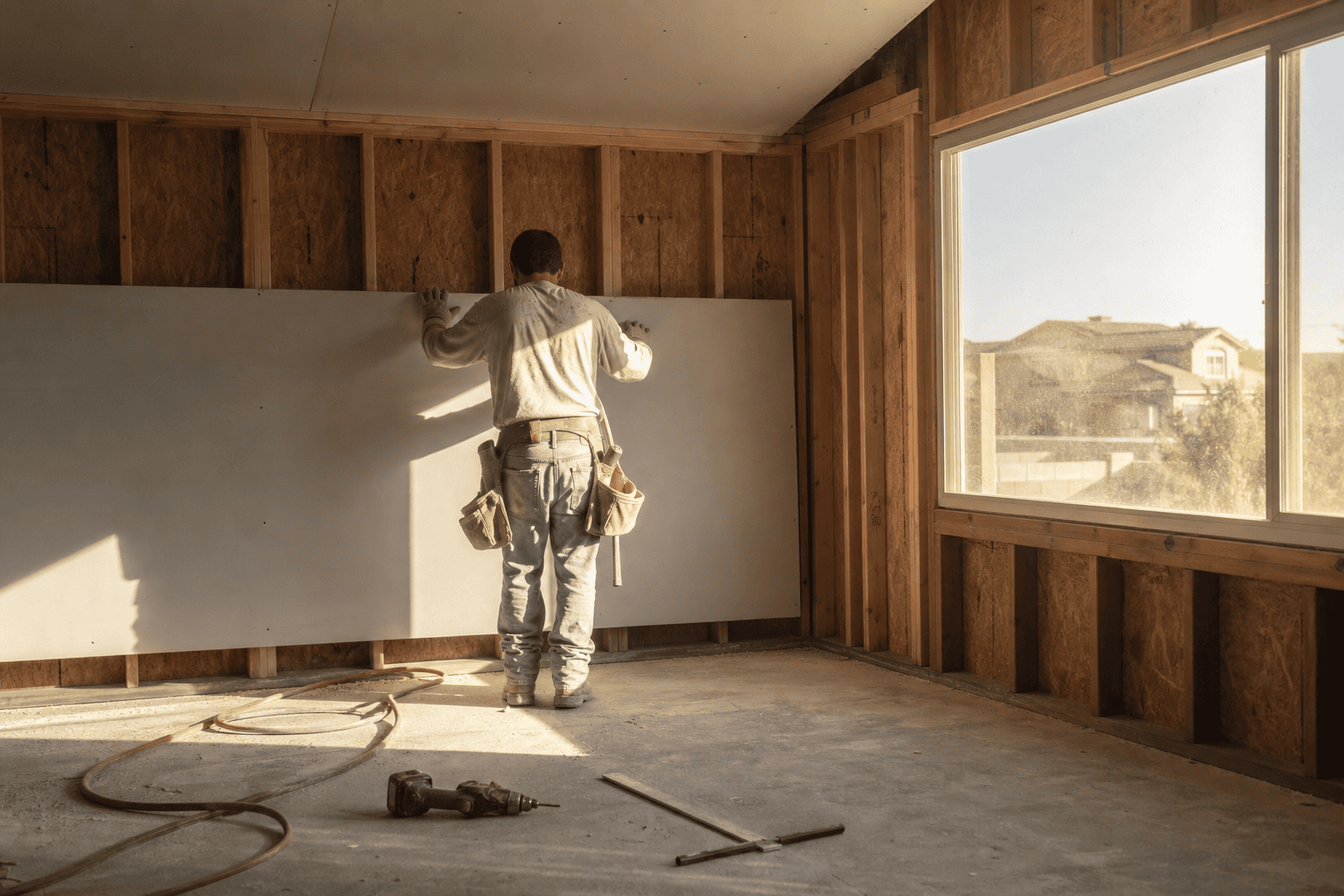
A Phoenix drywall contractor hangs gypsum board, tapes and finishes the joints, sprays texture, and often sets ceiling grid and non-load-bearing steel framing along the way. That work puts your crews inside other people’s buildings, up on stilts and lifts, surrounded by dust and mud. Phoenix drywall contractor insurance has to answer three questions before a general contractor or HOA board lets you on site. Can you pay for damage your crew does to a finished room? Are your injured employees covered? Does your certificate show the limits and endorsements the contract demands? The core program is general liability, workers compensation, commercial auto, and coverage for your tools and stocked board. This guide walks through each piece as it applies in Arizona, what the Registrar of Contractors requires alongside it, and where Valley drywallers most often come up short.
What Phoenix Drywall Contractor Insurance Should Include
| Coverage | What it does for a drywall contractor | What GCs and property managers usually ask for |
|---|---|---|
| General liability | Pays for bodily injury and property damage you cause to others, including a finished room next to the one you are hanging | $1 million per occurrence and $2 million aggregate, with an additional insured endorsement |
| Workers compensation | Medical bills and lost wages for injured employees. Arizona requires it once you have one employee | A certificate showing active coverage, often with a waiver of subrogation |
| Commercial auto | Vans and trucks moving crews, board, and mud between jobs | $1 million combined single limit is common |
| Inland marine | Lifts, stilts, sanders, texture rigs, and stocked board on site or in transit | Rarely required by contract, but the theft and damage exposure is yours |
| Commercial umbrella | Extra liability limits above general liability and auto | Commercial and municipal bids increasingly require it |
General liability carries the most fine print for this trade. It does not pay to redo your own work. A cracked joint or a texture that flashes is a workmanship dispute, and the policy treats it that way. It does pay when your work damages something else. Water tracked into a finished hallway, a lift that punches through a completed ceiling, or a slurry spill on new flooring all sit squarely in covered property damage. Two clauses decide how well the policy holds up on a real claim. Care, custody, or control language can strip coverage from property you are working on. Completed operations language decides whether a claim that surfaces months after you left the job still pays. Read both before you bind, and think of the limits as a floor. Carrying more liability coverage than the contract asks for has never hurt anyone. Our general liability insurance page covers the basics in more depth.
Arizona Licensing: R-10, C-10, and CR-10 Drywall
The Arizona Registrar of Contractors licenses the trade under the Drywall and Acoustical Systems classification. R-10 covers residential work, C-10 covers commercial work, and CR-10 is the dual license covering both. The scope includes gypsum wallboard, ceiling grid systems, movable partitions, tape and texture, and non-load-bearing lightweight steel wall partitions. Plaster and stucco sit in a different classification. You need the license once a job exceeds $1,000 in labor and materials, or whenever the job needs a permit, regardless of price. Splitting a larger job into smaller contracts does not create an exemption.
One caution for contractors who have worked in California: the numbers do not carry over. California’s drywall class is C-9, and California’s C-10 is electrical. Arizona’s C-9 is concrete. Certificates and bid packages that borrow the wrong state’s numbering draw a flag and delay your start date.
The Registrar does not require general liability insurance as a condition of licensing. It does require a license bond sized to your classification and your expected annual volume in Arizona. Residential and dual licensees also pay into the Residential Contractors’ Recovery Fund or post a separate $200,000 bond in its place.
| License | Expected annual gross volume in Arizona | License bond |
|---|---|---|
| R-10 residential specialty | Under $375,000 | $4,250 |
| R-10 residential specialty | $375,000 or more | $7,500 |
| C-10 commercial specialty | $150,000 or less | $2,500 |
| C-10 commercial specialty | $150,001 to $500,000 | $7,000 |
| C-10 commercial specialty | $500,001 to $1 million | $17,500 |
| C-10 commercial specialty | $1 million to $5 million | $25,000 |
| C-10 commercial specialty | $5 million to $10 million | $37,500 |
| C-10 commercial specialty | Over $10 million | $50,000 |
| CR-10 dual | Combined | Residential bond plus commercial bond |
These figures come from the Registrar’s bond instructions. Confirm the current schedule with the ROC before you file, because the ROC revises the tiers. When your volume crosses into a higher tier, the bond has to increase promptly. Falling behind on that step can suspend the license. Jobs on unincorporated lots still run through Maricopa County construction permits even when your state card is current.
Workers Compensation Starts With Your First Employee
Arizona requires workers compensation for any employer with one or more employees. The employer pays the entire premium, and the law prohibits deducting any part of it from wages. Most hang and finish payroll rates under NCCI class 5445 for wallboard installation, though your carrier assigns the final codes. The premium you pay at the start of the year is an estimate. At audit, the carrier reconciles it against actual payroll by classification. Clean records that separate field labor from clerical and sales payroll keep that audit bill in line.
Subcontractors are the audit surprise for this trade. If a 1099 finisher or texture crew cannot produce a current workers compensation certificate, most carriers charge you for their payroll at audit. Collect certificates before the crew starts, not after the auditor asks.
The Claims Phoenix Heat and Monsoon Season Write
Heat leads the list. From June through September, joint compound can skin before the knife seats it, and taping after mid-morning invites cracked seams and callbacks. Those callbacks are workmanship, and general liability will not pay them. The fix is scheduling and crew discipline, not a policy.
Monsoon moisture is different. A storm that pushes water through an unfinished opening ruins fresh board and can wick into a neighbor’s finished room. Damage to the board you were hanging often falls into the workmanship gap or under care, custody, or control. Damage to the finished room next door is covered property damage, and it can dwarf a typical callback. Photograph the site before you start and note any open exterior penetrations in writing. Stocked board left outside is a separate exposure. An inland marine installation floater covers material in transit and on site before it becomes part of the building.
Hang, Tape, and Texture: Get Your Work Mix on the Application
Production builders and HOA boards in the East Valley, from Queen Creek through Gilbert and San Tan Valley, often contract hang, finish, and texture separately. Plenty of Phoenix outfits do only one of the three. Arizona puts all of it under one license card, but your insurance application does not. Underwriters want payroll and revenue split by operation, along with how much of your work involves stilts, lifts, or ceilings above a set height. Understating the finish side to lower a quote is a mistake. Most drywall work rates under a single general liability class, so the savings are small and the audit adjustment is not.
The certificate side matters just as much. Most general contractors and property managers require an additional insured endorsement for ongoing and completed operations, primary and noncontributory wording, and a waiver of subrogation on workers compensation. If your policy cannot issue those endorsements, the certificate will bounce and the job will wait. Our drywall contractor insurance guide covers the coverage and classification details that apply in every state. This article focuses on the Arizona layer.
Get a Phoenix Drywall Contractor Insurance Quote
Western Pacific Insurance is licensed in Arizona and places coverage for drywall contractors across the Valley through multiple carriers. We confirm your classification matches your actual mix of hang and finish work, and we review the care, custody, or control and completed operations wording before you bind. Start with an Arizona quote request, or visit our Arizona insurance page to see everything we write in the state.


