
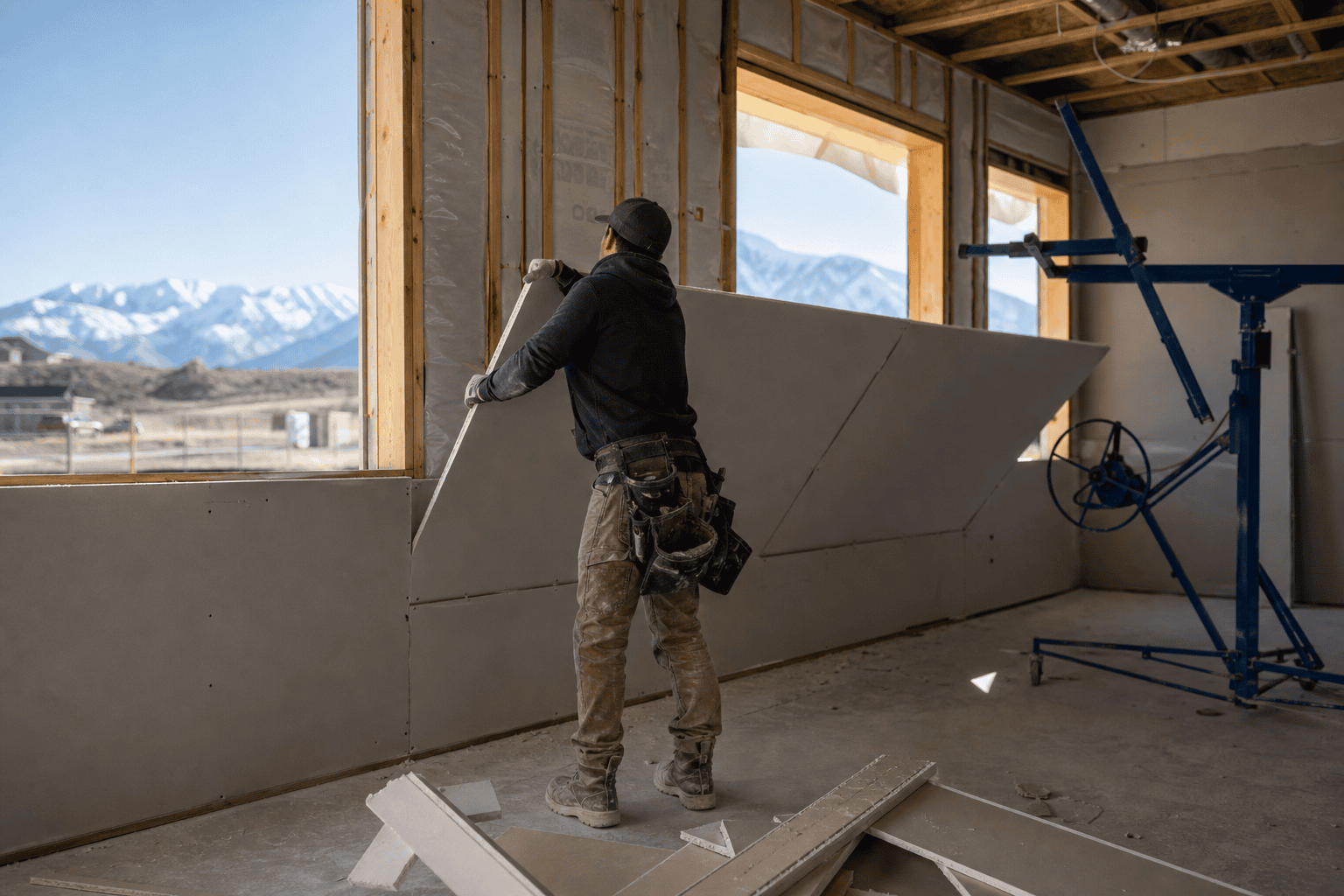
A Lehi drywall contractor hangs, tapes, and finishes gypsum board in some of the busiest subdivisions in Utah County. New builds around Traverse Mountain and Thanksgiving Point keep hang crews on a builder’s calendar. The office campuses along Silicon Slopes add Type X fire-rated work on metal studs. That work runs on prequalification packets, and the packet decides who gets the lot. Your certificate of insurance has to clear two bars at the same time. It has to satisfy Utah’s licensing floor for the S270 class. It also has to satisfy the limits the general contractor writes into the subcontract. This guide covers both, along with the gaps that tend to hide between them.
The Coverage a Lehi Drywall Contractor Needs
Start with the general liability policy the state requires for your license, then build around your actual work mix. Here is the short version. The detail follows below.
| Coverage | Why a Lehi drywall contractor needs it | Who asks for it |
|---|---|---|
| General liability | Bodily injury and property damage on the job, such as a sheet through a window or a visitor tripping over stacked board | Utah DOPL for the S270 license, plus every builder contract |
| Workers compensation | Injuries to hangers and finishers, including falls from stilts, benches, and lifts | Utah once you have employees; most builders even when you do not |
| Commercial auto | Vans and trucks hauling board and lifts between lots and campuses | Builders on most prequal packets, and Utah for any vehicle on the road |
| Inland marine | Lifts, screw guns, texture rigs, and material in transit or staged on site | Lenders on financed equipment; otherwise your own balance sheet |
| Professional liability for workmanship | Tear-out and redo costs on a rejected finish level, which general liability excludes | Rarely required, but often the largest uncovered exposure on new build work |
General liability
General liability pays when your operations injure someone or damage property that is not your own work. A hanger drops a sheet through a picture window, or a buyer walking the lot trips over a stack of board in the garage. Those are covered claims. The policy excludes the cost of fixing your own work, and that exclusion matters more on new construction than anywhere else. Carriers rate drywall by payroll and by the work you describe to them. A crew that adds texture and paint mid-year needs to tell its agent before the first invoice.
Workers compensation
Utah requires workers compensation once you employ anyone, including part-time hangers you pay by the sheet. A one-person operation with no employees files for a coverage waiver with the Utah Labor Commission. DOPL asks for that waiver at licensing. Builders read waivers carefully. A general contractor who hires an uninsured sub can end up paying that sub’s injury claim. Many require comp even from owner-only crews for that reason. If you plan to bid production work, price the policy before you need it.
Commercial auto and inland marine
Your vans run Pioneer Crossing between Traverse Mountain lots and the campuses near Thanksgiving Point all day, often loaded with lifts and stacked board. A personal auto policy will not respond to a claim on a business-titled truck. Business auto covers the vehicles, and an inland marine floater covers what rides in them. That floater earns its premium on multi-lot work, where a drywall lift moves between houses and leftover sheets sit in an unlocked garage overnight.
Workmanship and finish-level disputes
A builder who rejects a Level 4 finish, or a Level 5 skim that flashes under the great room lighting, is not filing a liability claim. That is a contract dispute, and general liability will not pay to tear the wall out and redo it. Professional liability, which some carriers sell as contractors errors and omissions, is where that cost lands. Our drywall contractor insurance guide explains how that coverage works and how a hang-only insurance class leaves tape, texture, and paint sitting outside the policy.
Utah’s General Liability Floor for the S270 License
Utah rule R156-55a sets the insurance a contractor must carry to hold a license. As of 2026, the general liability floor for every contractor classification sits around $1 million per occurrence and $2 million aggregate. The Division of Professional Licensing must appear as certificate holder. That is a large step up from the $100,000 per occurrence and $300,000 aggregate minimums that applied before April 2026. Plenty of websites still print those old numbers. Some 2026 application PDFs still show $1 million and $3 million.
Treat the highest figure you see as your floor. There is no penalty for carrying more than the state asks, and most builders along Silicon Slopes want more anyway. A policy that comes in under the current rule leaves a renewal problem sitting inside your license file. Our office checks your certificate against the division’s current rule before renewal, not against a stale article. An umbrella policy can sit on top when a builder contract calls for higher limits.
Which License Covers Drywall in Lehi
Utah puts drywall under S270 Drywall, Paint, and Plastering Contractor. The scope in R156-55a-301 covers gypsum and wallboard panels, lightweight metal and non-bearing partitions, ceiling tile and grid, insulation, stucco and plaster, and paints and coatings. That is a broad card compared with the hang-only classifications some states issue. One license carries a hang crew, a finish crew, and a paint crew.
Earning it takes two years, or 4,000 hours, of paid construction experience and a 25-hour pre-licensure course from an approved provider. You also pass the Utah Business and Law exam and register your business with the state. DOPL can also require a license bond, and surety bonds for specialty classes commonly start at $15,000. Licenses expire on November 30 of odd-numbered years and renew with six hours of continuing education. Confirm the details with DOPL before you file, because the division updates its requirements.
Small drywall patches can fall under Utah’s handyman exemption, but the dollar threshold is low. Any work on new construction or fire-rated assemblies belongs on a license. The license and the insurance class are also separate questions. S270 lets you hang, finish, paint, and plaster. Your policy only covers the operations your carrier rated, so keep the two in sync.
New Build Packages Along Traverse Mountain and Thanksgiving Point
Production builders sell drywall as part of the home, and the option sheet makes it look like trim. A standard package covers Level 4 in the living areas, moisture-resistant board in wet rooms, a garage firewall, and ceilings that have to hold through the first winter. Then a buyer upgrades to a Level 5 skim in the great room on the same lot. The finish standard on that house jumps. Your crew is now warranting a glass-smooth wall under a bank of south-facing windows.
Rejected punch lists on that work are contract disputes with the builder. General liability does not respond, and workmanship coverage does. Getting that split right is a claim issue even when your license card is perfect. Lehi City also issues its own building permits and runs its own inspections. A state license does not replace that step.
Commercial Type X Work Along Silicon Slopes
Office campuses near Thanksgiving Point need Type X fire-rated assemblies, shaft walls, and metal stud framing at a scale a house never reaches. Those contracts run larger, and the insurance language runs tighter. Expect additional insured endorsements, primary and non-contributory wording, waivers of subrogation, and often limits above the state floor. A residential hang class and a commercial corridor class do not price the same, so tell your agent which book you actually bid. Guessing wrong in either direction costs money, and guessing low can void a claim.
Certificates Win the Builder Book
The general contractors building this corridor prequalify their hang crews before the first bid. Bids die quietly when the certificate shows the wrong limits, a missing endorsement, or a lapsed policy. Keeping your certificate current at or above the state minimums, with your general contractor listed correctly, is free market positioning. We turn certificate requests around the same day for our contractor clients, and we review the subcontract insurance clause before you sign it.
Get a Lehi Quote
Western Pacific Insurance places drywall contractor coverage with multiple carriers across Utah County and the rest of northern Utah. We match your classification to the work you actually do. Your limits will satisfy the state and the builders who hire you. Start with a Utah quote request, or visit our Utah insurance page to see everything we write in the state.


