
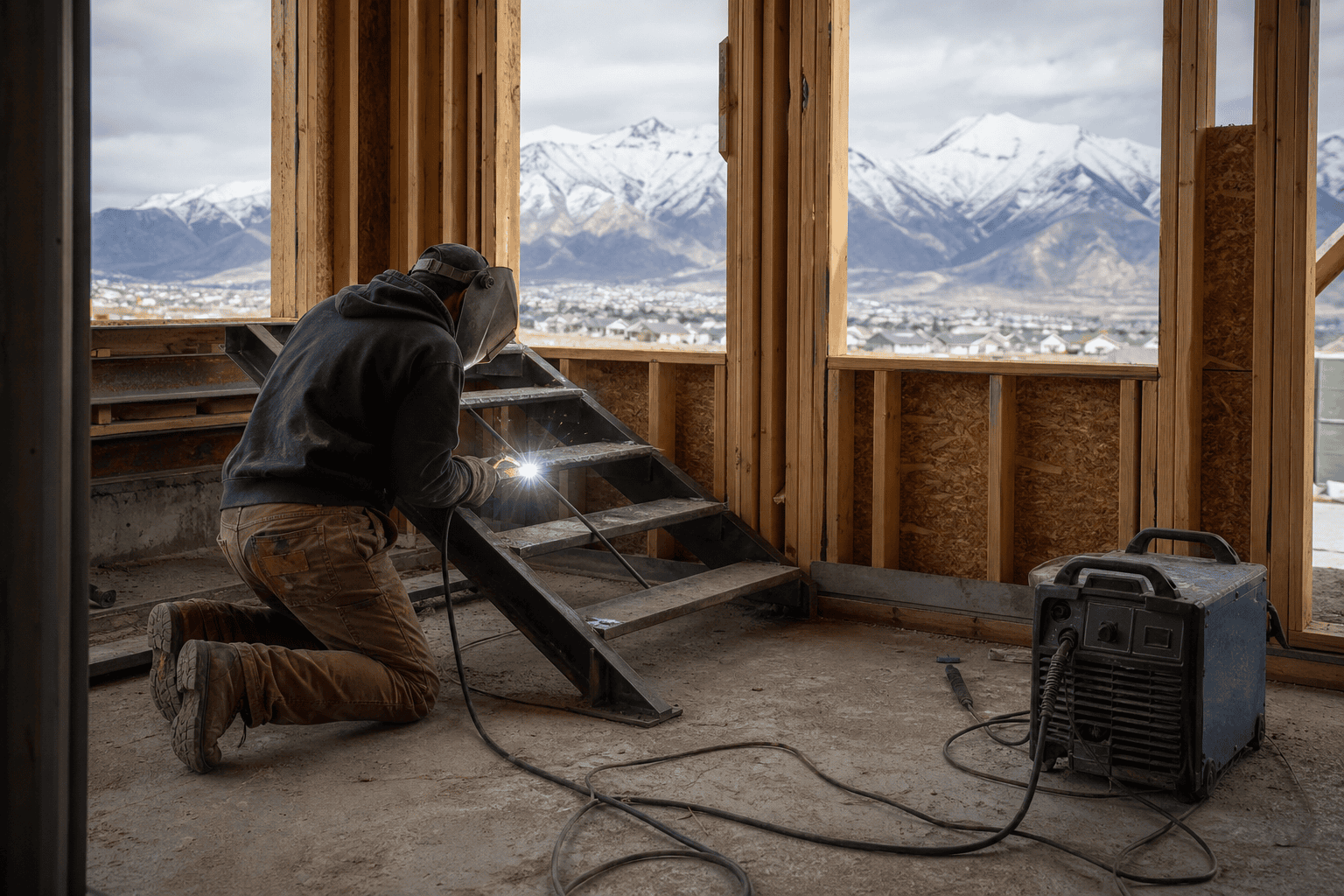
A Lehi welding contractor fabricates and installs the steel that builders sell as part of the house around Traverse Mountain and Thanksgiving Point. That means balcony rail, courtyard gates, and stairs that have to hold up through their first Wasatch winter. The work requires a Utah contractor license, and the license requires general liability at the state floor before DOPL will issue it. Lehi welding contractor insurance should cover four things at a minimum. You need general liability at or above Utah’s current floor, workers compensation or a waiver, commercial auto for the rig, and coverage for the welder and steel that ride in it. This guide walks through what the license requires, what the builders require, and where those two lists differ.
Which Utah License Covers Welding in Lehi
Utah puts most welding and steel work under the S220 Carpentry and Flooring Contractor classification. The scope in Utah Administrative Rule R156-55a-301 covers metal and steel structures, sheet metal, structural studs, bearing walls, and reinforcing bar. It also covers erecting shapes and plates used in structures, and it names riveting, welding, and rigging in the rule text. Utah folded the old S320 Steel Erection classification into S220 in 2019, along with steel reinforcing and metal building erection. If you bid stairs, rail, gates, or structural steel that becomes part of a building, S220 is the card to hold.
Getting the card takes a 25-hour pre-licensure course from an approved provider and a registered business entity. You also file a general liability certificate with the Division listed as certificate holder, plus workers compensation or a Labor Commission waiver. Specialty contractors who cannot show financial responsibility post a license bond, which starts at $15,000. Verify the current figures on DOPL’s specialty contractor page before you file. The Division has changed several of these requirements in the past two years.
Welding on personal property that never attaches to a structure is a different case. A trailer hitch repaired in a driveway generally falls outside contractor licensing, and so does a gate you fabricate in the shop and sell loose. The moment that gate hangs on posts set in a Lehi yard, it becomes contracting work. When the line is unclear, ask DOPL instead of guessing, and license the class you actually bid.
Utah’s General Liability Floor Now Sits at $1 Million per Occurrence
DOPL currently requires every licensed contractor, in every classification, to carry general liability of at least $1,000,000 per occurrence and $2,000,000 aggregate. The Division must appear on the certificate as certificate holder. That floor took effect in 2026 and replaced the old $100,000 per occurrence and $300,000 aggregate minimums. Many web pages still print the old numbers. Some 2026 application PDFs print $1 million and $3 million, because the aggregate moved during the rulemaking. The figure to trust is the one on DOPL’s live requirements page, and today that page reads $1 million and $2 million.
If your policy still carries the old limits, your next license renewal will stall until you fix it. The practical answer is to treat $1 million and $2 million as a starting point. General contractors on the Silicon Slopes corridor often ask subcontractors for more than the state floor. One bad year with two claims can also consume a $2 million aggregate. Carrying a higher aggregate or adding a commercial umbrella costs less than most contractors expect. It also keeps you compliant no matter which version of the rule a reviewer has in front of them. There is no penalty for carrying more than the state requires. There is a real penalty for carrying less.
What Lehi Welding Contractor Insurance Should Include
The state cares about one line on your certificate. Your customers, your lender, and your own balance sheet care about several more. A complete program for a welding contractor working Utah County usually looks like this.
| Coverage | What it does for a welder | Who asks for it |
|---|---|---|
| General liability | Pays for injury or property damage your work causes to others, including fire from hot work | DOPL and every general contractor |
| Workers compensation | Covers employee injuries, including burns, eye injuries, and falls during stair installs | Utah Labor Commission once you have employees |
| Commercial auto | Covers the truck and trailer that carry your welder and steel between jobs | Lenders, GCs, and Utah’s financial responsibility law |
| Inland marine (contractor’s equipment) | Covers welders, plasma cutters, generators, and stock steel on job sites and in transit | You, after the first theft from an unfinished lot |
| Professional liability | Responds to workmanship and design disputes that general liability excludes | You, and any GC who has fought a punch list |
| Commercial umbrella | Adds limits above general liability and auto when a contract asks for more | Larger GCs and commercial property owners |
Workers compensation applies once you have employees. A one-person shop still has to show DOPL a coverage waiver from the Utah Labor Commission. The waiver pays no benefits. It only documents that you have no employees and run an independently established business.
Inland marine earns its premium on multi-lot new construction. Your equipment moves between houses every few days there and sits in unfinished garages overnight. A commercial property policy tied to your shop address will not follow the welder to Traverse Mountain. Our welding contractor insurance guide explains each of these coverages in more depth, including how carriers classify structural work.
Steel Stairs, Rail Packages, and the Workmanship Gap
Builders around Traverse Mountain and Thanksgiving Point sell rail and iron packages with the home. Buyers pick a balcony rail from a finish board the way they pick cabinet hardware. On the option sheet, that package looks like trim. On the lot, it is structural steel welded in place, and the builder’s inspector will test it before closing.
When a builder rejects a weld, that rejection is a contract dispute over your workmanship. General liability policies exclude damage to your own work. The carrier will not pay to cut out and redo a stair the builder refuses to accept. Professional liability, sometimes written as contractors errors and omissions, is the coverage that responds to that kind of claim. Your general liability still matters on the same job. It responds when a failed weld injures someone or damages the house itself.
How the carrier classifies your operation matters as much as which coverages you carry. Ornamental iron, shop welding, and structural steel erection carry different ratings. A policy rated for rail packages may leave a structural stair outside what the carrier priced. Tell your agent exactly what you weld and where it goes, so the classification on the policy matches the work on the invoice.
Lehi City still requires a building permit and inspection when the job triggers one. A state license does not replace that step, so ask the builder who is pulling the permit for the steel before you start. Our general contractor insurance guide covers the certificate language most Utah GCs will send you.
Certificates and Hot Work: Getting on the Builder’s List
The general contractors building this corridor prequalify their steel subcontractors. The certificate of insurance is the first document they read. Bids die quietly when the certificate shows limits below the current state floor, a lapsed policy, or the wrong entity name. Keeping your certificate current, with the GC listed as additional insured where the contract requires it, is free market positioning. We turn certificate requests for contractor clients around the same day they come in.
Occupied commercial work adds a second layer. Welding inside a tenant-occupied building near Thanksgiving Point or along the Silicon Slopes office corridor usually triggers a hot work permit and a fire watch. The building owner and the fire code set those requirements, and the Utah State Fire Marshal publishes the rules they follow. Some carriers also attach hot work conditions to general liability, requiring a fire watch and specific procedures before coverage applies. Ask your agent to read those conditions with you. A residential rail crew and a commercial stair crew do not carry the same conditions, and they do not pay the same rate.
Get a Lehi Welding Contractor Insurance Quote
Western Pacific Insurance is an independent agency. We shop your account across multiple carriers and place it with the one that classifies your welding work correctly and prices it fairly. We write contractors across Utah County and the Wasatch Front, and we build certificates that satisfy both DOPL and the builders who hire you.
Start with a Utah quote request, or call our Utah team at (801) 955-3755. You can also visit our Utah insurance page to see everything we write in the state.


