
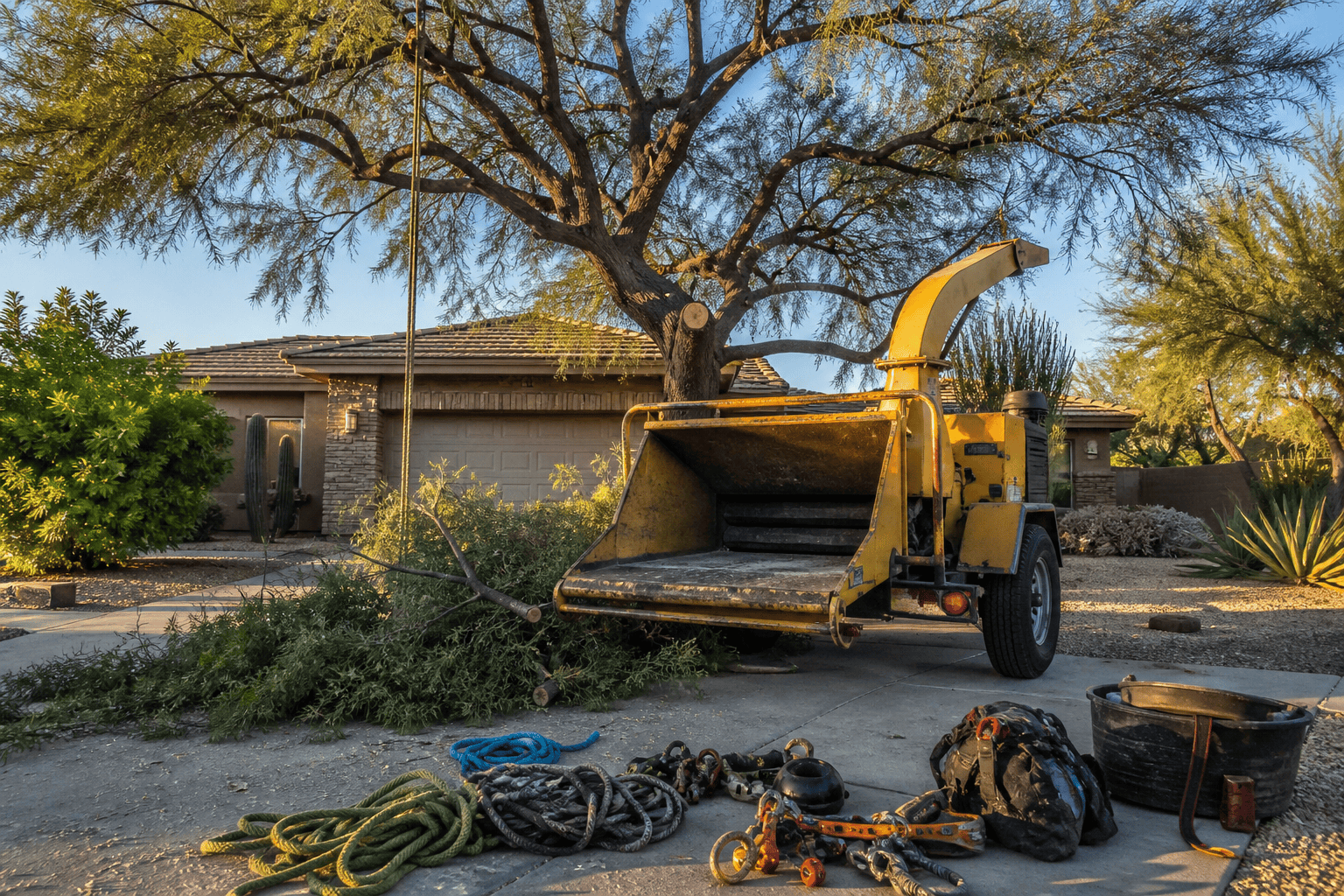
From the sidewalk, a tree crew can look like a landscaping crew. A truck, a trailer, some saws. Underwriters see something different. They see a climber sixty feet up on a rope, a limb over a neighbor’s roof, and a chipper running at the curb. Tree service insurance is built around those three things: someone working at height, heavy wood in motion, and equipment that can injure a person in seconds. Lawn care, fertilization, irrigation, and weed control belong on a landscaping contractor insurance program instead. This guide is for the operator who owns the climbing, pruning, removal, and stump grinding ticket. Western Pacific Insurance is an independent agency in Henderson, licensed in Nevada, California, Arizona, and Utah. If you want the wider contractor picture first, start with contractor insurance explained.
What Counts as Tree Service, and What Doesn’t
The line between tree service and landscaping matters more than most owners expect. Carriers rate the two trades differently, and many landscaping policies limit or exclude tree work above a set height. If your application says landscaping and your invoices say removals, you have a coverage problem waiting for a claim. Tell your agent which book you actually run.
| Belongs on a tree service policy | Belongs on a landscaping policy |
|---|---|
| Climbing and aerial pruning | Mowing, edging, and hedge shaping from the ground |
| Tree and palm removal, including takedowns over structures | Planting, sod, and bed installation |
| Stump grinding, on its own or after a removal | Irrigation and drip system work |
| Storm cleanup and emergency call-outs | Fertilization, weed control, and lawn spraying |
| Bucket truck, crane-assisted, and rope-access work | Hardscape, pavers, and low retaining walls |
Plenty of companies do both. That is fine, as long as the application shows the split. Underwriters will ask what share of revenue comes from tree work, how high your crews climb, and whether you remove trees near structures. Honest answers keep the policy matched to the work.
Tree Service Insurance: The Core Policies
Most tree operations run on four core policies, with a fifth added as contracts grow. Each one answers a different question about who got hurt or what got damaged.
General Liability
General liability is the base of the program. It responds when your operations injure a third party or damage property you do not own. A limb that drops onto the neighbor’s fence, a chip that cracks a windshield across the street, or a customer who trips over a rigging line all land here. Contracts with HOAs, property managers, and cities almost always require it. Tree work is a hazardous class, so many standard carriers decline the climbing exposure. Your liability policy may come from a specialty or surplus lines market, and that is normal for this trade. Read the endorsements closely, because that is where the limits on height, power lines, and chemicals live. See our general liability insurance page for how the policy works in general.
Workers Compensation
Workers compensation pays medical bills and lost wages when a climber, groundsperson, or driver is hurt on the job. All four states require it once you have employees, and tree work is one of the most dangerous trades in the country. There is still no tree-care-specific federal OSHA standard. Regulators lean on general industry rules and the general duty clause, and the industry runs on the ANSI Z133 consensus standard, which the Tree Care Industry Association continues to push OSHA to adopt. Underwriters know all of this, so they look hard at training, aerial rescue plans, and drug-free workplace programs before they price a policy. Two rating points matter for owners. First, tree pruning and removal payroll rates under its own class code, not the landscaping code, and mixing the two on payroll records invites an audit adjustment. Second, a climber you pay as a 1099 contractor is still your exposure. If that climber cannot show a certificate of workers compensation, your carrier will charge you for the payroll at audit.
Commercial Auto
Commercial auto covers the chipper truck, the dump truck, the crew pickup, and the trailer between jobs. A personal auto policy is not built for a truck towing a chipper with a business name on the door. Liability for a trailer generally follows the truck pulling it, but physical damage to the chipper itself usually does not. That belongs on inland marine, covered below. Add hired and non-owned auto if anyone drives a personal vehicle for the business, even for a parts run. Learn more on our business auto insurance page.
Inland Marine
Inland marine, often called a contractors equipment or tools floater, covers the gear that moves with the crew. Chippers, stump grinders, saws, climbing saddles, ropes, rigging, and mini skid steers all belong on it. A commercial property policy covers equipment sitting in your yard. It does not follow that equipment to the jobsite, into the truck overnight, or into a rental yard. Schedule the big-ticket items by serial number and use a blanket limit for small tools. Ask about rented and leased equipment coverage if you rent a grinder or a lift for larger jobs.
Umbrella and the Business Owners Policy
A commercial umbrella adds limits above general liability, auto liability, and employers liability. Municipal and HOA contracts often ask for more than a base policy carries, and an umbrella is the clean way to get there. A business owners policy bundles liability with property coverage for a shop or yard. Some carriers will write a small tree operation on a BOP, and many will not, so treat it as an option rather than an expectation.
Which Policy Pays for Which Tree Claim
Coverage questions get easier once you map the scene to the policy that responds.
| The claim | The policy that responds |
|---|---|
| Limb falls onto a neighbor’s roof during a removal | General liability |
| Climber falls or a groundsperson is struck by a log | Workers compensation |
| Chipper truck rear-ends a car on the way to the next stop | Commercial auto |
| Stump grinder stolen from the trailer overnight | Inland marine |
| Grinder tooth cuts a buried irrigation line on the customer’s lot | General liability, subject to the policy’s property exclusions |
| Wrong tree removed, or the customer’s own tree is damaged | Often excluded as damage to the work itself; ask your agent |
| Customer wants a free redo because they dislike the canopy shape | A contract or warranty cost, not an insurance claim |
The last two rows surprise people. General liability is written for damage to other people’s property, not for the tree or the job you were hired to do. A cutting error on the customer’s own tree is usually a business expense. Clear written scopes, marked trees, and photos of the drop zone before the first cut prevent most of these disputes.
Exclusions and Endorsements That Bite Tree Crews
Tree service policies are rarely plain vanilla. Before you bind, read for these items.
- Height limits. Some policies cap the height at which covered work can happen, or exclude climbing above a stated point. Match the cap to the tallest tree you actually take.
- Power line exclusions. Work within a set distance of energized lines is often excluded unless your crew holds line-clearance qualifications. Utility work is a separate underwriting conversation.
- Pesticide and herbicide. If you spray, inject, or treat trees, you need a pesticide applicator license from your state regulator and a policy that does not exclude chemical application. Many base policies do. Our pest control insurance guide explains how applicator coverage works.
- Damage to the property you are working on. The tree, the stump, and the ground right around them are usually carved out of general liability.
- Subcontractor conditions. Some policies void coverage for work performed by subs who lack their own insurance. Collect certificates before the job, not after the claim.
- Crane and rigging. Crane-assisted removals may need a separate endorsement or a riggers liability form for the load while it is in the air.
None of these exclusions make a policy bad. They make it specific. The goal is a policy whose limits and endorsements match the jobs on your calendar, with limits that run higher than the minimum a contract asks for, not lower.
Stump Grinding, Storm Work, and Aerial Access
Stump Grinding
Stump grinding belongs on the tree service file whether it follows a removal or stands alone. The exposures are flying debris, damage to sidewalks and sprinkler lines, and buried utilities. Call 811 before you grind, and photograph the area before the machine comes off the trailer. Grinders are also a favorite theft target, so make sure each unit is scheduled on inland marine at a value you would actually pay to replace it.
Storm Call-Outs
Storm work pays well and carries the most risk of the year. Crews work tired, in the dark, around downed lines, on trees that are already failing. Two insurance details matter here. First, tell your agent if you chase storms across state lines. Workers compensation policies list the states where you operate, and a crew hurt in a state you never listed can create a gap. Second, emergency work often means new customers with no written contract. Even a one-page scope signed on a phone protects you when the neighbor’s fence comes up later.
Bucket Trucks and Cranes
A bucket truck lives on commercial auto, but the aerial device on top changes the value of the vehicle. Confirm that the physical damage limit includes the boom, and ask whether your carrier wants the lift device scheduled separately. Cranes bring their own questions. A crane you own needs contractors equipment coverage and an operator with the right certification. A crane you hire with an operator shifts some risk to the crane company, but you still need to read the rental agreement, because many push liability for the load back onto you.
Licensing in Nevada, California, Arizona, and Utah
Licensing rules do not change what your insurance covers, but they do change how underwriters rate you and what contracts you can win. Here is where each state stands on tree work specifically.
California
California is the only one of the four states with a dedicated tree contractor license. The Contractors State License Board issues the C-49 Tree and Palm Contractor classification, which covers planting, maintaining, and removing trees and palms, including pruning, stump grinding, and guying. The C-49 replaced the old C-61/D-49 Tree Service limited specialty as of January 1, 2024, and it requires a trade exam. Contractors who already held a D-49 may keep working under it. The rule does not apply to incidental pruning by a gardener or nurseryperson. California also treats tree service as a mandatory workers compensation class. Under SB 216, D-49 holders have needed a policy on file with the CSLB since 2023 whether or not they have employees, and the universal requirement for all licensees is now scheduled for January 1, 2028 under SB 1455. If you climb for hire in California, plan on carrying workers compensation from day one.
Nevada
Nevada has no tree-specific license. Landscape contracting under the C-10 classification covers planting and maintaining trees, and the Nevada State Contractors Board’s own landscaper consumer guide says a licensed contractor is not needed for removal and trimming of trees and shrubs. Planting trees, installing irrigation, and laying sod do require a license. So a pure pruning and removal company can operate on business licenses alone, while a company that also plants needs the C-10. Local business licenses, and tree permits in some cities, still apply. An ISA Certified Arborist credential is a voluntary industry mark, not a state license, though underwriters like to see it.
Arizona
Arizona does not issue an arborist license. Whether the Registrar of Contractors applies depends on the scope of the job and on the statutory exemptions in A.R.S. 32-1121. That statute exempts a person who functions as a gardener by performing lawn, garden, shrub, and tree maintenance. It also carries a general exemption for casual or minor work under a stated contract price, which does not apply when a permit is required. Neither exemption spells out where routine maintenance ends and a structural removal begins. When a job is large or close to that line, ask the ROC for a determination rather than guessing. Anyone working under an exemption must include the words “not a licensed contractor” in advertising.
Utah
Utah’s construction trades rule, R156-55a-301, lists tree stump or tree removal among the activities that do not require a contractor license. Planting trees as part of landscape work still falls under the S330 Landscape and Recreation Contractor scope. If you hold a Utah contractor license for related work, the state sets minimum general liability limits for licensees, and those floors have moved recently, so treat any number printed on an older form as a floor rather than a target. City business licenses and local tree ordinances apply either way.
What Property Managers and HOAs Will Ask For
Commercial tree work runs on certificates of insurance. Expect a property manager to require general liability, auto, and workers compensation, and to ask to be named as an additional insured on your liability policy. Some contracts also require a waiver of subrogation on workers compensation and primary and noncontributory wording on liability. Each of those is an endorsement your carrier has to add, and each can carry a small charge. Build them into the policy up front so certificates go out the same day instead of holding up a start date. A certificate by itself gives the manager nothing. The endorsement behind it is what counts.
Questions to Answer Before You Get a Quote
Underwriters price tree work on details. Having these answers ready shortens the process and usually improves the terms.
- How much of your revenue comes from tree work versus lawn or landscape work?
- What is the tallest tree you remove, and how often do you work over structures?
- Do you climb, use a bucket truck, use a crane, or all three?
- Do you work near power lines, and does anyone on the crew hold line-clearance qualifications?
- Do you spray or inject trees, and who holds the applicator license?
- Which states do your crews work in, including storm response?
- Do you use subcontracted climbers, and do you collect their certificates?
- What equipment do you own, what is it worth today, and where does it sleep at night?
- What training, aerial rescue, and drug-testing programs do you run?
Tree Service Insurance in Henderson, Phoenix, San Diego, and Lehi
Local rules, tree species, and storm seasons change the details. We keep a page for each of our core metros: Henderson tree service insurance, Phoenix tree service insurance, San Diego tree service insurance, and Lehi tree service insurance.
Get a Tree Service Insurance Quote
Western Pacific Insurance is an independent agency, so we shop your climbing, removal, and stump grinding operation across the carriers that actually want this class of work. We insure tree and arborist businesses in Nevada, California, Arizona, and Utah. Tell us about your climbers, your trucks, your gear, and the jobs you take, and we will build a program that fits the work. Start with an insurance quote request.


