
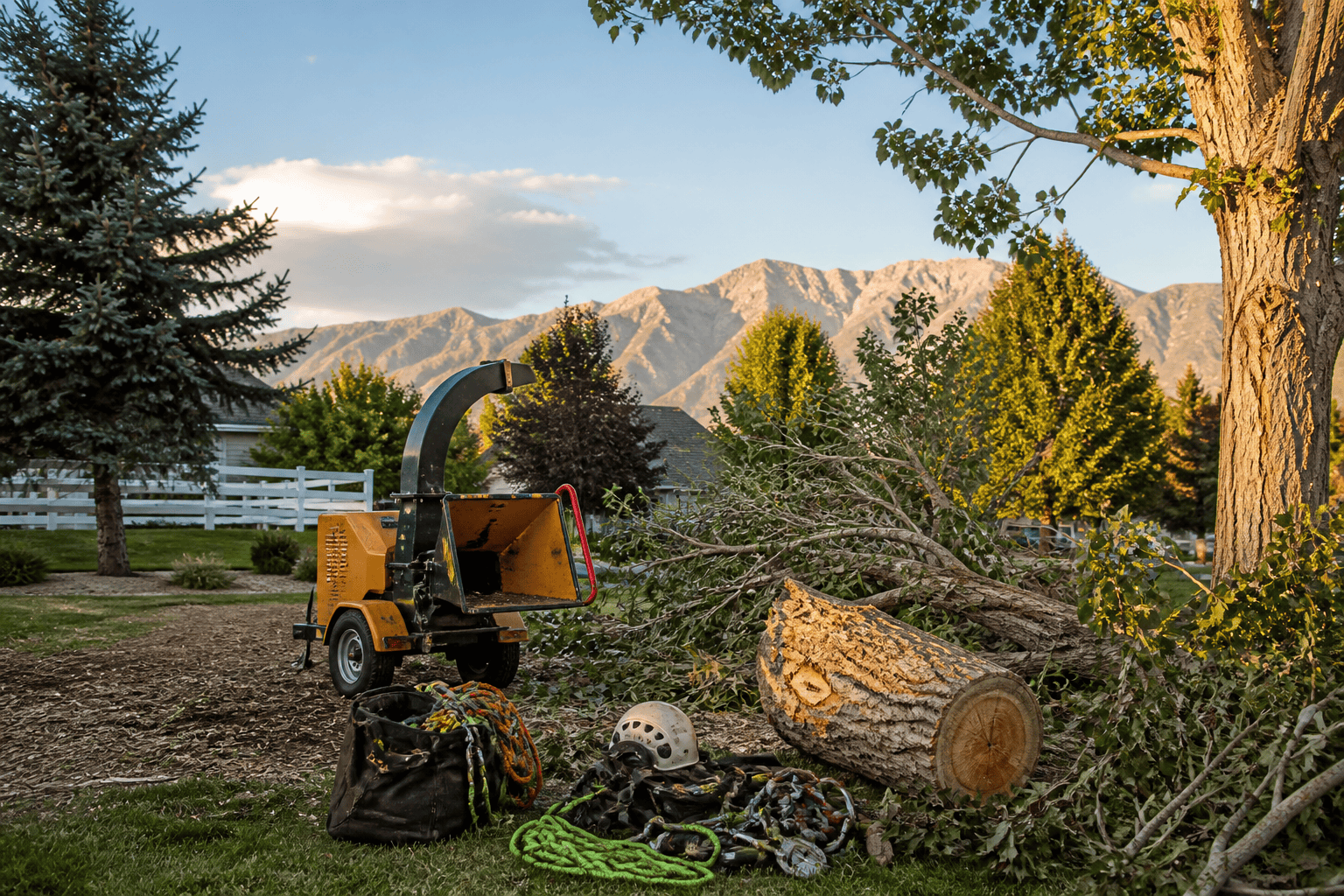
Tree work in Lehi does not have a slow season anymore. Spring snow snaps limbs across the older neighborhoods off Lehi Main. Canyon wind comes down off the Wasatch and drops cottonwoods along the Jordan River. Traverse Mountain homeowners want defensible space thinned before fire season, and builders around Thanksgiving Point need mature trees down before the next foundation goes in. The Silicon Slopes campuses along Pioneer Crossing keep a pruning calendar all year. Every one of those customers asks for the same thing before your climber leaves the ground: a certificate of insurance that matches the work you actually do. This guide walks through what a Lehi tree crew’s insurance file should contain, how Utah licensing applies to tree work, and the local habits that keep small jobs from turning into claims.
The Four Policies Every Lehi Tree Crew Needs
A tree service file is built on four policies, and each one answers a different kind of bad day. The mistake we see most often in Utah County is a crew carrying one or two of them and assuming the gaps are covered somewhere.
- General liability pays when your work damages someone else’s property or hurts someone who is not on your payroll. A limb through a neighbor’s roof on Traverse Mountain, a dropped top that crushes a fence, a customer’s car under a section that swung wrong. Those are general liability claims. It also carries the certificate everyone asks for.
- Workers compensation pays for injuries to your own crew. Utah requires it as soon as you have employees, and tree work is one of the trades where the Labor Commission and your carrier both pay close attention to whether you have it. A climber’s fall or a ground worker’s chainsaw injury is not a general liability claim. Without workers compensation, that medical bill and lost wage claim lands on the business.
- Commercial auto covers the chipper truck, the bucket truck, and the pickup pulling a stump grinder up Timpanogos Highway. A personal auto policy will not respond to a business-titled truck with a chipper hitched behind it, and many of them exclude the vehicle entirely once it is used for tree work.
- Inland marine covers your equipment wherever it goes. Chippers, stump grinders, saws, rigging, climbing gear, and a rented crane’s rigging attachments all belong on an equipment schedule. The truck itself sits on commercial auto, but the chipper towed behind it and the tools in the bed sit here.
For a deeper look at how each policy responds to a real claim, read our tree service insurance guide. If part of your revenue is mowing, irrigation, or planting, that side of the business has its own rating rules and belongs on Lehi landscaping contractor insurance.
Where Tree Crews Get Underinsured Without Knowing It
Most tree service coverage problems are not about the limit on the certificate. They come from how the policy was written in the first place.
Your class code has to say tree work. General liability rates tree pruning and removal under its own classification, and it prices very differently from landscaping or lawn care. A policy written under a landscaping code because it quoted cheaper will still pay many claims, but you will face a large audit bill, and some carriers will not renew once they see the actual work. If your policy says landscaping and your crew is topping trees in Thanksgiving Point, ask your agent to fix the rating now rather than after a claim.
Answer the height question honestly. Carriers ask how high your crew works, whether you climb or use a bucket, and whether you ever work near energized lines. Those answers shape the policy. If you tell a carrier your crew stays under 30 feet and a claim comes from a 70-foot cottonwood removal, you have handed the adjuster a reason to look harder at everything.
Line clearance is a different job. Trimming near Rocky Mountain Power lines is utility line-clearance work, and most standard tree service policies exclude it. Keep at least 10 feet from energized lines unless you are trained and insured for that specific work, and refer the customer to the utility when a tree has grown into the primary.
Subcontracted climbers need their own certificates. If you bring in a climber for a big removal and they carry no insurance, your policy is paying for their mistakes and your workers compensation audit will charge you for their payroll. Collect certificates before the job, not after.
Rented cranes need coverage too. Crane-assisted removals are common on the tight lots around Lehi Main and on the steep lots up Traverse Mountain. Ask your agent about hired equipment coverage and confirm who insures the crane, the operator, and the load before the truck arrives.
Property managers want more than a certificate. The campuses along Pioneer Crossing and the HOA boards on Traverse Mountain usually require additional insured status, a waiver of subrogation, and primary and noncontributory wording. Those are endorsements, and they need to be on the policy before the certificate promises them.
Utah Licensing Notes for Tree Work
Utah is unusually clear about tree work. The state’s contractor licensing rules list tree stump or tree removal among the activities that do not require a contractor license. That means no exam, no experience requirement, and no state license number for removal, pruning, or grinding. You can verify the current rule and any changes at the Utah Division of Professional Licensing.
A few related requirements still apply, and they trip up crews that assume “no license” means “no rules.”
- Lehi City business license. You need one to operate in the city, and Lehi treats trees in park strips and the public right-of-way as city property. Removing or heavily pruning a street tree usually needs city sign-off first. Check with Lehi City before you touch anything between the sidewalk and the curb.
- Planting and landscape installation need an S330. Utah’s S330 Landscape and Recreation Contractor classification covers grading, planting, and installing landscape. If your crew removes a tree and plants the replacement on the same ticket, the planting half can fall under contractor licensing. We cover that conversation in the landscaping pages linked above.
- Licensed contractors carry a general liability floor. If you hold an S330 or any other Utah contractor license, the state currently expects general liability at around $1 million per occurrence and $2 million aggregate. Treat that as a floor, not a target. Many application forms and web pages still print the older minimums, so do not let a stale form talk your limits down. Tree crews with no license face no statutory minimum, but the property managers and builders in Lehi will ask for the same $1 million and $2 million anyway.
- Spraying requires a pesticide applicator license. If you treat for aphids, scale, or borers as part of your service, the Utah Department of Agriculture and Food licenses commercial pesticide applicators. That work also needs to be disclosed to your general liability carrier, because chemical application is often excluded unless it is rated in.
- Call Blue Stakes before you grind. Utah law requires notice to Blue Stakes of Utah 811 two business days before excavation, and stump grinding around the newer subdivisions near Thanksgiving Point regularly runs into shallow gas, fiber, and irrigation lines. A cut fiber line on a Silicon Slopes campus is an expensive claim that a free phone call prevents.
- Workers compensation applies at your first hire. Utah does not give tree services a small-employer exemption. Owners can exclude themselves in some structures, but every employee on the crew has to be covered.
How the Work Differs Across Lehi
Lehi is really four different tree markets, and each one shapes the claim you are most likely to see.
Traverse Mountain is steep, windy, and sits against the wildland interface. Defensible-space thinning is steady work, and the HOAs there manage common areas with their own certificate requirements. Slopes make rigging and drop zones harder, and a rolling log that reaches a neighbor’s deck below is a general liability claim. Wind off the mountain also means storm calls at odd hours, when crews are tired and shortcuts get taken.
Thanksgiving Point and the established lots around it have the biggest mature trees in the city. Builders and homeowners there sell full removals, often crane-assisted, on lots where the neighbor’s roof is close. This is where crane coverage, drop-zone photos, and a clear scope in writing earn their keep. It is also where a customer is most likely to argue that you damaged sprinklers, pavers, or lawn under the drop zone, so document conditions before the first cut.
Silicon Slopes campuses along Pioneer Crossing are property-manager work. The trees are younger, the pruning is routine, and the paperwork is heavier. Expect a vendor packet, additional insured wording, a waiver of subrogation, and sometimes an umbrella requirement above your general liability. Traffic control on Pioneer Crossing itself is a real exposure, so keep cones, signage, and a spotter in the plan.
Lehi Main and the older neighborhoods have Siberian elms and cottonwoods that were planted decades ago on small lots with power lines running through the canopy. These are smaller tickets with higher risk per hour. Line proximity, tight drop zones, and older fences and outbuildings make this the area where a routine prune turns into a claim fastest.
Habits That Keep Claims Small
Insurance pays for the bad day. A few habits keep the bad days rare and make the claims that do happen easy to close.
- Photograph the drop zone, the neighbor’s roof line, and the customer’s hardscape before you start. Time-stamped photos end most damage disputes in one email.
- Write the scope down, including the height of the cut and what happens to the wood. A canopy-shape argument is usually a job cost you absorb. A limb on the next roof is a claim. Keep the two separate on paper.
- Call Blue Stakes before any grinding, even on a lot the customer swears is clear.
- Keep your crew’s training current on ANSI Z133, the tree care safety standard, and keep the records. Utah’s occupational safety division uses those standards when it inspects after an injury.
- Collect certificates from every subcontracted climber and crane operator before the job, and hand your own certificate over before the customer asks for it.
- Review your limits every renewal and only ever move them up. There is no risk in carrying more coverage than a job requires. There is real risk in carrying less.
Get a Lehi Tree Service Quote
Western Pacific Insurance writes tree service insurance for Utah County crews and builds the file around the work you actually take, whether that is defensible-space thinning on Traverse Mountain or crane removals near Thanksgiving Point. Tell us how high you climb, what you tow, and who you work for, and we will quote the four policies as one file with the endorsements your customers ask for. Start with a Utah quote request and we will take it from there.


