
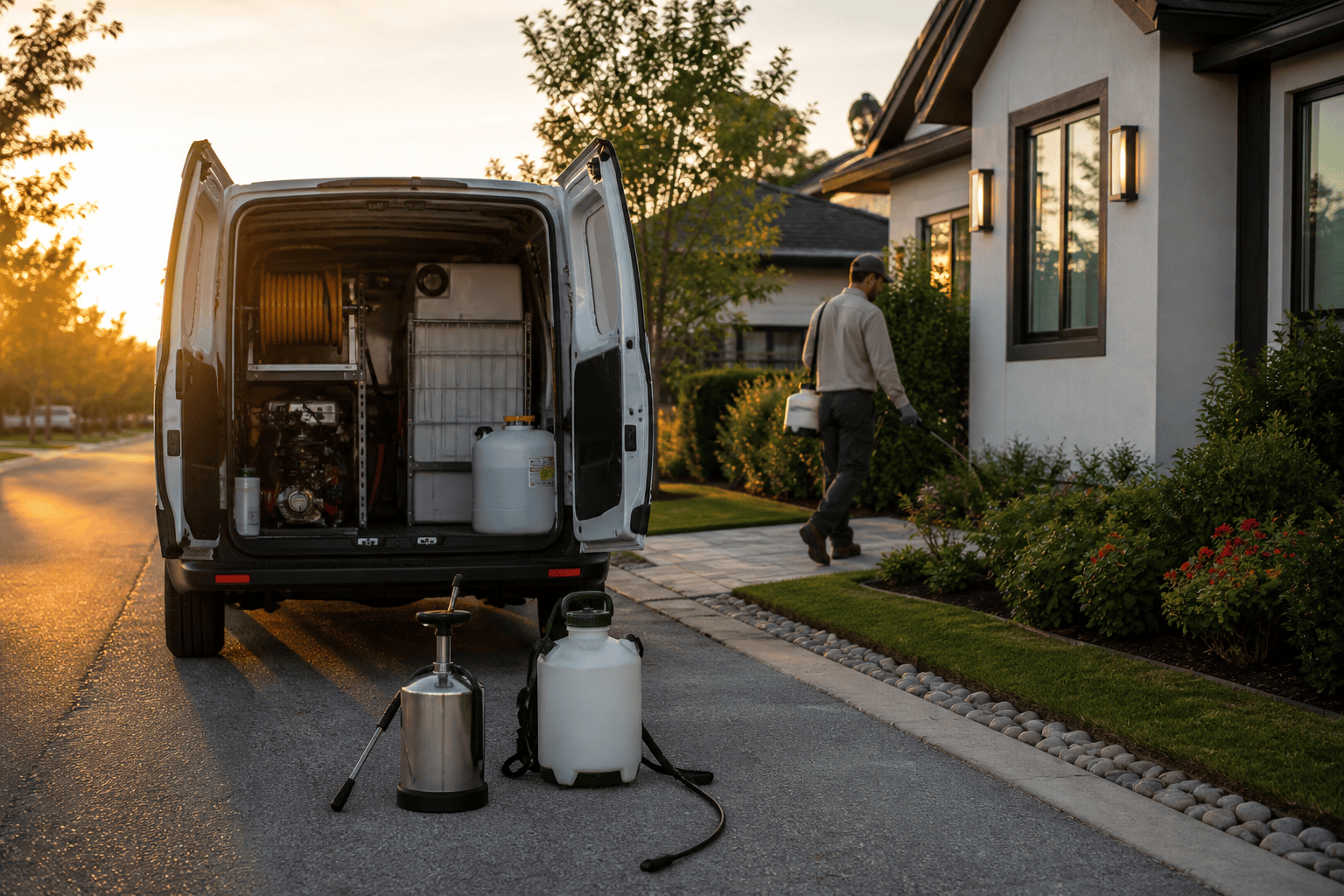
A monthly residential route in Henderson, a termite job in Phoenix, and a bed bug heat treatment in a San Diego apartment can all run out of the same van. They cannot run on the same assumptions about coverage. Pest control insurance is the program built for licensed exterminators and structural pest companies that treat insects, rodents, and wood-destroying organisms on other people’s property. Done right, it covers the general liability everyone asks about, the service vans, the equipment in the back, your technicians, and the pesticide pollution exposure that a standard contractor policy quietly excludes.
This guide is for the operator who holds the pest credential and signs the invoice. It is not a guide to landscaping contractor insurance, which is the file for mowing, fertilizing, and weed spray on turf. The two get confused constantly, and the confusion costs people at claim time. If you want the generic contractor stack that applies to every trade first, start with contractor insurance explained. Western Pacific Insurance is an independent agency in Henderson, licensed in Nevada, California, Arizona, and Utah, and we place pest accounts across all four states.
Who This Guide Is For
If your company holds a state pest control or pesticide business license and treats pests for hire, you belong here. That includes residential routes, commercial accounts in restaurants, warehouses, apartments, and offices, termite and wood-destroying organism work, bed bug programs, rodent control, and wildlife exclusion when your credential actually covers it. The test is simple: what does the invoice say? If it says pest control, structural pest, fumigation, or a related licensed category, this is your file.
A crew that sprays herbicide on lawns and trims shrubs is running a landscaping business, even if the same person also holds a pesticide card. That work gets rated, licensed, and insured differently. Plenty of shops run both a lawn division and a pest division, and those shops need both conversations. What they do not need is a landscaping policy pretending to cover a termite bond or a tent fumigation.
Whether you run one truck or twelve routes, the structure of the program is the same. What changes is payroll, fleet size, the products you carry, and whether you issue inspection reports. Tell your agent exactly which license categories you hold before the first certificate goes out, because the categories drive everything that follows.
What Does Pest Control Insurance Actually Include?
Most licensed pest operations run on five core policies, with two more that come into play as the book grows. Here is what each one does and, just as important, what it does not do.
General liability
General liability is the foundation. It responds when your operations injure someone who is not on your payroll or damage property that is not yours. A customer slips on a wet floor after a kitchen treatment. A technician knocks over a display in a retail store. A misapplied product stains hardwood in a home you were not hired to treat. Those are general liability claims. Our general liability insurance page covers the product itself in more depth.
Three things about a standard general liability form matter enormously in this trade, and we cover each one below: the pollution exclusion, the care, custody, or control exclusion, and the completed operations grant. A pest policy that ignores any of the three is a pest policy in name only.
Pesticide pollution liability
Standard general liability forms exclude pollution, and most carriers treat pesticides, herbicides, and fumigants as pollutants. Read that twice. The core activity of your business can fall outside a basic general liability policy unless something puts it back in. That fix is either an endorsement or a separate pollution policy, and the difference between the two is the most important decision on the account. We give it its own section below.
Commercial auto
The service van, the trailer that hauls heat equipment, and any personal vehicle a technician uses to grab supplies all belong on commercial auto. A personal auto policy will not respond well once the carrier sees a business vehicle with a logo and a chemical cabinet in the back. Our business auto insurance page explains the policy, and Henderson crews can start on Henderson commercial auto insurance.
Workers compensation
Workers compensation covers your own people: the technician who gets a chemical exposure, falls off a ladder in an attic, or takes a dog bite on a residential route. Every state we serve requires it once you have employees, and pest work sits in a class that carriers watch closely. Our workers compensation insurance page covers the employee side of the program.
Inland marine
Sprayers, backpack units, foggers, heat trailers, generators, bait stations, monitors, and inspection tools travel with the crew, which means the shop’s property policy does not follow them. Inland marine, usually written as a contractors equipment or tools floater, covers that gear on the truck, on the job, and in the customer’s garage overnight. A stolen heat generator is an inland marine claim, not a general liability story.
Commercial property or a business owners policy
The shop, the chemical storage room, the inventory of concentrate and bait, and the tools that never leave the building need a property form. A business owners policy can bundle general liability with property for a smaller operation. Larger shops usually split the two. Our commercial property insurance page is the service file for the building. Name the chemical storage on the application so the inventory is actually insured.
Commercial umbrella
An umbrella stacks additional limits above general liability, commercial auto, and employers liability. Property management groups, national restaurant chains, and school districts increasingly ask for it. One caution that matters here: many umbrellas carry their own pollution exclusion and will not automatically sit above a pesticide endorsement. Ask whether the umbrella follows the pollution coverage on the underlying policy before you count on it.
Which Policy Pays Which Claim?
Coverage gets clearer when you map real losses to the policy that responds. These are the claims we see most often in this trade.
| The claim | The policy that responds |
|---|---|
| Customer slips on a wet treatment path inside a restaurant kitchen | General liability |
| Technician is hurt by exposure, a ladder fall, or a dog bite on route | Workers compensation |
| Service van rear-ends a car between stops | Commercial auto |
| Sprayer, heat unit, or generator stolen from the van overnight | Inland marine (tools and equipment floater) |
| Finish or structural damage shows up weeks after a treatment | Completed operations under general liability, if the grant is intact and the damage is to other property |
| Pests come back and the customer wants a free redo | Usually a warranty or contract cost, not an insurance claim |
| Chemical drift, a spill in transit, or residue in indoor air reaches a neighbor or a tenant | Pollution liability or a pesticide applicator endorsement, depending on how the loss happened |
| Missed infestation on a wood-destroying organism inspection report used in a home sale | Errors and omissions or inspection-report coverage, not bare general liability |
| Stored concentrate burns in the shop after hours | Commercial property or business owners policy |
| Damage to the specific item or surface you were treating | Often excluded under care, custody, or control unless the policy is endorsed for it |
Four rows in that table carry real weight in practice: retreatment, pollution, inspection reports, and damage to the thing being treated. Each one is a place where a cheap policy looks fine on a certificate and fails at the claim.
Pesticide Pollution and Chemical Drift: The Coverage That Decides the Account
Competitors will tell you that you might need pollution coverage. They usually skip the part that decides whether a claim gets paid. There are two very different ways to solve the pollution exclusion, and they do not cover the same losses.
The pesticide or herbicide applicator endorsement
Most standard carriers offer an endorsement, commonly ISO’s Pesticide or Herbicide Applicator Coverage (CG 22 64) or a carrier’s own version, that removes the pollution exclusion for your application work. The catch is the condition. Coverage typically applies only when the application met the label, the applicable license, and the relevant statutes and regulations. Off-label use, an applicator working outside a category, or a treatment that violated a local rule can turn a paid claim into a coverage fight. The endorsement is a good tool for a clean, well-run route operation, and it is far better than nothing. It is not a substitute for a real pollution policy when your exposure is broad.
Contractors pollution liability
A standalone contractors pollution liability policy is written for the losses the endorsement leaves out: a concentrate spill in the van during transit, product that migrates into a storm drain, residue that lingers in a multi-unit building’s indoor air, cleanup costs, and third-party claims that arrive long after the job. It usually costs more and it requires a real application, but it is the form built for a company whose entire business is applying regulated chemicals to occupied structures.
Two state-level details show how seriously regulators take this split. Nevada’s Department of Agriculture uses its own certificate of insurance form for pest licensees, and that form asks the insurer directly whether the policy’s pollution exclusion applies to chemical drift damage to property other than the property being treated. If the answer is yes, the department will not accept the policy. Arizona’s proof of financial security form requires a pesticide and herbicide endorsement, plus a pollution transit endorsement where it applies, for the categories on your license. In both states, the licensing agency is checking the very wording most cheap policies get wrong.
Tell your agent which products you mix, whether you fumigate, how you haul and store concentrate, and how much of your work is inside occupied units. A lawn herbicide book still belongs on landscaping contractor insurance. Structural and health-related pesticide work belongs on this program, and you should not assume a landscaping chemical endorsement prices a bed bug heat trailer or a tent fumigation.
Care, Custody, or Control: The Property You Are Treating
Standard general liability excludes damage to property in your care, custody, or control, and it excludes damage to the specific part of property you are working on. In this trade, that can mean the very surfaces, furnishings, and structures you were hired to treat. A foam application that swells inside a wall, a heat treatment that warps laminate, or a bait placement that ruins a finish can all land in that exclusion.
Nevada’s licensing certificate is instructive here as well. It asks the insurer to confirm the policy covers damage to persons or property, including the property being treated, from chemicals, chemical drift, and equipment. Not every carrier will give that grant, and the ones that do often add it by endorsement with a sublimit. Ask for it in writing before you assume it is there.
Termite and Wood-Destroying Organism Work
Termite inspections, baiting, and liquid treatments sit in a different license category from a general cockroach route in every state we serve. California puts wood-destroying organisms on Branch 3. Nevada places wood-destroying pests in the structural category. Arizona treats wood-destroying organism management as its own applicator category and adds extra financial requirements once you treat termites or issue inspection reports. Utah wants the commercial pesticide category that matches the invoice.
The insurance problem with termite work is not the treatment. It is the report. When you sign a wood-destroying organism inspection report that a buyer, lender, or escrow relies on, a missed infestation looks like a professional mistake rather than a premises accident. That is an errors and omissions exposure, and general liability generally will not respond to it. Arizona makes this explicit: a business licensed in the wood-destroying insect inspection category that issues inspection reports must carry inspection-report errors and omissions coverage on its financial security filing, and a business that performs termite treatments must carry coverage for termite damage due to negligent treatment. Both are separate line items on the state form. Tell your agent if you write reports for real estate transactions, and never bid subterranean termite work on a general pest-only card.
Fumigation
Whole-structure fumigation with lethal gas is the highest-hazard work in this trade, and it is licensed separately everywhere: Branch 1 in California, a dedicated fumigation category in Arizona, Nevada, and Utah. Many standard carriers will not write it at all, which pushes fumigation accounts into specialty or surplus lines markets with their own forms and conditions. If you tent, tell your agent up front. A policy that quietly excludes fumigation while you run tarps on the weekend is a policy you are paying for and not using.
Bed Bug Programs
Bed bug work mixes chemical applications with heat, and heat changes the exposure. Heat trailers, temporary power, occupied apartments, and a scorched mattress or a tripped fire alarm are not the same claim as a bottle spill in a garage. Carriers price multi-unit heat programs differently from a one-bedroom chemical treatment. Tell your agent how often you run heat versus chemical-only jobs, and keep the heat equipment on inland marine so a stolen generator does not become a fight over which policy responds.
Rodent Control and Exclusion
Rodent work looks simple until bait stations sit inside a food facility or a trapping program runs in an occupied unit. Exclusion work that opens walls, seals foundations, or replaces vent screens can look like handyman remodeling to a carrier that thought you only placed bait. Photograph the areas you open. Tell your agent if you subcontract carpentry for exclusion, because a subcontractor without their own insurance becomes your exposure and your audit surprise. Keep the pest invoice on this program and route the construction invoices to the right file.
Wildlife Removal
Bats, birds, raccoons, and snakes generate calls for many pest shops, and some of that work requires wildlife or game credentials that sit outside the pesticide license entirely. A structural pest license does not automatically authorize every live-animal removal, and a pest policy does not automatically cover it either. Tell your agent which species you handle, whether you relocate animals, and whether you do attic cleanout and restoration afterward. Tree trimming and arborist work stay off this page altogether; that is a separate trade with its own file.
The Service Van and the Chemicals Inside It
The van that carries product is not a technician’s personal car with a magnet on the door. Commercial auto covers the route vehicles, the trailers, and hired or non-owned use when someone grabs supplies in a personal vehicle. Underwriters care about spill kits, locked chemical cabinets, secured containers, and where the trucks park overnight almost as much as they care about the vehicle schedule. A spill inside the van during a crash is usually a commercial auto question; product that migrates from that spill into a drainage system may be a pollution question. Good pollution coverage anticipates that overlap. Keep the van schedule and the client site on the right applications so each class stays honest.
Why Completed Operations Still Matters
Damage that shows up weeks after you leave is a completed operations question. A standard general liability policy is built to respond to injury or damage that occurs during the policy period, including damage that appears after the job is done, as long as the products-completed operations grant is intact. Some inexpensive pest policies restrict or remove that grant, or share its aggregate with the rest of the policy. Ask where completed operations lives before you bind, and ask whether the aggregate stands on its own.
Be clear-eyed about what is a claim and what is a callback. A failed treatment that only costs you another visit is a warranty cost, and most operators build it into pricing. Finish damage in a neighboring suite from drift or overspray is a property damage claim, and even then the pollution wording decides it. Photograph treated areas and adjacent finishes when the work is close quarters, and write invoices that match the license category and the policy class.
How Licensing Works in Nevada, California, Arizona, and Utah
Each of the four states we serve puts for-hire pest work under an agriculture department or a structural pest board, not a general contractor board. Categories split general pest, wood-destroying organisms, fumigation, and ornamental turf, and every one of those agencies ties license status to proof of insurance or financial security in some form. This table is the short version, and rules change, so confirm the current requirement with the agency before you rely on any figure.
| State | Licensing agency and credential | Category splits to watch | Insurance or financial security rule |
|---|---|---|---|
| Nevada | Nevada Department of Agriculture pest control business license under NRS and NAC Chapter 555, with a primary principal licensed in the categories the business runs | Urban, rural, and structural field includes industrial and institutional, structural (wood-destroying pests), fumigation, limited landscape, weeds, and aquatic subcategories; a general pest category is not a termite or fumigation credential | Statute requires proof of public liability and property damage insurance of not less than $50,000 for ground applicators, and the department’s certificate form shows per-occurrence and aggregate minimums that are license floors, not typical certificate numbers; the policy must cover chemicals, chemical drift, equipment, property being treated, and wood-destroying pest inspections where applicable; a pollution exclusion that reaches chemical drift to other property makes the policy unacceptable; the license suspends automatically if the insurance cancels |
| California | Structural Pest Control Board company registration; Operator, Field Representative, and Applicator licenses in Branch 1 (fumigation), Branch 2 (general pest), and Branch 3 (wood-destroying organisms) | Branch 1 covers fumigation with lethal gas; Branch 2 covers household pests without that fumigation; Branch 3 covers wood-destroying pests, including structural repairs, without that fumigation; lawn and ornamental herbicide work without structural pests generally falls under the Department of Pesticide Regulation instead | The Structural Pest Control Act requires registered companies to maintain at least $500,000 in general liability insurance on the board’s certificate form, a $12,500 surety bond, and a workers compensation certificate or a filed exemption |
| Arizona | Arizona Department of Agriculture, Pest Management Division business license with a registered qualifying party; applicator categories include industrial and institutional, wood-destroying organism management, wood-destroying insect inspection, ornamental and turf, right-of-way, aquatic, and fumigation | Financial security only has to cover the operations you actually run, so the categories you check on the form matter; termite treatments and inspection reports trigger separate requirements; ornamental and turf is not a structural credential | A.R.S. 3-3615 requires at least $500,000 of financial security, maintained at all times, with automatic suspension if it drops below that amount; the department’s form caps the deductible at one percent of the security and requires endorsements for pesticides and herbicides, fumigation, care, custody, and control, rights-of-way, inspection-report errors and omissions, wood-destroying organism management, and pollution transit for the applicable categories, plus minimum termite negligent-treatment and inspection-report E&O coverage when you perform that work |
| Utah | Utah Department of Agriculture and Food commercial pesticide applicator license for each person applying product, plus a commercial pesticide business license with a qualifying party who is an employee of the business | Business license and applicator categories have to match the invoice; the business name and license number must appear on proposals, service records, and service vehicles and trailers; a limited turf spot-treatment pattern exists for some herbicide-only books, and that book still belongs on landscaping insurance | UDAF licensing is separate from the Division of Professional Licensing contractor license and does not inherit that board’s contractor insurance floor; we found no statutory general liability dollar minimum on the primary UDAF business-license rules we reviewed, which is why property managers and commercial accounts, not the state, usually set the number, and they commonly ask for at least $1 million per occurrence and $2 million aggregate |
Watch the labels. A Nevada industrial and institutional category is not a termite inspection credential. California Branch 2 is not a Branch 3 termite card. Arizona ornamental and turf is not a substitute for wood-destroying organism management. Utah’s pesticide business license is not a contractor license. The wrong category is a licensing problem and a rating problem at the same time, and neither one is a void you can paper over with a certificate. Tell your agent which card you hold and which work you actually bid.
What Property Managers and Commercial Accounts Require
A certificate of insurance is evidence of coverage, not coverage itself. Most property managers, restaurant groups, HOAs, and commercial accounts want at least $1 million per occurrence and $2 million aggregate as a floor, and there is no downside to carrying more if the price makes sense. They also want to be named as additional insured, often with a waiver of subrogation and primary and noncontributory wording. The endorsements have to actually exist on the policy. A certificate promising wording the policy does not contain is a problem waiting for a claim.
Ongoing operations coverage for additional insureds commonly uses CG 20 10, and completed operations for additional insureds commonly uses CG 20 37. Some contracts also ask for CG 25 03, the per-project aggregate. We review the contract language and place the endorsements the job actually requires, then issue certificates that say only what the policy says.
Local crews can start with the city pages under this guide: Henderson pest control insurance, Phoenix pest control insurance, San Diego pest control insurance, and Lehi pest control insurance.
What Drives the Cost of Pest Control Insurance?
We will not publish a monthly teaser number, because the range in this trade is too wide for one to mean anything. Price follows the license categories, payroll, fleet size, the products you carry, and the kind of buildings you work in. A solo residential route prices very differently from a shop that writes termite reports, runs heat trailers in multi-unit housing, and services commercial kitchens. What moves the bill most:
- Fumigation, which often pushes the account into a specialty market
- Termite treatments and inspection reports, which add E&O and negligent-treatment exposure
- Choosing a full pollution policy over a pesticide endorsement
- Number of vehicles, driver records, and how concentrate is stored in transit
- Payroll and workers compensation class, including helpers and part-time technicians
- Work inside food facilities, healthcare, schools, and multi-unit housing
- Claims history and years in business
- Limits and endorsements your commercial contracts require
The general liability premium alone is rarely the surprise. Pollution, auto, the shop, workers compensation, and inspection-report wording are the lines that change the total. Shop the language and the classification, not just the number.
Seven Questions to Ask Before You Bind
- Which license categories did the carrier rate: general pest, wood-destroying organisms, fumigation, wildlife, or a mix?
- How does the policy handle pesticide drift, spills, and residue that standard forms call pollution, and is it an endorsement with conditions or a standalone pollution policy?
- Does the policy cover damage to the property being treated, or does the care, custody, or control exclusion apply in full?
- If you issue wood-destroying organism inspection reports, does the file show errors and omissions coverage for them?
- Does completed operations stay on after you leave the site, and does it have its own aggregate?
- Are the service vans and trailers scheduled on commercial auto, including hired and non-owned use, and does the umbrella sit over both auto and the pollution coverage?
- Can the carrier issue the additional insured, waiver, and primary and noncontributory endorsements your commercial accounts actually ask for?
“I Only Run Residential Routes, So Why Carry All of This?”
We hear this constantly, and it deserves a straight answer. One drift complaint from a neighbor with a koi pond, one technician who falls through an attic ceiling, or one van accident with a chemical cabinet in the back is enough to generate a real claim, and none of those cares whether the customer was a homeowner or a hotel. Beyond the raw exposure, insurance is a sales tool in this trade. HOAs, property managers, and many homeowners require a certificate before you start. In Nevada and Arizona, the licensing agency will not keep a business license active without the insurance or financial security the statute names. In California, the board will not issue company registration without the liability evidence, bond, and workers compensation filing the Act requires. A solo operator needs less coverage than a ten-truck shop, not none.
Frequently Asked Questions
Does general liability cover pesticide drift?
Often not by itself. Most standard forms treat pesticides as pollutants. A pesticide or herbicide applicator endorsement can restore coverage for compliant applications, and a standalone pollution policy goes further to cover spills, transit, residue, and cleanup. Off-label use and misapplication can still create coverage disputes even with an endorsement in place.
Do I need workers compensation if I work alone?
Nevada, Arizona, and Utah generally require it once you have employees. A true solo operator may still need exemption or waiver paperwork depending on the state and the entity type. California pest companies must file a workers compensation certificate or an exemption the Structural Pest Control Board accepts as a condition of company registration. Confirm the current rule for your situation rather than assuming none applies.
Does a landscaping policy cover structural pest work?
Usually no. Mowing, fertilization, and weed spray belong on landscaping contractor insurance. Structural pest, fumigation, and wood-destroying organism work belong on a pest control program. Bid and insure the category that matches the invoice.
Does the policy cover the surfaces I am treating?
Not automatically. The care, custody, or control exclusion in a standard general liability form can remove damage to the property you are working on. Some carriers add it back by endorsement, sometimes with a sublimit, and Nevada’s licensing form asks for it specifically. Ask for the grant in writing.
Is a homeowners policy enough for a home-based pest operator?
No. Homeowners policies exclude business activity, and paid pest work on someone else’s property will not find coverage there. The van between stops also sits outside personal auto once the carrier sees business use.
Can I get coverage with a prior claim?
Almost always, though the market and the price may change. An independent agency can move a risk between standard carriers and specialty markets until the fit and the cost both work.
How is pest control insurance different from landscaping contractor insurance?
Landscaping insurance covers the outdoor maintenance book: mowing, fertilization, weed control, and hardscape on a landscaping credential. Pest control insurance covers the licensed exterminator book: structural and health-related pests, wood-destroying organisms, fumigation when authorized, the service van, the equipment, and pesticide pollution. Shops that run both divisions need both programs, and the two should be written to line up rather than overlap.
Ready to Compare Options?
Pest work rewards a clean license category and honest chemical wording. Western Pacific Insurance shops your operation across a broad carrier lineup and matches the policy language to the routes you actually run, pairing general liability with the pollution, auto, equipment, shop, workers compensation, and certificate wording this trade demands. If a residential route is growing into termite reports or multi-unit heat work, we will say so before the certificate goes out. Request a quote and tell us about the pests you treat, because we help businesses with their insurance needs all the time. Operators in each state can also start on our Nevada, California, Arizona, and Utah insurance pages.
For the regulatory side, the U.S. Environmental Protection Agency’s safe pest control overview covers the public-facing rules underwriters expect you to follow, and the primary licensing sources are the California Structural Pest Control Board’s company registration requirements, Arizona Revised Statutes 3-3615, Nevada Revised Statutes 555.330, and Utah’s R68-7 pesticide business rules.


