
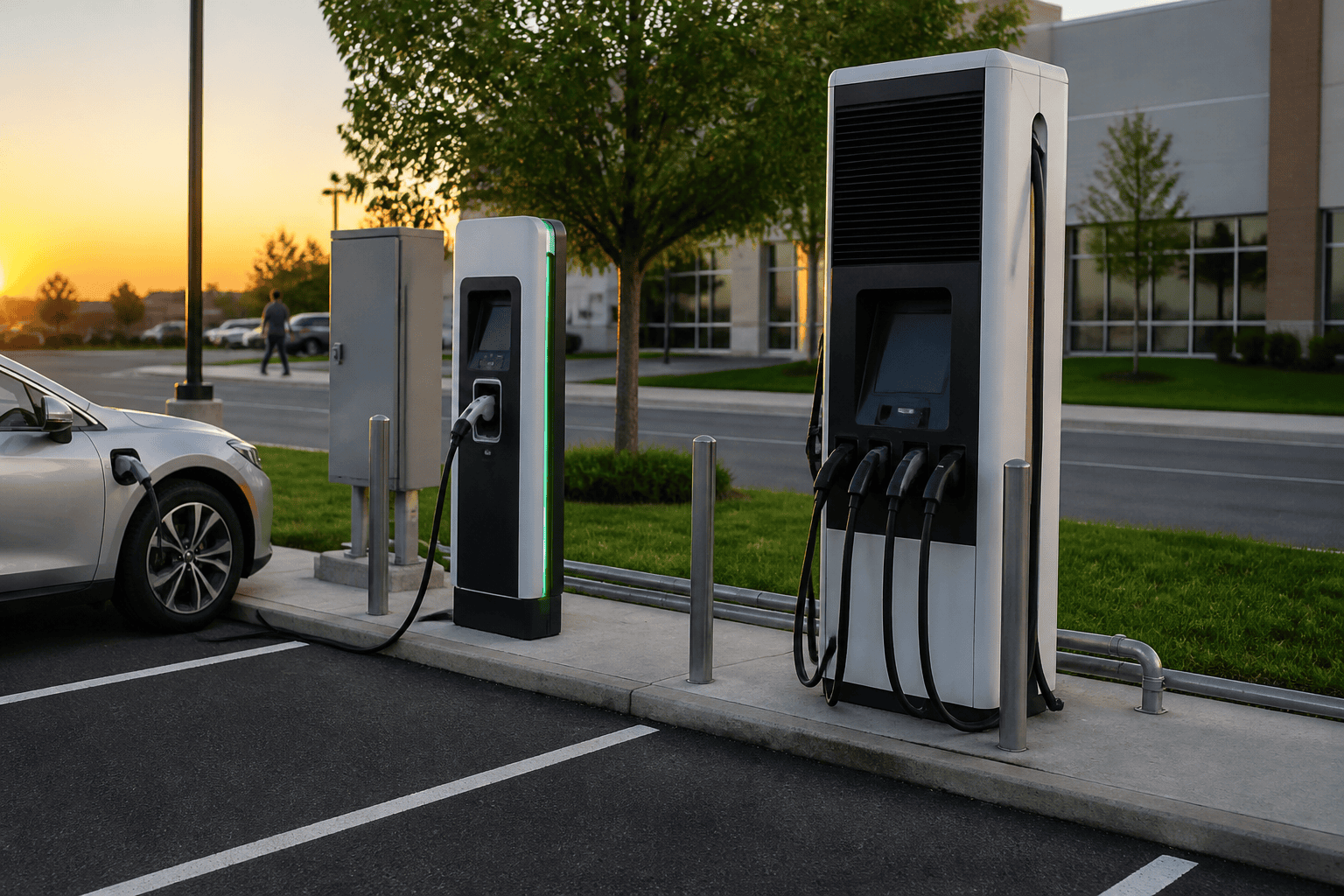
EV Charging Contractor Insurance: Level 2 and DC Fast Installs
The same electrician can hang a Level 2 wallbox in a garage on Monday and set a DC fast cabinet in a parking lot on Thursday. To an underwriter, those are two very different jobs, and a policy priced for one may not fit the other. EV charging contractor insurance is the program built for crews who install EVSE, short for electric vehicle supply equipment, on property that belongs to someone else. It grows out of electrical contractor insurance, which covers the full trade. Charger work adds exposures that a general electrical policy may never have priced.
This guide is for the installer whose name is on the charger invoice. It does not cover insuring a fleet of electric vehicles or a personal EV. We are an independent agency in Henderson, licensed in Nevada, California, Arizona, and Utah, and we place this coverage in all four states. If you want the basics that apply to every trade first, start with contractor insurance explained.
Who Needs EV Charging Contractor Insurance?
You need this coverage if you hold an electrical license and charger installs show up on your invoices. That includes residential Level 2 work in a garage, workplace and multifamily Level 2 runs, and DC fast cabinets on commercial lots. What matters is that the invoice names EVSE. A service-panel upgrade with no charger attached is ordinary electrical work, and the electrical contractor guide covers that side of your book.
A few neighboring risks belong in other conversations. If the vehicles themselves are the exposure, not the pedestal you installed, see EV fleet insurance for business. If you run the whole site and hire the other trades, see general contractor insurance. Low-voltage data work is a separate class as well, because a 240-volt wallbox and a 24-volt control loop carry very different hazards. Solar and battery storage share a license family with chargers in some states, yet carriers underwrite them separately. Tell your agent about that work too, so nothing on your invoices sits outside the policy.
What Coverage Does an EV Charger Installer Need?
Most installer programs rest on a handful of core policies. General liability is the foundation, and it responds when your work injures someone else or damages their property. Picture a tenant who trips over a temporary cable in a parking garage, or a core drill that finds a post-tension cable in the slab. Workers compensation covers your installer who is shocked, burned, or hurt in a trench or on a lift. Commercial auto covers the trucks that carry pedestals and cable between sites.
Your equipment needs its own protection. Inland marine, usually sold as a tools and equipment floater, covers your meters, torque tools, and spare EVSE wherever they travel. An installation floater covers the charger itself from your shop until the owner accepts the job. If you keep a shop, a business owners policy can bundle general liability with property coverage for the building and its contents.
Two more policies matter as you grow. A commercial umbrella adds limits above your general liability and auto policies. Property managers increasingly ask for one before a crew sets foot on a public lot. Professional liability responds when the claim is about your design decisions, such as a load calculation that overlooked the existing panel’s capacity. General liability usually treats that as a professional dispute and does not respond.
Once chargers make up most of your book, expect underwriters to ask detailed questions about the equipment. The U.S. Department of Energy’s Alternative Fuels Data Center is a solid plain-language reference for how the equipment classes differ.
Which Policy Pays Which EVSE Claim?
Coverage questions get easier when you match real claims to the policy that responds. The table below covers the losses we see most often in this trade.
| The claim | The policy that responds |
|---|---|
| A tenant trips over a temporary cable during a garage install | General liability |
| Your installer is shocked, burned, or hurt in a trench or on a lift | Workers compensation |
| A meter, torque wrench, or spare wallbox is stolen from the truck overnight | Inland marine (tools and equipment) |
| A pedestal is damaged in transit before the owner accepts the job | Installation floater |
| Your truck hits a parked car between job sites | Commercial auto |
| A fire traces back to your circuit months after you finish | Completed operations under general liability, for damage to other property |
| The wallbox you just installed fails and the owner wants it redone | Often excluded as your work or as property in your care |
| The owner says your load calculation overlooked the panel | Professional liability, or your own pocket |
| Spare chargers burn in your shop after hours | Commercial property on the shop, not general liability |
Two of those rows are less simple than a table can show. Damage to the charger you are installing often falls outside general liability. A fire that spreads to the next parking bay is a different claim entirely. Both deserve a closer look.
Why Completed Operations and the Charger Itself Still Matter
Suppose a circuit you installed in July faults in October and starts a fire. That is a completed operations claim. Standard general liability responds to injury or damage that happens during the policy period, including damage that shows up after you leave the job. Some low-priced installer policies restrict or remove that coverage, which guts the policy for a trade whose worst claims arrive months later. Before you bind, ask where completed operations appears in the policy. Ask whether it has its own aggregate limit or shares one with everything else.
Many insurance pages stop at “general liability covers property damage” and skip the detail that decides who pays for a redo. General liability typically excludes damage to the particular part of the property you are working on. It also excludes property in your care, custody, or control. The wallbox you are installing falls into both gaps.
Here is how that plays out. If a loose lug ruins the unit, replacing it is usually your cost of doing business. If that same lug starts a fire that damages the car in the next bay, the damage to the car is more likely a covered claim. That split surprises contractors more than anything else on the policy. Photograph the stall before you start, and describe the work on your invoice the way your policy classifies it.
Chargers sitting in your shop or riding on your truck raise a related question. Theft of a staged pedestal usually falls under inland marine or the installation floater, not general liability. On larger jobs, the contract may make the owner or the general contractor responsible for insuring equipment on site. Confirm who carries that coverage before the first cabinet leaves your warehouse.
Level 2 vs DC Fast: Why Underwriters Treat Them Differently
Level 2 EVSE is typically a 240-volt AC wallbox or pedestal, and it lives in residential garages, workplace lots, and multifamily carports. It looks simple, yet it is not the same as swapping a receptacle. Electrical code treats a charger as a continuous load, so a 48-amp unit needs a 60-amp circuit. That circuit often lands on a panel that was already close to full. A policy written around lighting and receptacle repairs may never have priced that exposure, which is why your application should name charger work specifically.
DC fast charging changes the conversation again. You are setting cabinets, pulling 480-volt three-phase power, trenching across active commercial lots, and coordinating with the utility. Underwriters see more severity in every one of those steps, so a Level 2 garage book and a highway-corridor DC fast book price differently. Tell your agent which kind of work you actually bid. If you do both, the application should show both, with a rough split of revenue.
Public funding adds one more layer. Under the federal NEVI standards, electricians on those projects need EVITP certification or a registered apprenticeship credential. Funding and program rules have shifted more than once, so read each solicitation closely. Expect higher insurance limits and stricter certificate wording on that work as well.
Commercial Property for the Shop
Your shop is a property exposure, and general liability does nothing for it. Spare wallboxes, DC cabinets, transformers, and cable reels add up quickly, especially when you are staging equipment for a multi-site job. A business owners policy or a standalone commercial property policy covers the building, your stock, and the tools that stay put. Summer heat in a closed Henderson warehouse and a frozen pipe in a Utah County bay are both shop claims.
Keep the boundaries straight. General liability will not rebuild your storage cage after a fire, and inland marine will not replace inventory that never left the building. List the shop address on your application, and set the contents limit high enough to include equipment staged for upcoming jobs. If you have to guess at that limit, guess high, because one big job can briefly double what sits in the building. Our commercial property insurance page explains how that coverage works.
Commercial Auto for the Installer
The truck that hauls a pedestal needs its own policy, and a personal auto policy is the wrong place for it. Commercial auto covers your vans and flatbeds as they run between the shop, the supply house, and the job. It should also include hired and non-owned auto coverage. That protects your business when an employee runs for parts in a personal vehicle and causes an accident along the way.
Our business auto insurance page covers the policy in detail, and Henderson crews can start with Henderson commercial auto insurance. The vehicles your clients charge on your pedestals are a separate matter, and the EV fleet guide covers them. If you ever handle both sides for one client, keep the installer trucks and the client fleet on separate applications. Mixing them muddies the classification on both policies and can complicate a claim.
How Do Licensing Rules Differ in Nevada, California, Arizona, and Utah?
None of the four states we serve issues a standalone “EV charger” license. Each one places charger installation within its electrical classifications, and some split residential wiring from a full electrical license. The table gives you the short version.
| State | License | What to watch | Bond and insurance rules |
|---|---|---|---|
| Nevada | C-2 electrical; C-2a electrical wiring | C-2d is low voltage and does not cover a 240-volt wallbox; C-2g is photovoltaics | Bond from $1,000 to $500,000; every license carries a monetary limit; workers comp required for employees; the board does not require general liability |
| California | C-10 Electrical | C-10 also covers storage and PV, which carriers underwrite separately | $25,000 contractor bond; no general liability mandate for a sole proprietor; an LLC must carry at least $1 million in liability coverage; a C-10 with no employees can still file an exemption; workers comp becomes universal January 1, 2028 |
| Arizona | R-11, C-11, or CR-11 Electrical | C-11 covers work under 600 volts, so tell your agent if a DC fast job goes beyond that | Bonds scale with license class and volume; a license is required at $1,000 or for any job needing a permit; the registrar does not require general liability; workers comp required with one employee |
| Utah | E200 General Electrical; E201 Residential Electrical | E200 can also reach solar, but your insurance classification still has to name charger work | Current general liability floor of around $1 million per occurrence and $2 million aggregate; workers comp or a Labor Commission waiver |
The labels are easy to confuse, and the differences matter. A Nevada C-2d low-voltage license does not cover charger installs. Arizona’s C-11 covers electrical work under 600 volts, which is not a blank check for utility-scale projects. California raised its licensing threshold from $500 to $1,000 in January 2025, and Utah raised its general liability floor in 2026. Plenty of pages still print the old California figure and Utah’s old $100,000 and $300,000 minimums. The $25,000 California bond comes from Business and Professions Code 7071.6.
Nevada’s monetary limit deserves attention before you bid. A contractor licensed at $250,000 cannot take a $900,000 multi-site DC fast package without first raising that limit. Remember that these state rules are minimums. The contracts you sign will almost always ask for more than the state does. For more detail, see our state electrical pages for Nevada, California, Arizona, and Utah.
How Much Does EV Charging Contractor Insurance Cost?
Your price follows your classification, payroll, revenue, deductible, and claims history. It does not follow a national average on a comparison site. A solo installer doing Level 2 garage work prices very differently from a shop setting DC fast cabinets across commercial lots. For that reason we do not publish a teaser monthly rate, because any number we printed would be wrong for most readers.
Compare policy language and classification before you compare price. Two quotes can look far apart simply because one quietly restricts completed operations. Keep in mind that a callback costing a few thousand dollars usually falls inside your deductible anyway. The policy exists for the large claim, which is why the wording around it matters more than a small difference in premium.
The policies around general liability often move the total more than the general liability premium does. Workers compensation, commercial auto, tools, and the shop are the lines that surprise people. Work at height, a helper on payroll, and a growing DC fast book all change the picture. Request a quote and we will price the work you actually do.
Questions to Ask Before You Bind
Walk through these with your agent before the first certificate goes out.
- Which classification did the carrier assign: Level 2, DC fast, or both?
- If you trench commercial lots or set 480-volt cabinets, does the application show it?
- What happens to coverage when a charger job adds a service upgrade or a solar tie-in?
- Does completed operations coverage continue after you leave the job, and does it have its own aggregate?
- How does the policy treat damage to the charger you just installed?
- Are your meters, torque tools, and spare EVSE covered under inland marine, and is there an installation floater for units in transit?
- Can the carrier issue the additional insured wording that property managers and general contractors actually require?
What Do General Contractors and Site Owners Require?
A certificate of insurance is evidence of coverage. It is not the coverage itself. Most general contractors, property managers, and site owners set $1 million per occurrence and $2 million aggregate as the minimum. Larger public sites often want an umbrella on top. Treat that figure as a floor. Carrying more than the contract demands costs little, while carrying less can cost you the job or leave a claim partly unpaid.
They will also ask to be named as additional insured, with a waiver of subrogation and primary and noncontributory wording. Those endorsements have to exist on the policy itself. A certificate that promises wording the policy lacks is a problem waiting for a claim. Ongoing operations usually calls for form CG 20 10, and completed operations calls for CG 20 37. Many contracts also require CG 25 03, which gives each project its own aggregate limit. Send us the contract before you sign it, and we will match the endorsements to what it actually requires.
If you work in one of our home markets, the local guides go deeper. Henderson crews can read Henderson EV charging contractor insurance, and Valley crews can read Phoenix EV charging contractor insurance. San Diego County crews have San Diego EV charging contractor insurance. Lehi and Utah County crews have Lehi EV charging contractor insurance.
Push Back: I Only Hang Level 2 Wallboxes, So Why Carry All of This?
We hear this often, and it deserves a straight answer. Residential Level 2 work feels low risk, since you are in and out of a garage in an afternoon. The exposure says otherwise. You are adding a continuous high-amperage load to a house where a family sleeps, often on a panel decades older than the charger. A single trip and fall in a shared garage can cost far more than you billed for the job. A serious injury to a helper can reach six figures.
Insurance is also a sales tool in this trade. Property managers, builders, and plenty of homeowners want a certificate before you start. Utah requires general liability just to hold an E200 or E201 license. In California, a C-10 contractor needs workers compensation the moment there is help on payroll. A solo operator’s program is simpler than a ten-person crew’s. It has fewer policies and a smaller premium, but it should never be empty.
Frequently Asked Questions
Do I need workers compensation if I work alone?
It depends on the state. Nevada, Arizona, and Utah require it once you have employees, and Utah asks for a Labor Commission waiver when you have none. In California, a solo C-10 can still file an exemption until January 1, 2028, unless the license qualifier is an RME. C-10 is not among the classes that must carry workers comp regardless of employees. Today that list is C-8 concrete, C-20 HVAC, C-22 asbestos abatement, C-39 roofing, and C-61/D-49 tree service.
Does general liability cover the charger I just installed?
Usually not. General liability typically excludes damage to the part of the property you are working on, so redoing your own installation is normally your cost. Damage your work causes to other property, such as a fire that spreads to the next bay, is a different and more likely covered claim.
Does an electrical license mean my insurance automatically covers EV charger installs?
No. The license family is electrical, but your insurance classification still has to match your invoices. A policy built around lighting and receptacle work may not have priced continuous-load EVSE. A mismatch does not automatically void your coverage. It can, however, lead to audit charges, premium adjustments, or a harder conversation at claim time. Name charger work on the application from the start.
Will my homeowners or personal auto policy cover side jobs?
No. Homeowners policies exclude business activity, so paid work on someone else’s charger finds no coverage there. Personal auto works the same way once the carrier sees business use, and hauling equipment between job sites is business use.
Can I get coverage with a prior claim?
Almost always, although the market that fits you may change. As an independent agency, we can move your account between standard carriers and specialty markets until both the coverage and the price make sense.
How is this different from electrical contractor insurance?
Electrical contractor insurance covers the full trade, including service work, lighting, panels, and commercial wiring. EV charging contractor insurance focuses on the charger exposures: the Level 2 and DC fast split, equipment in transit, the shop, and the truck. Many contractors need both conversations under one program. If chargers are only part of what you do, start with the electrical guide.
Ready to Compare Options?
Charger work rewards clear invoices and an accurate classification. We shop your operation across a broad lineup of carriers and match the policy language to the jobs you actually take. That means pairing general liability with the completed operations, tools, shop, and certificate wording this trade demands. If your Level 2 book is growing into DC fast, we will tell you what needs to change before the next certificate goes out. Request a quote and tell us about the work you do, because we help businesses with their insurance needs all the time.


