
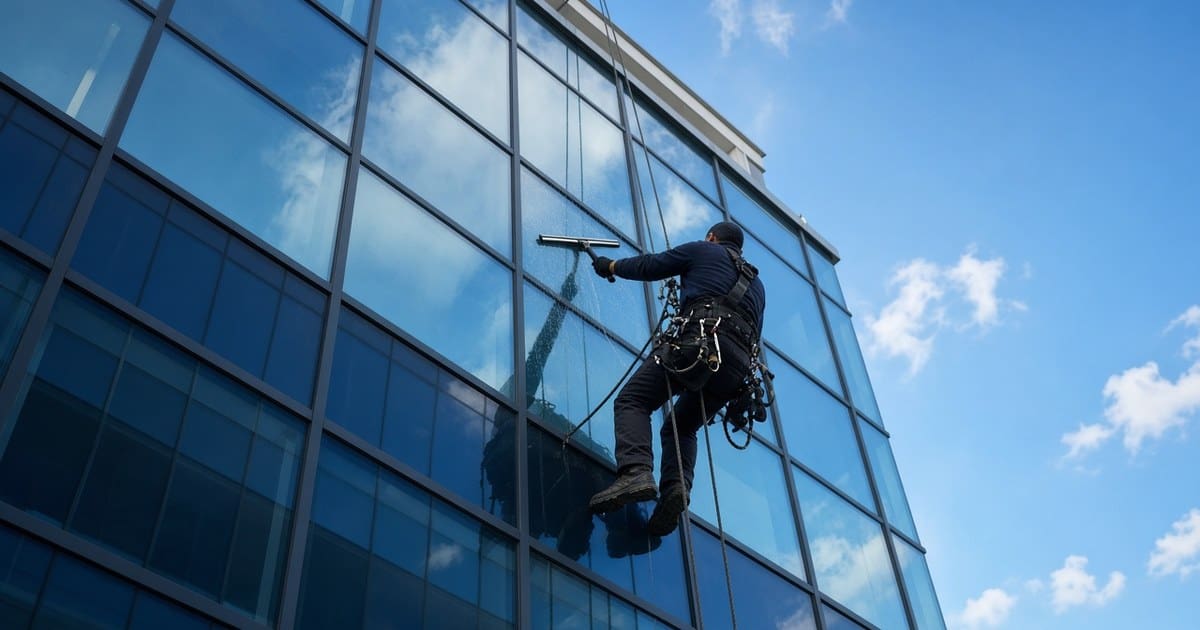
Window washing looks simple from the sidewalk: a squeegee, a bucket, a steady hand. The insurance side is less simple. A crew working storefronts with an extension pole faces a very different risk profile than a rope access team descending a twelve-story office tower, and the right policy needs to reflect that difference. This guide covers the coverages a window cleaning business typically needs, where the coverage gaps tend to show up, and what property managers usually require before letting a crew on the roof.
Why window cleaning is underwritten differently
Most of the workday is uneventful. The exposure comes from a small number of moments where height, weight, and gravity intersect: a ladder foot sliding on a wet paver, a bucket tipping off a lift platform, a worker trusting a roof anchor that someone else was supposed to inspect. Falls, falling tools, and damage to glass or finishes are the claims that come up again and again.
Because of that, an underwriter will usually ask about access method before anything else: your typical and maximum working height, the split between ground-pole work and ladder, lift, or rope access, and whether the crew does any interior cleaning. Some carriers rate or restrict high-rise and rope descent work separately, so a policy built for a residential route is not automatically the right fit once a business starts bidding towers. Describe the work accurately on the application, including the higher-risk jobs the crew only takes on occasionally.
Crews that also run pressure washing or soft-wash equipment on building exteriors should look at our pressure washing insurance guide as well, and those who have added interior janitorial routes may find our cleaning business insurance page useful.
General liability: the first policy a client asks about
General liability responds when the work injures someone outside the company or damages property that belongs to someone else: a pedestrian hit by a dropped tool, a car scratched by a leaning ladder, water pushed past a failed seal into a tenant’s office, a lobby floor chipped while moving a lift.
Two details in the policy language are worth reading closely. The first is how the policy treats the glass itself. Many general liability forms limit coverage for damage to the exact property being worked on, often referred to as care, custody, and control. Whether a scratched pane of low-E glass falls inside or outside that limitation depends on the specific form and endorsements, so it is worth asking an agent how a policy handles it before promising a client a replacement.
The second is completed operations coverage, which applies to claims that surface after the crew has left the job. A hard-water treatment later blamed for etching, or a reinstalled screen that falls out weeks later, both fall under completed operations. Photographing existing scratches, chips, and failed seals before starting any commercial job will not change what a policy excludes, but it gives a business something concrete to point to if a claim is disputed later.
Workers compensation and fall risk
Falls are the injury that keeps window cleaning owners up at night, and workers compensation is what covers medical costs and lost wages when one happens to an employee. Nevada, Arizona, California, and Utah all generally require coverage once a business has employees, though the details differ. California’s requirement applies to nearly every employer, while Nevada, Arizona, and Utah each carry their own statutes with specific exceptions for owners and certain worker arrangements. It is worth confirming how crew members are classified, since labeling a regular employee a subcontractor rarely holds up after an injury claim.
Federal OSHA’s rope descent standard, 29 CFR 1910.27, requires a building owner to notify the employer in writing that each anchorage point has been identified, tested, certified, and maintained to hold at least 5,000 pounds per attached worker, and it bars anyone from using an anchor until that documentation exists. The same rule limits rope descent above 300 feet unless another access method is not feasible or presents a greater hazard. The full text is available on OSHA’s website. Nevada, Arizona, and Utah operate their own state OSHA plans that must be at least as protective as the federal standard, and California has separate window cleaning safety orders.
Underwriters take notice of businesses that keep anchor certification paperwork, written fall protection procedures, and training records on file. None of that guarantees a lower price, but it often decides whether a carrier is willing to write rope access work at all.
Commercial auto for vans, poles, and trailers
A van loaded with ladders, a pure-water tank, and sometimes a lift trailer behind it is a commercial vehicle, not a personal one, and a personal auto policy is not built to cover it. Commercial auto coverage applies to owned vehicles, while hired and non-owned auto coverage picks up the gap when an employee makes a supply run in their own car. Let an agent know about any towed lifts or trailers so they are listed correctly, and mention the added weight of a full water tank.
Equipment: poles, water systems, and lifts
Water-fed pole systems, reverse osmosis and deionization units, rope descent gear, and ladders represent real money, and most of it spends its life in a van or on a job site rather than inside a building. Standard commercial property coverage typically does not follow equipment off premises. Inland marine coverage, sometimes called a contractors equipment floater, is designed for exactly that kind of mobile gear. Businesses that rent boom lifts or swing stages should also ask about rented equipment coverage, since rental contracts often make the renter responsible for damage while the equipment is in their care.
Umbrella coverage and certificate requests
Higher-value commercial contracts almost always come with an insurance requirements page attached. Property management firms, high-rise owners, and general contractors commonly ask for additional insured status, primary and noncontributory wording, a waiver of subrogation, and liability limits above what a standard general liability policy provides. An umbrella or excess policy is the usual way to reach those higher limits.
Read the insurance section of a contract before signing it, not after. A certificate of insurance only reflects what the underlying policy actually says, so if a contract calls for an endorsement that is not in place, producing a certificate will not close that gap. Sending the requirements to an agent early gives them time to fix it.
Two smaller coverages come up often for crews working inside occupied buildings. A janitorial-style bond or crime coverage responds if an employee is accused of theft from a client, which many office managers and higher-end homeowners ask about before handing over keys or alarm codes.
Licensing rules in Nevada, Arizona, California, and Utah
Routine window washing is generally not treated as licensed contracting in any of the four states, but that changes quickly once the work shifts into installing or repairing something. Here is where each state stands:
- Nevada: NRS 624 defines contracting as constructing, altering, repairing, or improving a structure, and routine cleaning is not a listed classification. Glass and glazing installation or repair is its own licensed scope, so confirm with the Nevada State Contractors Board before quoting glazing, film, or post-construction cleanup.
- Arizona: The Registrar of Contractors licenses construction and improvement work, not routine cleaning. Glass installation and repair falls under licensing, and the ROC offers a scope determination form for businesses that are unsure where they stand.
- California: Routine window cleaning generally falls outside CSLB licensing, though Cal/OSHA’s window cleaning safety orders still apply. Construction cleanup (D-63) and repair or installation work at or above the $500 threshold require a license.
- Utah: Utah Admin. Code R156-55a-301 lists window washing among the activities that do not require a contractor license, though licensed trades bundled into a job, such as glazing or electrical work, still need one.
No license requirement does not mean no paperwork. Every state and most cities require some form of business license or registration, and clients will still expect proof of insurance regardless of licensing status. For more on how contractor coverages fit together, see contractor insurance explained.
Which policy responds to what
- A dropped squeegee dents a parked car: general liability.
- Water gets past a failed seal into a tenant’s suite: general liability, subject to the policy’s form and exclusions.
- A client claims a scraper scratched the glass: general liability, depending on care, custody, and control language.
- A reinstalled screen falls weeks later: general liability, completed operations.
- An employee falls from a ladder: workers compensation.
- A van rear-ends someone on the way to a job: commercial auto.
- A pure-water system is stolen from a van overnight: inland marine.
- A rented boom lift is damaged on site: rented equipment coverage, if scheduled.
- A client accuses an employee of theft: crime coverage or a bond.
Local guides
Building stock, weather, and client expectations vary by market. We have written local pages for Henderson, Phoenix, San Diego, and Lehi.
What to have ready for a quote
An accurate window cleaning insurance quote generally requires a rough breakdown of revenue by access method, maximum working height, payroll by role, a list of vehicles and trailers, equipment values, whether lifts are rented, the commercial versus residential mix, and any claims in the past five years. If a property manager has already sent insurance requirements, include those too.
Western Pacific Insurance places window cleaning coverage in Nevada, Arizona, California, and Utah. Call 702-932-3105 or request a quote online.


