
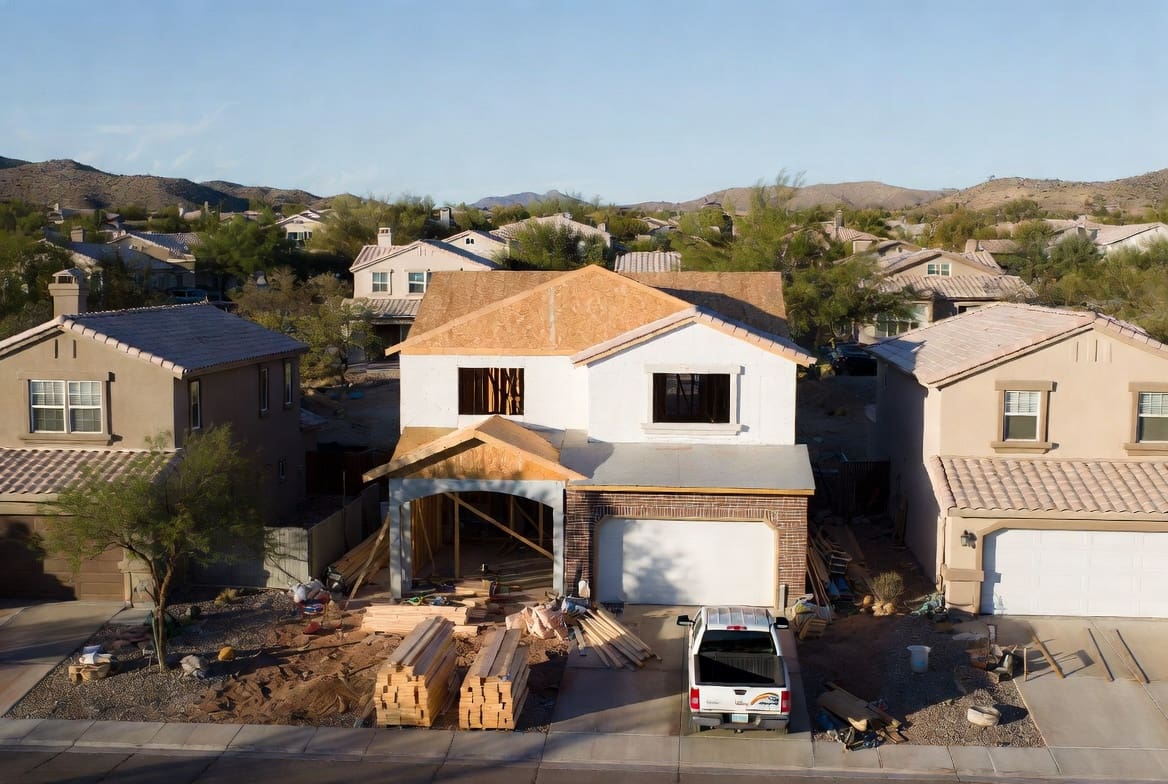
Two houses burn down in the same fire. Both owners had replacement cost coverage. One family rebuilds without writing a check. The other comes up $150,000 short. The difference is one endorsement most homeowners have never heard of. Below we explain standard, extended, and guaranteed replacement cost, what each pays after a total loss, and how to pick the right level in Western rebuild markets.
What does standard replacement cost coverage actually pay?
Most homeowners policies today settle dwelling claims at replacement cost. That means the insurer pays to rebuild or repair with materials of similar kind and quality, with no deduction for depreciation. That sounds complete, and it is, right up to your dwelling limit. The limit is the Coverage A number on your declarations page. It’s a ceiling, not a promise.
Here’s the problem. If your Coverage A limit is $400,000 and rebuilding actually costs $475,000, standard replacement cost coverage pays $400,000. The last $75,000 is yours. The Insurance Information Institute puts it plainly: a typical policy pays to replace your home up to the limits of the policy. Your settlement depends on which policy type you carry. Extended and guaranteed replacement cost exist to solve exactly this gap.
What is extended replacement cost coverage?
Extended replacement cost is an endorsement that adds a buffer above your dwelling limit, usually 25% or 50%, sometimes as low as 10%. Cost data from NerdWallet and Progressive both describe the typical range as 10% to 50% above Coverage A. The buffer only kicks in when a covered rebuild exceeds your limit.
Run the numbers on that $400,000 home. With a 25% extended replacement cost endorsement, your effective ceiling becomes $500,000. The $475,000 rebuild is now fully covered. With a 50% endorsement, the ceiling is $600,000, which absorbs even a severe cost overrun after a regional disaster.
Why would costs jump that much? Because rebuilding costs spike when everyone rebuilds at once. After a wildfire or a major hail event, hundreds of homeowners compete for the same framers, roofers, and lumber at the same time. Materials and labor reprice fast. The Insurance Information Institute notes that some insurers pay 20% or more over the limit for exactly this reason. If building costs go up unexpectedly, you’ll have extra funds to cover the bill.
What is guaranteed replacement cost coverage?
Guaranteed replacement cost removes the ceiling entirely. The insurer pays whatever it costs to rebuild your home with like kind and quality, even if the final bill lands far above your dwelling limit. If your $400,000 home somehow costs $650,000 to rebuild, a guaranteed replacement cost policy pays it.
That’s the strongest dwelling protection you can buy, and it comes with two catches. First, it costs more. Policygenius estimates guaranteed replacement cost typically adds around 5% to 10% to your total premium. Second, and more important in 2026, fewer carriers offer it at all. We’ll get to why in a moment.
One rule applies to both endorsements: neither pays for a better house than the one you lost. The Insurance Information Institute is explicit that neither a guaranteed nor an extended replacement cost policy will pay for upgrades beyond what was destroyed. These endorsements restore your home. They don’t improve it.
Extended vs. guaranteed replacement cost: the real difference
| Feature | Standard replacement cost | Extended replacement cost | Guaranteed replacement cost |
|---|---|---|---|
| Payout ceiling | Dwelling limit (Coverage A) | Limit plus 10% to 50% | No stated ceiling |
| Protects against cost surges | No | Yes, up to the buffer | Yes, fully |
| Availability in 2026 | Standard on most policies | Widely available | Limited, carrier by carrier |
| Typical added cost | Included | Varies by buffer chosen | About 5% to 10% of premium (Policygenius) |
| Pays for a better home than you had | No | No | No |
The short version: extended raises the ceiling by a percentage you choose. Guaranteed removes the ceiling. Both settle at replacement cost, and both require your base limit to be set honestly in the first place.
Why is guaranteed replacement cost so hard to find now?
A generation ago, guaranteed replacement cost was a common selling point. Today the Insurance Information Institute describes it as something only a few insurance companies still offer. NerdWallet notes it’s harder to find than extended replacement cost, and Policygenius reports availability can be limited depending on your state and region.
The reason is concentrated catastrophe risk. An open-ended promise to rebuild at any price is exactly the exposure carriers have been shedding in Western states. A single wildfire can total hundreds of homes in one afternoon and send rebuild costs vertical. Carriers that still offer guaranteed replacement cost often reserve it for well-maintained homes, newer construction, or specific regions.
This is where an independent agency earns its keep. We represent multiple carriers, so we can tell you which ones still write guaranteed replacement cost for your home and ZIP code. We can also tell you whether the premium difference over a 50% extended endorsement is worth paying. Sometimes it is. Often a properly set dwelling limit with a 50% buffer accomplishes nearly the same protection for less.
If guaranteed coverage isn’t available for your home, don’t treat that as a dead end. The practical substitute is a stack: an accurate dwelling limit, the largest extended buffer your carrier offers, an inflation guard that adjusts the limit annually, and adequate ordinance or law coverage for code upgrades. That stack covers most of what a guaranteed policy would, at a price more carriers are willing to quote.
How many homeowners actually carry this protection?
Fewer than you’d think. A 2023 Policygenius survey found that more than two in three homeowners may lack guaranteed replacement cost, and about 80% may be without extended replacement cost. An American Property Casualty Insurance Association survey cited by the Triple-I points the same direction. It found roughly two thirds of insured homeowners could be missing key add-ons like inflation guard, extended replacement cost, and ordinance or law coverage.
| Scenario: $400,000 dwelling limit, $520,000 actual rebuild | Insurer pays | You pay |
|---|---|---|
| Standard replacement cost | $400,000 | $120,000 |
| Extended, 25% buffer | $500,000 | $20,000 |
| Extended, 50% buffer | $520,000 (full rebuild) | $0 |
| Guaranteed replacement cost | $520,000 (full rebuild) | $0 |
Read that table from the homeowner’s side. The standard policy leaves a $120,000 gap that lands on your savings, your retirement, or a loan. A 25% buffer shrinks the gap to $20,000, while the 50% buffer and the guaranteed policy both close it. Now notice what all four rows share: every outcome depends on the $400,000 base limit being honest in the first place. A stale limit shrinks every payout on the table. That’s why we treat the replacement cost estimate, not the endorsement, as step one of every homeowners review.
Should you pick a 25% or 50% extended buffer?
Think about how your home would burn. If your likely loss is a kitchen fire or a burst pipe, the buffer barely matters, because partial losses rarely exceed the dwelling limit. The buffer exists for the total loss, and total losses in the Southwest usually come from events that hit whole neighborhoods: wildfire, severe wind, hail.
That changes the math. When 300 homes need rebuilding at once, you’re bidding against 299 neighbors for the same contractors and materials. Costs don’t rise 5% in that environment. They can rise by a third or more. If you live in a wildfire-exposed area, a high-wind corridor, or a fast-growing metro where construction labor is already tight, we generally recommend the 50% buffer. The premium difference between 25% and 50% is usually modest. The difference at claim time can be six figures.
One clarification, because carriers sometimes blur it: an inflation guard is not a substitute for the buffer. Inflation guard adjusts your limit gradually each year for normal cost trends. The buffer handles the sudden surge after a disaster. You want both, and they do different jobs.
If you’re in a lower-catastrophe area with stable construction costs, 25% is often reasonable. The honest answer depends on your ZIP code, your home’s features, and how current your dwelling limit is. That last part matters more than most people realize, which brings us to the fine print.
The fine print that can void your endorsement
Here’s the detail competitors gloss over. Extended and guaranteed replacement cost endorsements are conditional. Carriers only extend the promise if you hold up your end, and the conditions typically include three things.
First, you must insure to 100% of the carrier’s estimated replacement cost, not a number you negotiated down to save premium. Second, you must accept the annual inflation adjustment the carrier applies to your dwelling limit. Third, you must report significant remodels and additions, because a new primary suite or an expanded kitchen raises your rebuild cost. Skip the notification and the endorsement may not respond to the value you added. Timing matters too, so report projects when they finish rather than at your next renewal. Carriers set their own notification windows, and the safest window is now.
We see this go wrong in one specific way. A homeowner shaves the dwelling limit at renewal to cut premium, not realizing they just invalidated the condition their extended replacement cost endorsement depends on. If you want the buffer, the base limit has to be honest. Ask us to run a current replacement cost estimate before you touch Coverage A.
“My dwelling limit already looks high.” Why that’s not the same thing
Homeowners often compare their Coverage A limit to their Zillow estimate and conclude they’re overinsured. Those are different numbers measuring different things. Market value includes your land, your location, and buyer demand. Replacement cost is the price of labor and materials to rebuild the structure. The Insurance Information Institute cautions that the price you paid for your home may be more or less than the cost to rebuild it.
In some Western markets, land is half the market price, so rebuild cost runs below market value. In others, construction costs have outrun home prices, and the rebuild number is higher. The only way to know is a current replacement cost estimate, which we run as part of every homeowners review. Sometimes we find clients overinsured and cut the premium. That’s the advantage of an agency with no house product to defend.
How we build this coverage across Nevada, Utah, California, and Arizona
Rebuild risk looks different in each of our states, so we wrote a local guide for a major metro in each one. Read the version for Henderson, Nevada, Lehi, Utah, San Diego, California, and Phoenix, Arizona. You can also start from your state page: Nevada insurance, Utah insurance, California insurance, or Arizona insurance.
Frequently asked questions
Is extended replacement cost worth it?
For most homeowners, yes. The endorsement is inexpensive relative to what it protects against, and rebuild cost surges after regional disasters are the most common way homeowners discover they’re underinsured. If your area faces wildfire, hail, or severe wind, we’d call it essential rather than optional.
Does guaranteed replacement cost have any limits at all?
It has no stated dollar ceiling on the rebuild, but it isn’t unlimited in scope. The endorsement rebuilds your home with like kind and quality. It won’t fund upgrades, and it still excludes perils your policy excludes, like flood and earthquake, which need separate coverage.
How do I find out which one I have?
Check your declarations page for an endorsement named extended, additional, or guaranteed replacement cost, often shown as a percentage next to Coverage A. If you can’t tell, send us the declarations page. We read these daily and we’ll tell you in plain English what you have.
Will either endorsement pay to bring my home up to current building codes?
Generally no. Code upgrades are handled by a separate feature called ordinance or law coverage, and an older home rebuilt in 2026 must meet 2026 codes. Many policies include only a small amount of this. It’s a distinct gap worth reviewing alongside your replacement cost decision.
What if my carrier’s replacement cost estimate seems too high?
Push back with data, not a haircut. Ask how the estimate was built, correct any wrong inputs like square footage or finishes, and compare estimates across carriers, which we can run for you. What you shouldn’t do is arbitrarily lower Coverage A, since that can void the buffer’s insure-to-value condition.
Does replacement cost apply to my belongings too?
That’s a separate election. Your personal property can be settled at replacement cost or at actual cash value, which deducts depreciation. The dwelling endorsements in this article don’t change how your contents are settled, so check both settings when you review your policy.
Ready to check your own numbers? We’ll run a current replacement cost estimate and show you which carriers still offer guaranteed replacement cost for your address. Then we’ll price the 25% and 50% buffers side by side. Start your homeowners quote here, or call the office and ask for a replacement cost review. It takes ten minutes and it’s the cheapest six-figure decision you’ll make this year.


