
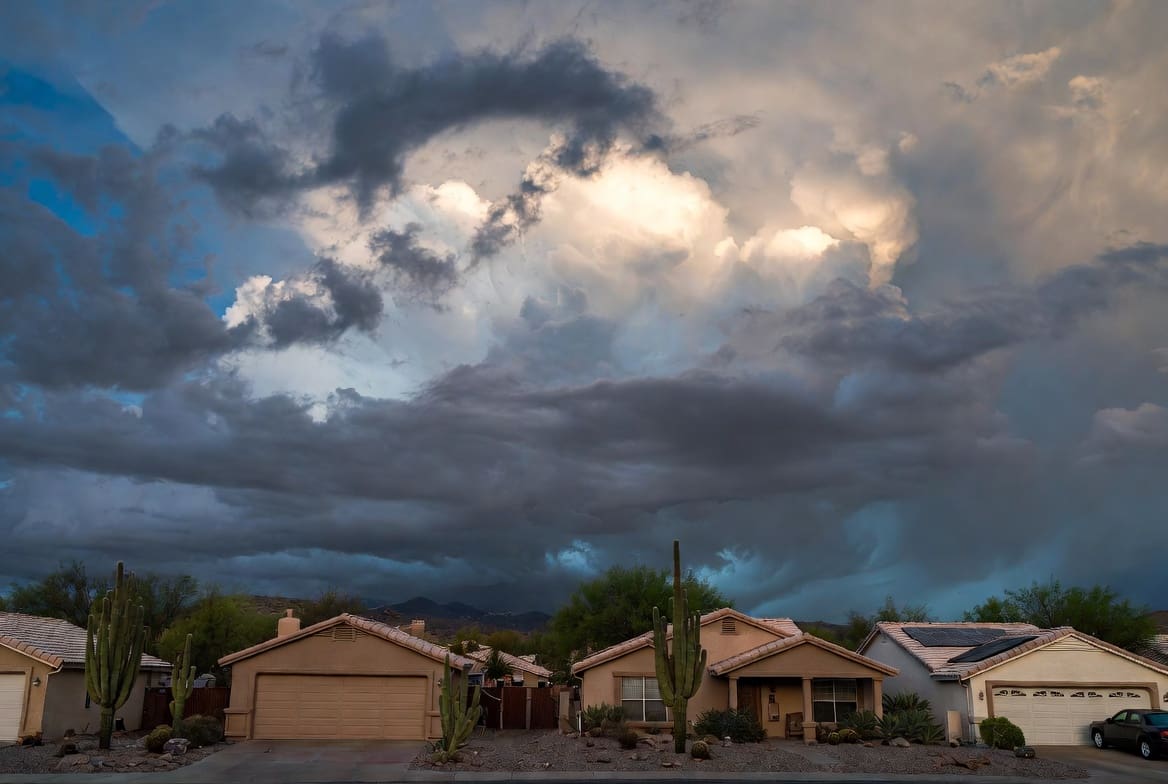
Every Phoenix homeowner knows the drill from mid-June through September: the sky turns brown, the wind hits, and the rain follows sideways. The National Weather Service’s Phoenix monsoon safety guidance notes that thunderstorm gusts here almost always exceed 40 mph. The strongest top 100 mph and cause damage similar to a tornado. That’s a roof-and-exterior claims machine, and in a bad year it hits thousands of homes across the Valley at once. This guide explains how extended and guaranteed replacement cost coverage work for Phoenix homeowners. It also covers why monsoon geography makes the buffer decision matter more here.
Monsoon math: when the whole Valley files at once
The dangerous claim in Phoenix isn’t the one only you file. It’s the one you file along with ten thousand neighbors. A severe outflow event can tear through Mesa, Gilbert, and Queen Creek in one evening. Roofers book out for months and material prices jump. A rebuild that would’ve cost one number in April costs a different number in August. An extended replacement cost buffer of 25% to 50% above your dwelling limit exists to absorb exactly that repricing.
The Valley’s split personality matters too. Retirees and snowbirds often own older homes in Sun City, Mesa, and Apache Junction with aging roofs and dwelling limits set years ago. Young families in the East Valley own newer builds insured at builder volume pricing that a one-off retail rebuild would exceed. Different homes, same underlying gap: the limit on the declarations page trails the real cost of putting the house back.
What Arizona requires, and what your lender requires
Arizona law doesn’t require homeowners insurance. Your mortgage lender requires enough to protect the loan, and that’s where the lender’s interest ends. Nothing in that arrangement checks whether your limit could actually rebuild your home after a total loss. It also ignores what happens when a Valley-wide storm inflates every contractor’s bid. That check is yours to run, and it’s the first thing we do in a policy review.
Building your coverage in Phoenix
Our Phoenix checklist has three steps. First, get a current replacement cost estimate. If your home is older, confirm how your roof would be settled, since roof age drives both premiums and claim outcomes here. Second, add an extended replacement cost endorsement. For most Valley homes we price both the 25% and 50% buffers, and lean toward 50% in storm-heavy corridors. Third, if you own a higher-value home in Scottsdale, Paradise Valley, or Ahwatukee, ask which carriers still offer guaranteed replacement cost in Arizona. We’re independent, so we can quote several carriers and show you the actual spread instead of one company’s take. For the complete comparison of all three coverage levels, read our guide to extended vs. guaranteed replacement cost.
Does extended replacement cost help with monsoon roof claims?
Mostly indirectly. Partial roof claims rarely exceed your dwelling limit, so the buffer usually isn’t triggered. Where it earns its premium is the total or near-total loss during a surge, when the whole Valley is rebuilding and prices spike. Think of it as catastrophe pricing protection.
I’m a snowbird. Does part-year occupancy change any of this?
It can. Carriers treat extended vacancy differently, and some coverages tighten when a home sits unoccupied for months. Tell us your occupancy pattern honestly and we’ll structure the policy around it, including the replacement cost endorsements. Surprises at claim time are the thing we’re paid to prevent.
Ready for a review? Start an Arizona homeowners quote, or visit our Arizona insurance page. Ten minutes now beats a six-figure gap after the next big storm.


