
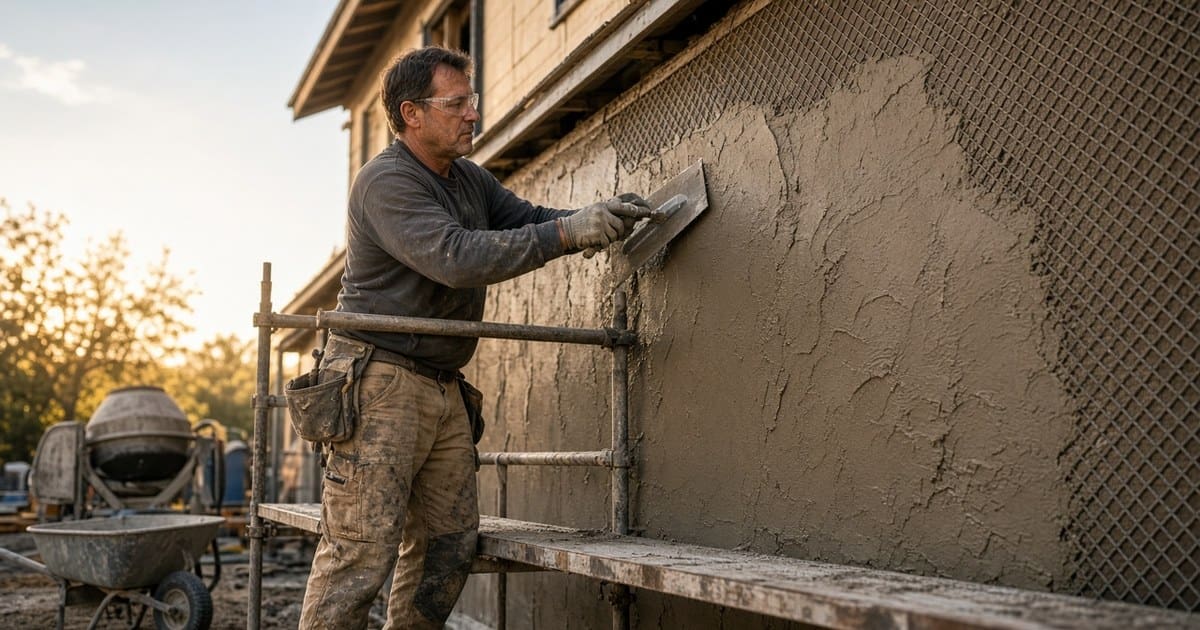
It is the second week of a re-stucco on a two-story house. The scratch coat is up on the back wall, the brown coat is going on the front, and the mixer is running in the driveway. A plank slips off the staging and dents the homeowner’s car. A gust carries spray across the side yard and onto the neighbor’s windows. Two years later the same owner calls about a crack running from the corner of a window and a stain spreading across the drywall inside. Those are three different problems, and good stucco contractor insurance answers each one with a different policy.
This guide is for exterior plastering crews: three-coat cement stucco over lath, one-coat systems, color and finish coats, stucco repair and patching, and exterior insulation and finish systems (EIFS). If most of your work is interior wallboard, our drywall contractor insurance guide fits that work better, and crews that only apply coatings will find more in our painting contractor insurance guide. We also have local versions for Henderson, Phoenix, San Diego, and Lehi.
Which policy pays which stucco claim
| What happened | Where it usually lands |
|---|---|
| A plank or bucket falls from the scaffold and damages a car or hurts a passerby | General liability |
| Overspray or splatter lands on a neighbor’s windows, car, or pavers | General liability, subject to the policy’s terms |
| A crew member falls from the staging or is hurt mixing or carrying material | Workers compensation |
| The mixer, pump, or your own scaffold sections are stolen from a jobsite | Inland marine (tools and equipment) |
| Your truck hits a parked car on the way to the job | Commercial auto |
| Water gets behind a finished wall and damages the framing and drywall | Completed operations under general liability, which may respond to the resulting damage but not to redoing your own stucco |
The table is a starting point for stucco contractor insurance, not a promise. Exclusions, endorsements, and the facts of each claim decide what is actually paid.
Your own wall versus the damage it causes
General liability is built to pay for injuries and damage you cause to other people, not to guarantee your workmanship. The standard commercial general liability form excludes damage to the particular part of a building you are working on when the damage comes out of your operations, and the particular part that has to be redone because your work was done wrong. Once the job is finished, damage to your own completed work is excluded too, unless the damaged work, or the work that caused the damage, was done by a subcontractor working for you.
In practice, that means a failed lath detail is two claims. If water gets in and rots sheathing and stains the drywall inside, those are other people’s work and property, and that resulting damage may be covered under your general liability policy. Tearing off and replacing your own stucco is usually your cost, the same way a callback always has been. Read the exclusions on your own policy with your agent, because carriers add endorsements that narrow or change these rules.
Cracks, water, and completed operations
Most stucco claims show up long after the crew has left. Cracks, staining, and water around windows, roof lines, and penetrations tend to surface after a season or two of weather, sometimes after the house has sold. That is why completed operations coverage, the part of general liability that responds after a job is done, matters so much for this trade.
Ask your agent how your policy handles completed operations, whether that aggregate limit is separate from the one for ongoing work, and what happens to coverage for past jobs if you change carriers. Some contractor policies also carry exclusions for mold, fungi, or bacteria, which can change how a water claim is handled, so ask whether yours does. Our framing contractor insurance guide walks through the same your-work question from the framer’s side of the wall.
EIFS changes the conversation
EIFS is not the same as traditional cement stucco, and insurers treat it differently. The standard insurance industry exclusion endorsement for these systems defines one as a non-load-bearing exterior cladding made of a rigid or semi-rigid insulation board, such as expanded polystyrene, the adhesive or fasteners that attach it, a base coat, a finish coat, and any flashing, caulking, or sealant used with it.
When that endorsement is on a policy, it removes coverage for bodily injury, property damage, and personal and advertising injury arising out of installing, repairing, or maintaining EIFS or any substantially similar system. It also removes coverage for your work on any exterior component of a building on the part that uses EIFS, which can reach a crew that only patches around an EIFS window or wall. Some carriers attach it to contractor policies routinely. If you install or repair EIFS, even occasionally, say so on the application and ask your agent to show you whether the policy carries an EIFS exclusion before you take the job.
Silica dust and your crew
Mixing, cutting, and grinding cement-based materials can put respirable crystalline silica in the air. OSHA has a construction standard for silica (29 CFR 1926.1153), and employers can either follow the dust controls listed in the standard’s Table 1 or measure their workers’ exposure and choose their own controls. For insurance, injuries to your own employees sit with workers compensation. Some general liability policies also carry a silica exclusion for claims from other people, so ask whether yours does. Our guide to workers comp questions for contractors covers payroll and classification.
Mixers, pumps, scaffolding, and the truck
A mortar mixer, a stucco pump, hoses, and your own scaffold sections are expensive, and they spend their lives on jobsites and trailers. General liability does not cover property you own. Inland marine coverage, sometimes called tools and equipment coverage, is built for gear that moves from job to job. Our inland marine page explains how it works. List the pump and mixer by value, and ask whether rented or borrowed equipment is included.
The truck and trailer belong on commercial auto. If you use a personal pickup for work, our guide to personal vs commercial auto insurance explains why a personal policy may not respond the way you expect.
Licensing for stucco work in Nevada, Arizona, California, and Utah
| State | Classification that names the work |
|---|---|
| Nevada | State Contractors Board C-17 Lathing and Plastering. Subclassification C-17e covers coatings of stucco and cement, and C-17b covers plastering. |
| Arizona | Registrar of Contractors C-36 (commercial), R-36 (residential), or CR-36 (dual) Plastering, which covers coating surfaces by trowel or spray with sand mixtures such as stucco. |
| California | Contractors State License Board C-35 Lathing and Plastering. |
| Utah | Division of Professional Licensing S230 Masonry, Siding, Stucco, Glass, and Rain Gutter, or S270 Drywall, Paint, and Plastering. Both scopes name stucco and stucco to lathe. |
A license class describes the work a board lets you contract for. It does not automatically create or cancel insurance coverage, but carriers do ask what you are licensed for and what you actually do, and the two should match. Utah also sets liability insurance minimums for contractor licensing, covered on our Lehi page. Check the current rules with your board before you bid work outside your classification.
Certificates, additional insureds, and higher limits
Builders, HOAs, and property managers usually want a certificate of insurance before you start, and many ask to be added as an additional insured. A certificate shows coverage; it does not change it. Our guide to certificates of insurance for contractors explains what to check before you send one. If a contract asks for limits above your general liability, a commercial umbrella can add a layer on top, and our comparison of excess liability and commercial umbrella policies explains the difference.
What to have ready for a quote
- Your mix of new construction, repair, and re-stucco work, and how much is residential versus commercial.
- Whether you install or repair EIFS, and roughly what share of your work it is.
- Payroll, number of employees, and whether you use subcontractors and collect their certificates.
- A list of mixers, pumps, scaffolding, and other equipment with values.
- Vehicles, trailers, and who drives them.
- Your claims history and any contract or certificate requirements from the builders you work for.
We do not promise eligibility, rates, or availability, because those depend on the carrier, your state, your claims history, the work you actually do, and the coverage you choose. Policy terms vary by carrier. Western Pacific Insurance is an independent agency that works with stucco and plastering contractors in Nevada, Arizona, California, and Utah, and we can review your general liability, equipment, auto, and workers compensation together. Have your current declarations pages ready, then call 702-932-3105 or request a quote online.


