
Phoenix Septic Contractor Insurance: What R-41 Crews Need Before the First Trench
Phoenix keeps growing in two directions, and one of them has no sewer. Cave Creek, New River, Rio Verde Foothills, Queen Creek, and the edges of San Tan Valley still put homes on tanks and leach fields. Maricopa County steers small-lot subdivisions toward sewer, so septic work here skews toward large lots and custom builds. That means caliche, hardpan, and open trenches in heat that turns dangerous by ten in the morning. The insurance that fits this trade looks different from a general contractor program, and a policy bought off a generic form leaves real holes. This guide walks through what a Phoenix septic contractor insurance program should include, how Arizona licenses the work, and where local crews usually leave gaps.
Arizona Licenses Septic Work Under R-41, C-41, and CR-41
The Arizona Registrar of Contractors gives septic its own box. R-41 covers residential work, C-41 covers commercial, and CR-41 covers both. The scope reads the same across all three. The licensee may excavate, install and repair pipe, backfill, and compact soil as needed to install and repair septic tanks, aerobic digesters, and leaching fields. You can read the full list on the ROC license classifications page.
Read that scope closely, because it shapes your insurance. Excavation on a septic ticket sits inside the license, so it belongs on this policy under this classification. Trenching for a builder on a separate invoice is different work, and it belongs on an excavation program. Plumbing classifications also name septic tanks and leach lines, and A-12 Sewers, Drains and Pipe Laying overlaps from the engineering side. A crew holding two of those licenses needs an agent who can describe both operations to the carrier. Otherwise one classification quietly absorbs the other at a lower rate, and the audit claws it back a year later.
The ROC does not require general liability to hold a license. It requires a bond scaled to your volume. It also requires workers compensation as soon as you have one employee, with a no-employee affidavit for owners who work alone. Builders, site owners, and lenders are the ones who demand liability coverage, and they set the limits.
Five Policies, Then the Septic-Specific Questions
The base program for a Phoenix septic contractor has five pieces. General liability responds when your work damages someone else’s property or injures a person who is not your employee. Workers compensation covers your crew, and Arizona mandates it from the first hire. Commercial auto covers the trucks and the trailers hauling tanks and trenchers between Queen Creek and Cave Creek. Our business auto insurance page explains how to schedule them. Inland marine covers the excavator, the trencher, the laser, and the vac equipment wherever they sit tonight. An installation floater covers prefab tanks and treatment units between your yard and the county’s final sign-off.
Those five look the same for most trades. Septic adds three questions that most contractor policies never ask.
First, sewage. The standard general liability form carries a pollution exclusion, and effluent counts. Picture a tank you set leaking toward a neighbor’s well, or a field you built surfacing raw sewage in a side yard. The carrier will read that exclusion before it reads anything else. A contractors pollution liability policy, or a pollution endorsement written for the trade, closes the gap. Our septic contractor insurance guide covers the exclusion and the your-work exclusion in detail.
Second, completed operations. A leach field failure surfaces years after backfill, often when the homeowner sells and the transfer inspection finds it. Your completed operations coverage has to still be in force on that day, on a policy that never lapsed and never dropped the coverage to save premium.
Third, professional services. That one deserves its own section, because Arizona rules make it specific.
The Transfer-of-Ownership Inspection Is a Professional Liability Exposure
Arizona rule R18-9-A316 requires a qualified inspector to examine any septic system within six months before the property changes hands. The rule lists ROC-licensed septic contractors among the people who qualify, once they hold the ADEQ-recognized training certificate. Maricopa County explains the process on its ownership transfer page.
Plenty of Phoenix septic crews add these inspections as steady income between installs, and it is a good line of business. It is also a written opinion on a state form, delivered to a seller, handed to a buyer, and relied on at closing. If a field you passed fails eighteen months later, the buyer’s attorney reads your Report of Inspection first. General liability typically excludes professional services, and an inspection report is a professional service. If you sign those reports, you need professional liability coverage, sometimes called errors and omissions. You also need to tell your agent the inspections exist, so the classification and the limits fit the work.
Permits, Backfill Tags, and What Happens Between Them
In Maricopa County, the Environmental Services Department issues a Construction Authorization before you break ground. A Discharge Authorization follows the final inspection, with an authorization-to-backfill tag in between. Alternative systems, including aerobic units and anything that is not a gravity tank and trench, must be designed and stamped by an Arizona-registered engineer. The county’s onsite wastewater FAQ lays out the steps.
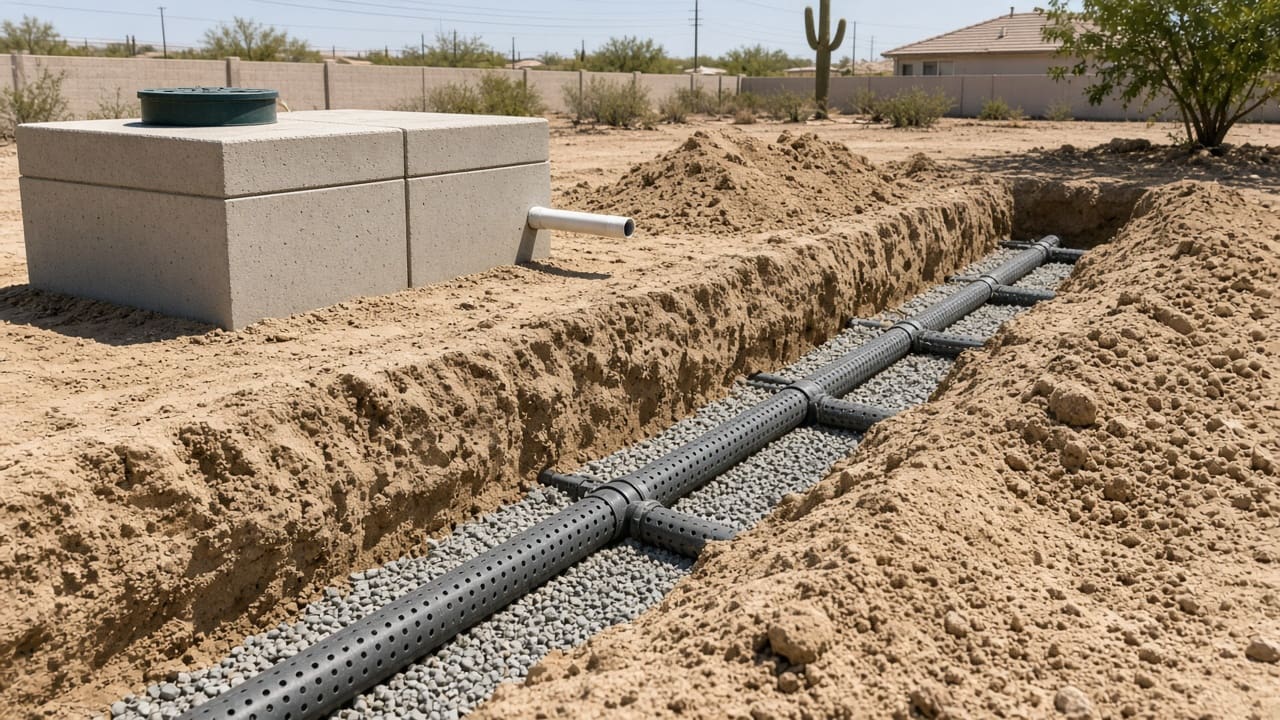
The window between authorization and backfill is where your property exposure lives. An open trench with a set tank and staged pipe sits exposed to a monsoon cell, a curious neighbor, and a thief who wants the trencher parked beside it. Schedule the equipment on inland marine at replacement cost, put staged tanks on the installation floater, and keep the excavation guarded overnight. If an inspection slips and you hold open trenches across an August weekend, say so when you bind the policy. Carriers rate open excavations differently, and they will ask.
Aerobic and engineered systems change the underwriting conversation too. They carry pumps, controls, and electrical components a conventional field never had, and carriers rate them differently from a tank-and-leach ticket. Describe the mix of systems you install on the application. If pump-outs and repairs ride alongside installs, disclose the sewage handling so the pollution question has an answer before a claim tests it.
Certificates Get You on the Builder’s List. Endorsements Keep You There.
East Valley and north Valley builders prequalify septic subs before the first trench opens. Their subcontractor agreements ask for additional insured status, a waiver of subrogation, and primary and noncontributory wording. Those have to be endorsed onto the policy. A certificate that types them in without the endorsement behind it protects no one, and the builder’s risk manager knows the difference. The builder hiring you needs a program of their own, which we cover under Phoenix general contractor insurance.
Set limits to the work you are bidding this year, not the work you did three years ago. A single-tank residential crew and a commercial aerobic shop are different risks, and their limits should be different. When bids grow, limits go up. There is no penalty for carrying more liability than a contract requires, and there is a large one for carrying less.
Get a Phoenix Septic Contractor Insurance Quote
Western Pacific Insurance is licensed in Arizona, and we write septic contractors across the Phoenix metro. As an independent agency, we shop your operation across a broad lineup of carriers and describe your classifications the way the ROC does. Then we match the pollution, completed operations, and professional liability pieces to the work you actually run. Start with an Arizona quote request, or visit our Arizona insurance page to see everything we write in the state.
Your yard and shop are a commercial property question. Dig-and-grade as its own invoice lives on Phoenix excavation contractor insurance, and building plumbing lives on plumbing contractor insurance.


