
Phoenix Excavation Contractor Insurance: Arizona A-5 and CR-2

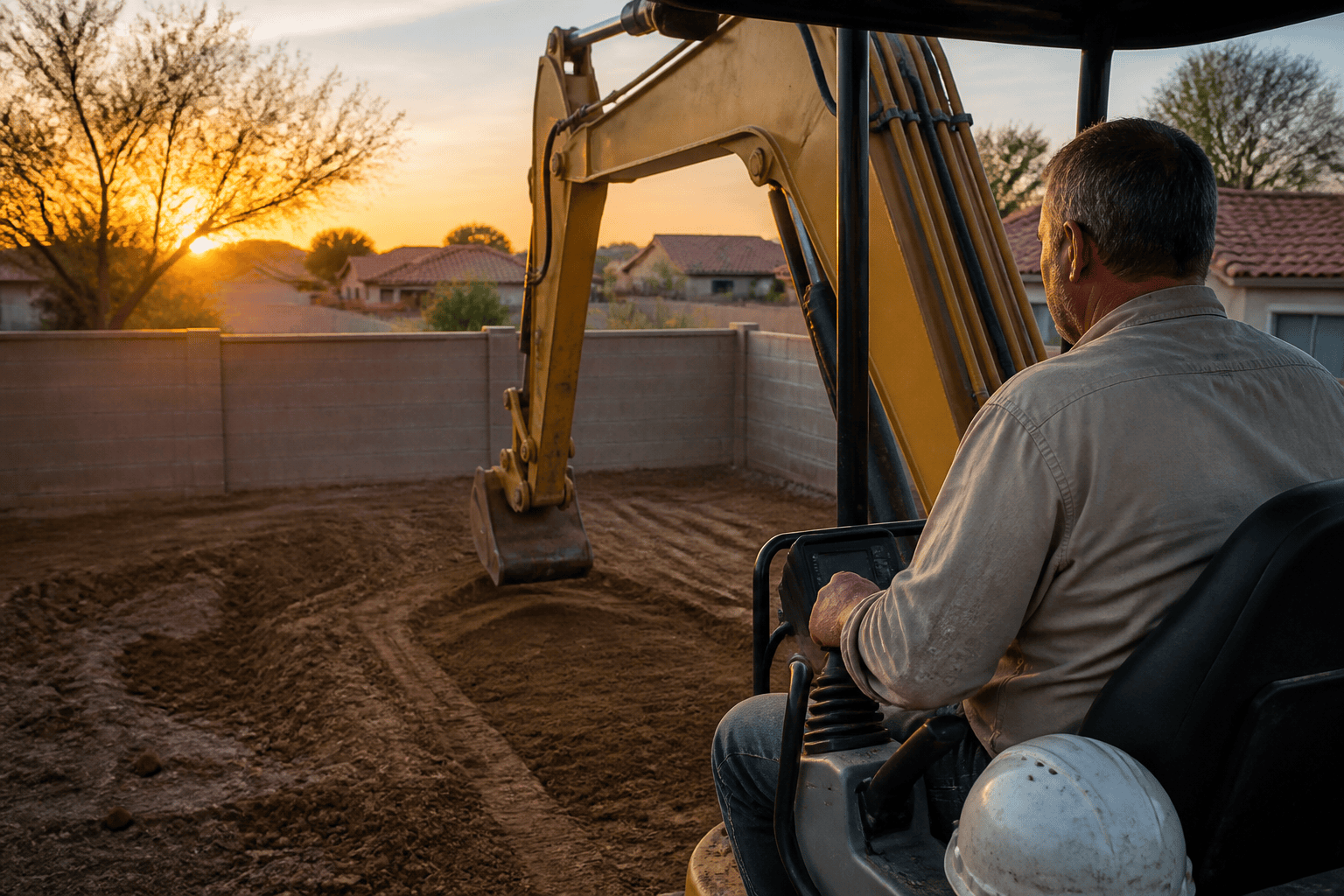
Queen Creek HOAs write a graded courtyard into the same spec book as a utility trench. Arizona calls that excavating and grading. Process dirt work sits on A-5, R-2, or CR-2, and that is not California numbering. A Valley yard still cooks a closed trailer after a July noon. Monsoon moisture turns a spoil pile into a slide before the punch list. Phoenix excavation contractor insurance has to match the heat window, the excavating card, and the certificate the HOA actually accepts. For the program page that already ranks for service intent, see our excavation contractor insurance service page.
An excavation contractor moves earth for a living. You dig footings and utility trenches, cut and fill pads, grade lots for drainage, and compact what you place. In the Phoenix area that work runs from custom home lots in Queen Creek to commercial sites along the Loop 202. It also puts expensive iron, open trenches, and buried utilities into the same workday. Phoenix excavation contractor insurance is the set of policies that pays when one of those goes wrong. For most crews that means general liability, workers compensation, commercial auto, and an equipment floater, with an umbrella on top. This guide covers the Arizona license classes, the coverage each part of the job needs, and the local conditions that drive claims. If you already know what you need, our excavation contractor insurance service page covers the program itself.
The Arizona Registrar of Contractors licenses this trade as Excavating, Grading and Oil Surfacing. The class comes in three versions, depending on whether you work commercial, residential, or both. All three cover digging, trenching, grading, horizontal boring, compacting, and filling. They also cover oil surfacing, plus shoring, casing, geotextiles, and liners when the earthwork calls for them. None of them allows you to excavate for water, gas, or oil wells. You can read the full scopes on the Registrar’s license classifications page.
| License | Market | Bond schedule, by estimated annual volume |
|---|---|---|
| A-5 | Commercial. Adds incidental blasting and drilling. | General commercial and engineering: $5,000 to $100,000 |
| R-2 | Residential | Specialty residential: $4,250 under $375,000, then $7,500 |
| CR-2 | Dual. Combines both scopes. | The R-2 amount plus specialty commercial: $2,500 to $50,000 |
Bond amounts follow the volume of work you expect for the year. The Registrar confirms your figure when it approves the application, so treat the table as a planning guide. If your volume outgrows your tier, raise the bond, because the rule treats a knowing underestimate as misrepresentation. Residential and dual licensees also pay into the Residential Contractors’ Recovery Fund or post a separate $200,000 bond. Qualifying parties document their experience and pass both a trade exam and the Statutes and Rules exam.
Arizona requires a license for any job of $1,000 or more in labor and materials, or any job that needs a permit. Splitting one earthwork package into smaller contracts doesn’t get around that threshold. The Registrar doesn’t make general liability a condition of the license, but nearly every builder, HOA, and city you work for will. Keep in mind that a license bond protects your customers. If the surety pays a claim, it expects you to pay it back, so a bond never replaces insurance. City and county jobs often add bid and performance bonds, which we place through our surety bonds program.
| Coverage | What it pays for on a dirt job |
|---|---|
| General liability | Injury or property damage to others, such as a cut fiber line or a cracked block wall next door |
| Workers compensation | Medical bills and lost wages for injured employees, from cave-ins to heat illness |
| Commercial auto | Dump trucks, water trucks, pickups, and the trailers that move your equipment |
| Contractors equipment (inland marine) | Your excavators, skid steers, trench boxes, and rented machines, on site or in transit |
| Contractors pollution liability | Cleanup and damage when you hit a fuel line, a sewer, or contaminated soil |
| Umbrella | Extra limits over your liability policies when a loss runs past them |
General liability deserves the closest read, because contractor policies vary widely and dirt work touches the most common exclusions. Look for a subsidence or earth movement exclusion, which can remove coverage for settling, sliding, or shifting soil. Look for limits on explosion, collapse, and underground damage, since buried utilities are your daily exposure. Check how the policy treats completed operations as well, because a pad can settle long after you demobilize. We compare these forms in more depth in our excavation contractor insurance guide.
One gap surprises many owners. Your commercial auto policy covers the truck and the trailer, but its coverage stops short of the machine chained to the deck. The excavator riding on that lowboy belongs on the equipment floater. Rented machines work the same way, since most rental agreements make you responsible for the full value. Make sure your floater includes rented and leased equipment, at a limit that matches the largest unit you bring onto a job.
Arizona requires workers compensation as soon as you have one employee, whether full time or part time. You pay the whole premium as the employer, and you can’t pass any of it to your crew through payroll deductions. The Industrial Commission of Arizona enforces the requirement.
Your premium depends on payroll and on the class codes assigned to it. General excavation usually falls under NCCI code 6217, while sewer, water main, and gas main work carry their own codes. Deep trench payroll costs more because cave-ins are the deadliest hazard in the trade. OSHA requires a protective system in any trench five feet or deeper, unless you’re digging entirely in stable rock.
A shop that only grades pads and one that opens utility trenches look very different to an underwriter, and the same holds on the liability side. Describe your real mix of work on the application, and keep payroll records that separate the two. A crew coded to the wrong class turns into an audit bill at the end of the term, or a coverage dispute after a claim.
Two seasons shape dirt work in the Valley. Summer heat pulls moisture out of fill quickly, and soil compacted too dry can settle months later. If that settlement means regrading your own pad, general liability generally won’t pay, because policies exclude the cost of redoing your work. Damage to someone else’s property is a separate question. A settled pad that cracks a slab or a finished wall may be covered, depending on how the earth movement exclusion reads. Heat reaches your people too. Heat illness is a workers compensation claim, and July afternoons in an open cut produce them.
Monsoon season runs from mid June through September. A fast storm can wash a spoil pile into a neighbor’s yard or soften a trench wall that stood fine that morning. OSHA calls for a competent person to inspect an excavation after every rainstorm, before anyone goes back in. Washout damage to a neighboring wall, pool, or landscaping is the kind of property claim liability coverage exists for. Photos of the site and the adjoining properties, taken before you start, make that claim much easier to sort out. Valley caliche adds its own wrinkle, since a routine dig can turn into breaker work that strains equipment and schedules.
Arizona law requires you to contact Arizona 811 at least two full working days before you dig. Utility owners then mark their lines, and you wait until every operator on the ticket has responded. That ticket matters to your insurance in two ways. Underwriters ask about your locate practices when they price an excavation account. After a utility strike, the ticket number and your photos of the marks become the core of your defense. Keep them in the job file along with any potholing records, because repair bills for fiber and gas lines climb quickly once the utility adds its outage costs.
Most of your work arrives with insurance requirements attached. HOA boards in Queen Creek, Gilbert, and San Tan Valley, along with builders and cities, will ask for a certificate before you mobilize. Remember that a certificate is only a summary. The rights come from the endorsements behind it. That usually means additional insured status for ongoing and completed operations, primary and noncontributory wording, and a waiver of subrogation. Send us the contract before you sign it, and we’ll confirm your policy can deliver what the contract promises.
Contracts commonly call for $1 million per occurrence, and many property managers and municipalities now ask for $2 million or more. Treat any contract figure as a floor. A single trench injury or gas line strike can exceed it, and higher limits through an umbrella usually cost little next to the exposure. Finished courtyards raise one more issue. Mature desert trees, pavers, and walls inside your work area can fall under the care, custody, or control exclusion. Ask how your policy handles property you’re working on or around before the bucket gets near it.
Western Pacific Insurance is an independent agency licensed in Arizona, and we place coverage for excavation contractors across the Valley. Because we work with multiple carriers, we can match your account to one that wants your mix of pads and trenches. We also read the earth movement, underground, and completed operations wording before you bind. Start with an Arizona quote request, or visit our Arizona insurance page to see everything we write in the state. For details on the program itself, see our excavation contractor insurance page.


