
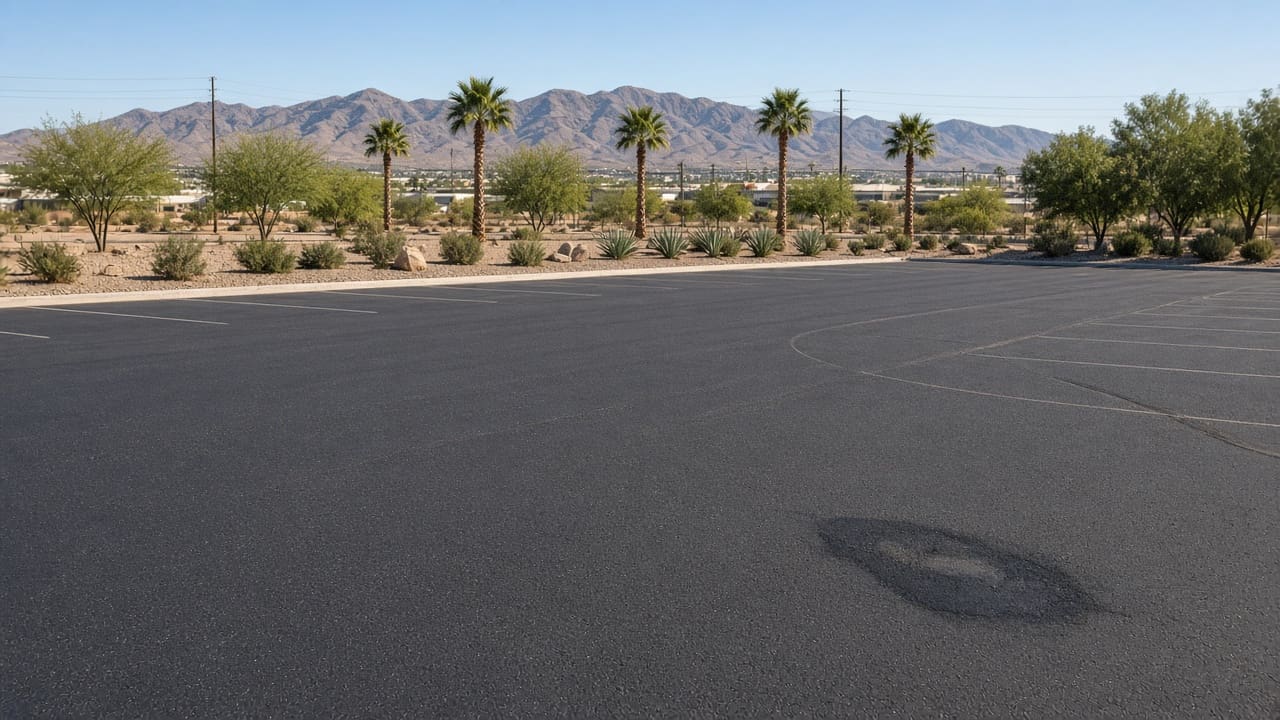
Phoenix Paving Contractor Insurance: Valley Asphalt Coverage
A Phoenix paving crew might open a Mesa shopping-center lot before
sunrise, finish a Chandler office apron before tenants arrive, and
still field a certificate request from a property manager who wants
additional insured wording before the first load of mix hits the
ground. The desert heat shrinks the workable window, so soft asphalt,
parked cars, and early delivery trucks often end up sharing the same
site at the same hour. Paving contractor insurance in the Valley has
to account for that pace from the start.
General liability, commercial auto, workers compensation, and
inland marine each cover a different piece of the operation, and seal
coating, striping, night arterial work, and municipal specs each
raise their own underwriting questions. This guide walks through the
Arizona starting point and the claim patterns that come up most often
for Valley paving contractors. For the broader four-state picture,
see our paving
contractor insurance guide.
The Phoenix Coverage Stack
General liability is the first line of defense against third-party
injury and property damage from paving work. A driver turns into a
soft aisle in a Tempe lot. Hot mix spatters a parked car beside a
Scottsdale retail pad. A roller clips a curb or light base on a
Gilbert HOA street. Any of those can turn into a liability claim,
though care, custody, or control of the customer’s property, and
damage to the paving work itself, can change how the claim gets
handled. Ask how your policy treats completed operations before you
tell a client that every soft-spot dispute after monsoon season will
be covered, because that answer depends on the form.
Workers compensation covers an employee who’s burned, strains a
muscle, or gets struck while raking, flagging trucks, or working
beside the paver in extreme heat. Arizona generally requires workers
compensation once you have employees, subject to the state’s own
definitions and exceptions, so keep your payroll and seasonal-helper
records current as your crew size shifts through the year.
Commercial auto covers your dump trucks, crew trucks, trailers,
and any distributor or water truck running Valley routes. Backing
beside occupied stalls, hauling mix on the Loop corridors, and
staging near live traffic all create a vehicle exposure that general
liability doesn’t touch. Hired and non-owned auto coverage can help
when you rent a truck or an employee uses a personal vehicle for a
company errand, though the details depend on your specific form.
Inland marine, or scheduled equipment coverage, follows your
pavers, rollers, saws, and compactors wherever they go. Equipment
left on a trailer overnight at an East Valley job site concentrates
theft risk in one place, and general liability won’t replace a stolen
roller. Tell your agent where your equipment is stored between jobs
and which units are valuable enough to schedule individually.
Claims That Begin Before the Mat Cools
|
Phoenix scene |
First policy |
|---|---|
|
A tenant drives onto a |
General liability |
|
Hot mix or tack coat |
General liability; |
|
A dump truck sideswipes |
Commercial auto |
|
A laborer is burned by |
Workers compensation |
That table is a starting point, not a guarantee that any given
claim is covered. Before you pave, photograph the existing pavement,
drains, curbs, and any nearby vehicles, and record the mat’s
thickness, the patch limits, and who’s responsible for controlling
early traffic. Valley heat and monsoon timing both tend to show up in
disputes later, so they belong in your job notes from day one.
Arizona Licensing Starting Point
Arizona’s ROC lists A-14 for commercial asphalt paving, R-13 for
residential asphalt paving, and CR-69 as a dual classification
covering both. Seal coating has its own separate commercial and dual
paths under ROC’s classification rules. Confirm the current scopes,
qualifying-party experience requirements, exam or waiver options, and
bond requirements directly with the Arizona
Registrar of Contractors before you bid Phoenix-area work, since
these details change.
City transaction privilege tax licenses and local registrations
can still apply on top of your ROC license. Property managers and
general contractors will often ask for general liability, additional
insured wording, specific auto limits, and completed operations
coverage even when ROC itself doesn’t require them, so your license
class alone won’t satisfy every contract you’re asked to sign.
What Commercial Contracts Across the Valley
Require
A homeowner may just need a driveway finished before a listing
photo goes up. A retail center or HOA usually wants more: a
certificate before the truck even arrives, additional insured
wording, primary and non-contributory language, a waiver of
subrogation, completed operations coverage, and specific auto limits.
Every one of those terms needs a matching endorsement, because a
certificate can’t create coverage for a soft mat the carrier already
excluded, or for pollution exposure the policy hasn’t been endorsed
to cover.
Read the scope carefully before you agree to pave an occupied lot.
Note the drains, light poles, gates, striping, and night-work
windows, and know who decides when traffic can return to the surface.
If a job asks for coverage well outside standard asphalt paving, have
that request reviewed with your agent rather than stretching your
paving description to fit it.
Build Your Quote Around Your Real Phoenix
Operation
Bring your annual receipts, the split between residential and
commercial work, employee payroll, temporary labor use, truck and
trailer details, equipment values, overnight storage locations, your
operating radius, the percentage of night work you run, seal coat or
striping revenue, and any prior claims. Let your agent know whether
your crews work beside open traffic, heat materials on site, or mill
existing pavement, because a simple driveway description can build
the wrong program if it hides multi-lot commercial overlay work
underneath it.
Revisit your program whenever your Phoenix operation adds a paver,
a second crew, municipal night work, or a new materials stream. A
description built around a small driveway crew usually doesn’t hold
up against East Valley shopping-center schedules. Update your carrier
before your operation changes, not after a claim reveals that your
old application no longer describes the work you’re actually doing.
Valley Heat and Monsoon Timing
Phoenix paving schedules bend around heat and storms more than
most trades have to plan for. A mat that opens to traffic too soon,
or a finish grade that ponds after the season’s first monsoon, often
becomes a completed-operations dispute months later. Write your
reopen rules directly into the job notes, and photograph drains and
low spots both before and after the overlay. None of that creates
coverage on its own, but it gives your carrier real facts to work
with if a tenant claims the lot failed within its first week.
Night work on arterial edges or busy retail lots changes both the
auto and liability picture. Flaggers, lighting, and haul routes all
matter to an underwriter. Let your agent know what share of your
revenue comes from night closures, so your program gets rated for the
work you actually do instead of a quieter driveway book.
Fleet, Materials, and Subcontractors
Valley paving companies often own dump trucks, rent water trucks,
and hire out striping once the mat has cooled. Each of those pieces
needs a clear home on your insurance application. Commercial auto
covers your owned units, hired and non-owned auto covers rented
trucks or an employee’s personal vehicle on a company errand, and
certificates from any striping or milling subcontractor belong in
your file too. Don’t assume a general liability policy will answer
for a truck accident or a stolen roller, because it won’t.
If you store emulsion or heat materials at a yard in Mesa or
Chandler, ask your agent about property and pollution wording
specifically. Standard liability forms often limit pollution
coverage, and while a limited endorsement may be available, the terms
vary by carrier. Describe your materials handling honestly before you
tell a property manager that every spill scenario is already solved.
Western Pacific Insurance places coverage for paving contractors
across Arizona, Nevada, California, and Utah. Call 702-932-3105
or use our insurance
quote form, and bring your next certificate request along with an
honest picture of the mats your crews lay across the Valley.


