
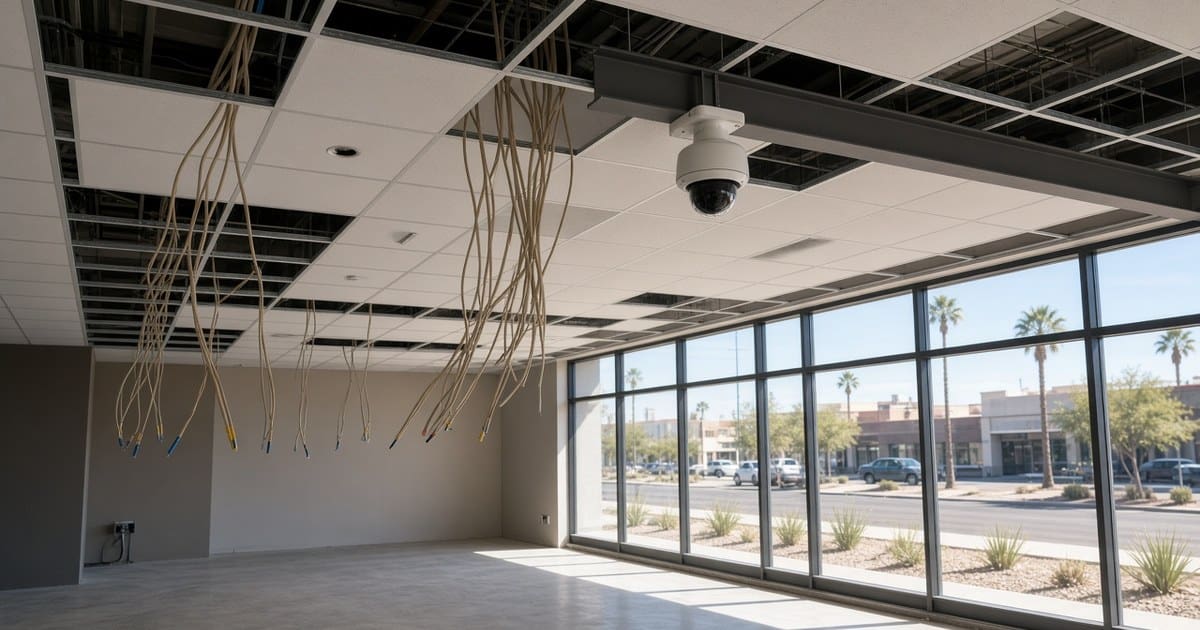
A low-voltage crew in the Phoenix Valley can start the morning terminating fiber in a Scottsdale suite, spend the afternoon pulling Cat6 through a Tempe tenant improvement, and end the day with a general contractor in Mesa asking for a certificate before anyone opens the ceiling grid. The work moves fast, the vans sit in the heat, and the claims tend to come from small things: a cracked ceiling tile, a certifier that walked off overnight, a penetration that starts leaking months after turnover.
This guide covers how insurance for low-voltage contractors works in the Phoenix area, what Arizona expects on the licensing side, and what Valley general contractors tend to ask for before your crew mobilizes. It is a local companion to our four-state low-voltage contractor insurance guide, which covers the full coverage stack in more depth.
The Coverage Pieces Phoenix Low-Voltage Contractors Usually Need
No single policy covers a cabling, security, or AV business. The exposure is split across several coverages, and each one answers a different question. Independent agencies like ours place these with carriers that write contractor business; the carriers, not the agency, insure the risk, and the policy language decides what is and is not covered.
General liability
General liability responds when your work injures a third party or damages someone else’s property. Picture a visitor tripping over a temporary cable in a Scottsdale office, a tech in Tempe scuffing a finished wall while fishing wire, or a ladder clipping a glass storefront near the Camelback corridor. These are the everyday scenarios general liability is built for.
Completed operations
Completed operations is the part of the liability picture that applies after you have left the job. If water finds an improperly sealed penetration weeks or months later, or a device fault damages other property, that is the conversation. One point catches contractors off guard: an owner may ask you to rebuild a failed panel or device as “your work,” and many liability forms limit or exclude the cost of redoing your own work. General liability is designed around damage your work causes to other things. Before you promise a client that your insurance will pay for a rebuild, ask your agent where your policy draws that line.
Workers compensation
Low-voltage work involves ladders, heavy reels, tight ceiling spaces, and unfinished corridors, which is exactly where employee injuries happen. In Arizona, workers compensation requirements generally attach once you have employees, with some statutory exceptions. Report your real payroll, including apprentices and anyone you treat as an independent contractor, because classification questions surface during audits.
Tools and equipment (inland marine)
Fusion splicers, cable certifiers, camera kits, and spare hardware live in vans and on carts. Inland marine coverage is designed for mobile property like this. Carriers often ask about overnight parking, locked storage for spare gear, and whether materials sit on open job sites after hours. In the Valley, where vans bake in the sun and crews cover a lot of ground between Mesa, Tempe, and Scottsdale, those habits deserve honest answers on the application.
Commercial auto and hired and non-owned auto
If the company owns vans or trailers, commercial auto is the coverage for them. If an employee occasionally runs parts in a personal vehicle, hired and non-owned auto is worth reviewing. Tell your agent how far your crews travel and how many stops they typically make so the vehicle exposure is rated on how you actually work.
Add-ons that come with bigger jobs
An installation floater can cover equipment and materials in transit or staged on site until the owner accepts the work. An umbrella adds limits above your liability and auto policies when a GC requires them. Bonds show up on public and larger private projects. Professional liability (E&O) becomes relevant if you design systems, select devices, or program access control rules that a client later disputes. Not every cabling policy includes any of these, so treat each one as its own conversation.
Which Policy Usually Responds First in the Valley
This table is a starting map for Phoenix-area scenarios, not a promise of coverage. Policy terms, exclusions, limits, and the facts of each claim decide the outcome.
| Valley scenario | Policy that usually starts the conversation |
|---|---|
| A visitor in a Scottsdale suite trips on a temporary cable during a data pull | General liability |
| A tech scuffs a finished ceiling or wall in a Tempe tenant improvement | General liability |
| A cable certifier is stolen from a van overnight near Mesa job sites | Inland marine (tools and equipment) |
| An employee strains a shoulder lifting reels on a Camelback corridor buildout | Workers compensation, when Arizona requirements apply |
| A company van hits a parked car between Scottsdale and Tempe sites | Commercial auto |
| An employee in a personal car has an accident on a parts run | Hired and non-owned auto review |
| Camera kits are damaged in transit before the owner accepts the job | Installation floater or inland marine review |
| Months after turnover, a penetration leak damages other property | Completed operations under general liability |
| A client claims access control programming was negligent | E&O or professional liability |
Many of these disputes begin as a labeling, penetration, or programming question and only become an insurance question once the client totals up repair costs or downtime. Keep as-builts, cable test results, and photos of penetrations before they close in your job files. Those records will not rewrite a policy exclusion, but they make it much easier to reconstruct what happened.
Arizona ROC Licensing for Low-Voltage Work
In Arizona, contractor licensing runs through the Registrar of Contractors (ROC). The low-voltage communication classifications are R-67, C-67, and CR-67 Low Voltage Communication Systems. ROC materials describe these scopes as covering work such as alarms, telephone, sound, intercom, public address, television and video, and low-voltage signaling, within the published limits of the classification.
The electrical classifications (R-11, C-11, and CR-11) cover power wiring and are not interchangeable with a low-voltage communication license. If your invoices mix low-voltage and power electrical scopes, confirm with ROC which license covers which work rather than assuming one classification stretches across both. Fire-alarm and life-safety scopes can also carry their own requirements, so check those separately.
Licensing does not stop at ROC. Depending on where you work, city transaction privilege tax licenses and local business registrations can apply in Phoenix, Scottsdale, Tempe, and Mesa. Please verify current requirements directly with ROC and each city before you advertise a classification or bid a job. If your firm also does power electrical, see our guide to Arizona electrical contractor insurance.
What Valley General Contractors Ask For
Requirements vary a lot from one GC to the next. A retail tenant improvement in Mesa may only ask for basic proof of liability coverage. A Camelback corridor office buildout may want additional insured status, primary and non-contributory wording, waiver of subrogation, and umbrella limits before you set foot on site. A medical or professional suite in Scottsdale may put extra weight on certificates before anyone touches nurse-call systems or secure data pathways.
Two things are worth remembering. A certificate of insurance is a summary of your coverage, and it does not create coverage on its own; the endorsements on the actual policy do. And it is much easier to sort out requirements before the bid than the morning your crew is scheduled to start. Send the GC’s insurance requirements to your agent early, and do not promise wording in a bid until you know your policies can deliver it.
How Your Client Mix Shapes the Quote
Valley low-voltage work tends to be a patchwork: professional offices along the Camelback corridor, retail and restaurant tenant improvements in Mesa, coworking and medical suites in Tempe, and camera and access systems for buildings around Scottsdale. Each type of work changes how an underwriter sees the risk. A medical office may involve nurse-call or sensitive data pathways. A retailer may care most about camera uptime after a remodel. A multi-suite building calls for careful labeling so the next technician does not cut the wrong fiber.
Tell your agent which project types make up most of your revenue, and whether one GC represents a large share of your receipts. Concentration can matter to a carrier as much as total volume. Be clear about what you actually sell, too. A firm that only installs to a GC’s plans is a different risk than one that designs systems and programs access rules. If you also handle power electrical, EV charging, or generator work, name that revenue separately instead of folding it into a generic “low voltage” description.
Van, Shop, and Staged Inventory
Plenty of Valley contractors start out with everything in a van and later lease a small shop bay in Tempe or Mesa. That move can change how property and tools are insured. A carrier may ask where vehicles park overnight, whether spare cameras and cable are kept in locked storage, and whether reels sit on open job sites after hours. Keep your equipment values current when you buy new splicers or stage a large order for a big buildout, so the coverage reflects what you actually have on hand.
Getting Ready for a Phoenix Low-Voltage Quote
The more clearly you can describe the business, the smoother the quote goes. Bring:
- Annual receipts and payroll
- Your residential versus commercial mix
- The share of fire-alarm or access control work, if any
- Tool and equipment values, and the value of materials you typically stage
- Your shop address and your typical operating radius across the Valley
- Prior claims history
- Whether you design systems or install to GC plans
- Recent certificate requirements from your GCs, plus a sample subcontract
- The ROC classification you hold
Revisit the program when the business changes: a new van, additional employees, a second location, or a large multi-site GC account. Coverage that fit a two-person crew may not fit the company a year later.
Talk With an Independent Agency That Works With Contractors
Western Pacific Insurance is an independent agency that places coverage for low-voltage contractors in Arizona, Nevada, California, and Utah. Because we are independent, we can look across multiple carriers to find a fit for how your business actually operates. Call 702-932-3105 or use our insurance quote form. Bring your next certificate request and a sample subcontract, and we will start the conversation from the work you really do in Scottsdale, Tempe, Mesa, and along the Camelback corridor.


