
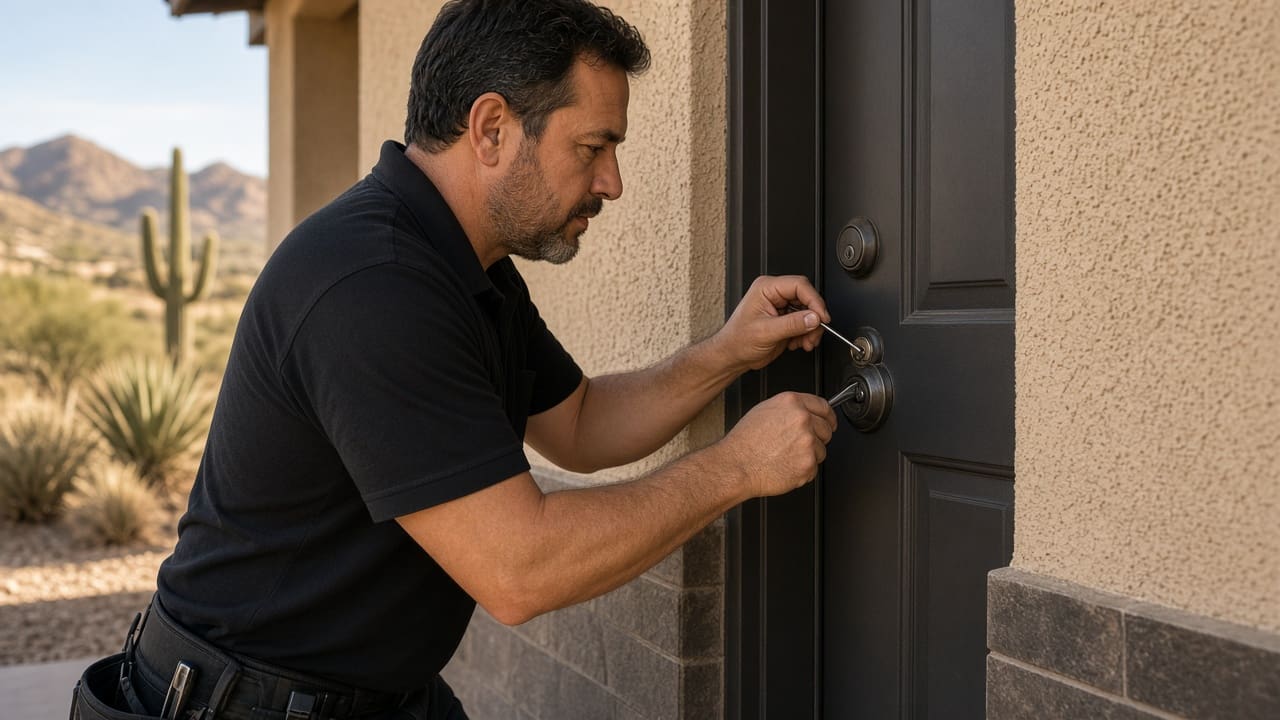
A Phoenix locksmith might start before sunrise to beat the heat, cut a replacement key at an apartment community by mid-morning, and finish the day at a retail site with a lock cylinder that won’t release. The service van is a workshop on wheels, carrying tools, inventory, access information, and the responsibility for every customer site on that route. See our locksmith insurance guide for the full coverage framework before the Phoenix specifics below.
The Insurance Stack for Phoenix Locksmiths
General liability is the starting point for third-party injury and property damage. A customer may allege that an opening damaged a door or frame, that installed hardware scratched surrounding trim, or that tools left out created a trip hazard. The policy still has real boundaries around the property being worked on, defective work, and care, custody, or control, so describe the real service mix and let the carrier evaluate those boundaries with accurate information.
Commercial auto should cover the service vans traveling between Phoenix, Tempe, Glendale, and the surrounding service area. A personal policy usually isn’t designed for regular business use, multiple stops, equipment transport, or employee drivers. Hired and non-owned auto can help with rented vehicles or personal vehicles used on business calls, but it doesn’t replace coverage for the owned vans themselves.
Inland marine is the policy to discuss for equipment that leaves the shop. Key machines, programmers, code machines, drills, picks, blanks, cylinders, and electronic devices can represent a lot of value riding in one vehicle. Ask about theft from an unattended van, overnight parking, inventory, scheduled equipment, deductibles, and valuation, and coordinate the tools limit with whatever physical damage and contents treatment the auto policy already provides.
Phoenix Claim Patterns Are Route Problems
Heat, traffic, and crowded commercial lots add pressure to ordinary calls. A technician may damage an older door while opening it, back into a customer’s vehicle, or suffer an eye or hand injury while cutting a key. GL, commercial auto, and workers compensation can each be involved depending on which of those actually happens, and a work order plus before-and-after photos help establish the condition of the property either way.
Access work creates its own class of allegation. A customer may claim a master-key schedule was entered incorrectly, that a credential went to the wrong person, or that a key-control mistake caused a financial loss. General liability may address resulting property damage or bodily injury, but a pure financial or professional-services allegation may call for E&O instead, if a carrier offers it for the operation. Explain mechanical, automotive, electronic, credential, and access-control work clearly on the application so the right coverage actually gets considered.
Employee dishonesty or crime coverage is also worth a conversation once technicians handle master keys, codes, credentials, or customer property regularly. Review the definitions and recordkeeping conditions closely, since authorization logs, restricted access to code records, employee background procedures, and a documented key handoff are useful controls even when a loss never becomes a claim.
Arizona Licensing and Local Checks
The Arizona Registrar of Contractors generally requires a license when a business contracts, or offers to contract, to build, alter, repair, or improve a building or other structure, but the ROC classification list reviewed doesn’t identify a general locksmith classification. That means a locksmith shouldn’t pick a classification by guesswork.
If a job reaches construction-related installation or a separate system scope, request an actual determination from the ROC. The ROC does list R-67 for specified low-voltage communication systems, covering certain alarm, telephone, sound, intercommunication, television, and video work, but that description isn’t a blanket answer for every access-control or lock assignment. Phoenix and other local jurisdictions can also require business registration, transaction privilege tax treatment, permits, or other approvals.
Arizona generally requires workers compensation for employers with employees, subject to statutory exceptions. Confirm the current requirement with the Industrial Commission of Arizona and make sure the policy payroll reflects actual technician duties, since a sole owner, a working member, and a hired technician can each be treated differently under the law and the policy.
Protect the Van and the Customer Relationship
Keep key machines secured while the van is unattended and maintain an inventory of high-value devices. Shut down and secure cutting equipment after use, and record the customer’s identity, authorization, location, work performed, replacement parts, and sign-off on every job. If the job concerns a commercial master-key system, retain the authorization and delivery record along with it.
Heat, Monsoon Weather, and Equipment Storage
Phoenix heat puts extra stress on a mobile operation. A van may sit on hot asphalt while a technician works in a shaded entry, and electronic programmers, batteries, adhesives, and inventory should be stored according to the manufacturers’ instructions rather than left to the truck cab. During monsoon weather, sudden wind and rain can turn an outside work area into a property-damage or slip exposure fast, so a simple pause, a cord check, and an equipment cover can prevent a rushed loss.
Traffic and route density matter too. A driver may make calls across several municipalities in one day, load a heavy key machine beside an active lot, or reverse near pedestrians. Commercial auto underwriting should get the real garaging address, territory, driver list, vehicle use, and overnight parking arrangements, and the vehicle list is worth revisiting whenever a technician takes a van home or a new route opens.
Commercial Accounts, Certificates, and the Paper Trail
Phoenix property managers often manage many units and several layers of authorization. A locksmith should retain the dispatch ticket, the person who approved the call, the unit or door number, the keys issued, and the completion signature, and when a master-key schedule changes, keep the approved schedule and note who accepted the final set. A controlled process reduces the chance that an ordinary service call turns into an access dispute.
Property managers and commercial customers may also ask for additional insured status, primary and noncontributory wording, a waiver of subrogation, or a particular limit before sending work. Give the contract to your agent before a certificate has to go out, since those requests usually require endorsements and shouldn’t be handled after the fact. A certificate shows evidence of the policy; it can’t add the endorsement or change the coverage form on its own.
Review the Policy as the Business Expands
A sole operator with one van may later hire technicians, add automotive key work, or install access hardware for office buildings. That growth can change GL classification, auto drivers, payroll, inland marine limits, crime exposure, and the availability of E&O, so schedule a review when the service menu changes rather than waiting for renewal to catch up. Report actual work plainly, including work that’s occasional but still material to the risk.
Quote the Operation Honestly
Underwriters need annual sales, payroll, drivers, vehicle values, tool values, loss history, and service territory. They also need to know whether the company works in homes, apartments, vehicles, offices, retail sites, or construction settings, and what share of revenue comes from mechanical locks, automotive keys, access hardware, and other services. A complete description is more useful to everyone than a low estimate that leaves the carrier guessing.
When a call goes wrong, protect people first, prevent additional damage, photograph the scene, preserve the work order, and notify your agent promptly. Don’t promise a customer that a particular policy will pay; the facts and the policy form need to be reviewed together before anyone makes that call.
Western Pacific Insurance places locksmith coverage in Arizona and across Nevada, California, and Utah. Call 702-932-3105 or request an insurance quote for a Phoenix program built around your vehicles, tools, and actual access work.


