
Locksmith Insurance: Coverage for Keys, Access Work, Tools, and Service Vans
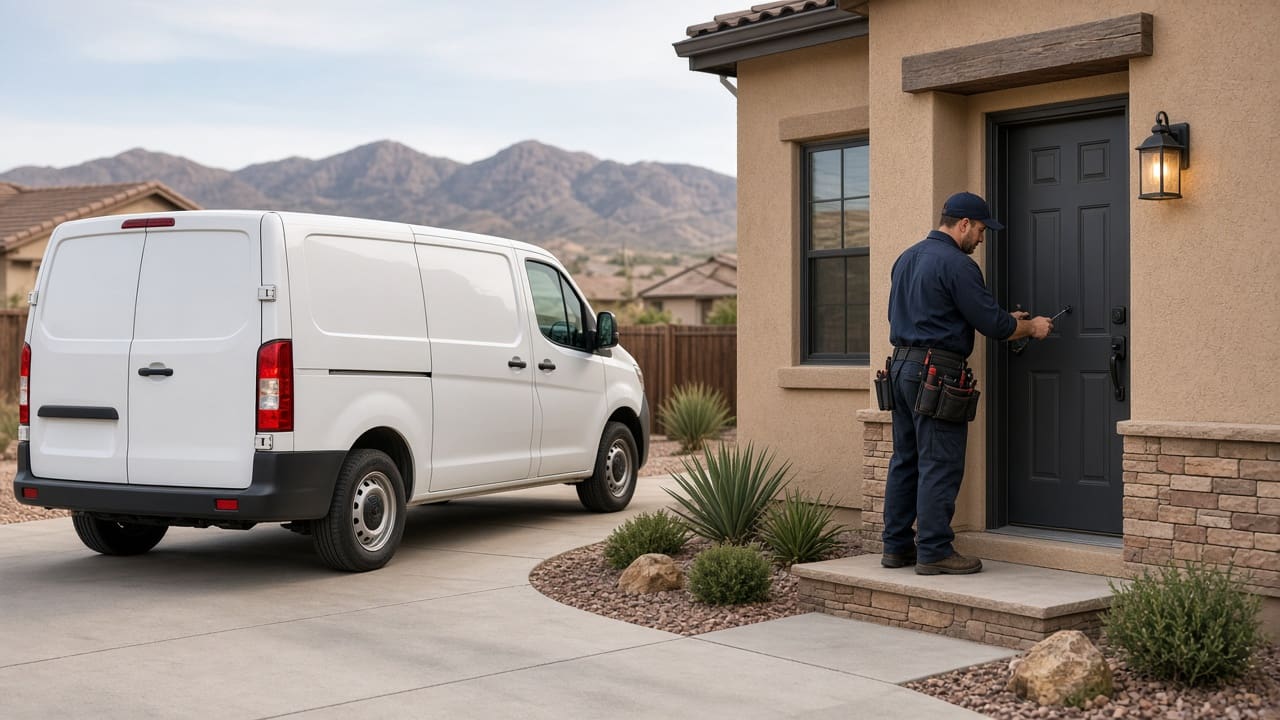
The call comes in at 10:42 p.m. A tenant is standing outside an apartment in Henderson, a key has snapped in the cylinder, and the property manager wants the door secured before morning. The locksmith arrives with a van full of blanks, picks, a programmer, and a key machine. One careful opening can turn into a damaged frame claim, a van exposure, a tool theft question, or an argument about who authorized access in the first place.
That’s why locksmith insurance needs to follow the actual work. A locksmith opens, repairs, installs, modifies, rekeys, and originates keys for locks, and the business may also handle master-key systems, access hardware, credentials, or related low-voltage equipment. Each part of that route raises a different insurance question, so the right program starts with an honest work description and builds the policies around the people, vehicles, tools, customer property, and access information actually involved.
The Coverage Stack for a Locksmith Business
Most locksmith operations need more than one policy. General liability addresses many third-party injury and property damage claims. Commercial auto follows the service vans, and inland marine protects mobile tools and equipment. Workers compensation covers employee injuries where required, and E&O may be worth adding when the operation provides technical access or key-control services that create professional exposure. Crime or employee fidelity coverage addresses a separate trust question involving keys, credentials, or property.
| The exposure | Coverage to discuss |
|---|---|
| Door, frame, trim, or customer property damaged during an opening | General liability, subject to policy wording and exclusions |
| Service van hits another vehicle between calls | Commercial auto |
| Key machine or programmer stolen from a van | Inland marine tools and equipment, if the form covers the loss |
| Technician cuts a finger or suffers a work injury | Workers compensation where required |
| Master-key or access mistake creates a pure financial allegation | E&O or professional liability, if available for the operation |
| Employee is accused of taking property after a service call | Crime or employee fidelity coverage, subject to definitions and conditions |
Treat the table as a starting map rather than a claims promise; the actual policy form controls, and a carrier may treat the same event differently depending on whether it’s accidental property damage, defective work, a professional service allegation, or an intentional act.
General Liability and the Customer Premises
General liability is the base of a locksmith program because technicians work in other people’s homes, apartment buildings, offices, vehicles, and retail spaces. A customer may allege a drill scratched a door, an opening damaged a frame, a newly installed lock marred surrounding trim, or someone tripped over tools near the work area. GL is built to address covered third-party bodily injury and property damage arising from that kind of work.
The important boundary sits between damage to nearby property and the item actually being worked on. A standard GL policy commonly excludes or limits coverage for the insured’s own faulty work and for property in the insured’s care, custody, or control. If the work order says the locksmith is repairing a particular door, the carrier may look closely at whether that door, or a component of it, counts as the property being worked on; if a tool falls and damages a nearby display case instead, the analysis can go a different way. The exact facts, definitions, and endorsements decide it.
GL also doesn’t usually turn a workmanship dispute into an insured repair budget. If a cylinder was installed incorrectly and needs to be removed and replaced, the cost to redo the locksmith’s own work may not be covered, even though resulting damage to other property might be. Tell your agent what kinds of hardware you install, where technicians actually work, and whether the business takes responsibility for a customer’s system while it’s being serviced.
Lock and Key Claim Patterns Worth Planning For
A lockout can look simple until the first piece of hardware fails. A technician applies force to an old cylinder and the frame splits. A key blank gets cut to the wrong code and a tenant can’t get into a unit. A master-key schedule is entered incorrectly and a property manager says too many doors became accessible. A technician leaves a door unsecured while waiting on replacement hardware. None of these belong under the same coverage automatically.
Physical damage to a customer’s door, frame, vehicle, or other property is usually a GL conversation. A complaint that the work didn’t perform as promised is more often a workmanship or contract issue. A claim that a key-control system was designed or administered incorrectly can raise a professional liability question, and an employee’s intentional conduct can pull in crime, fidelity, or intentional-act exclusions instead. The first report to your agent should describe what happened in plain language rather than trying to guess the coverage category up front.
Keep the work order. Record the customer’s identity and authority to request the service, the address, the vehicle or unit number, the condition before work, the tools used, the replacement parts, the completion time, and the customer’s sign-off. For commercial accounts, save the authorization email or dispatch ticket, and for master-key or credential work, document who supplied the information and who received the finished keys or credentials.
Commercial Auto for the Service Route
A locksmith van is a mobile workshop carrying key machines, blanks, cylinders, programmers, drills, batteries, ladders, and paperwork between calls. A vehicle used primarily for that work belongs on commercial auto rather than a personal auto policy, especially once the driver is making several stops a shift, backing into apartment lots, parking along active roads, or loading equipment while the next call is already waiting.
The policy conversation should cover every owned vehicle used in the business and every regular driver, along with the radius of operations, vehicle use, employee driving, overnight parking, and whether tools or inventory stay in the van. Physical damage coverage for the van itself doesn’t automatically insure what’s inside it, which is exactly where commercial auto and inland marine need to be coordinated.
Hired and non-owned auto can help when the business rents a vehicle, borrows one, or an employee uses a personal car for a business call, but it isn’t a replacement for scheduling owned vans, and it doesn’t automatically cover damage to the borrowed vehicle itself. Ask about the business’s actual dispatch practices before settling on limits.
Inland Marine for Key Machines and Mobile Tools
The tools leave the shop every morning. A key machine alone can cost far more than a casual inventory list suggests, and programmers, code machines, specialty picks, electronic devices, blanks, cylinders, and replacement hardware add up quickly across several vans. Inland marine coverage, often written as tools and equipment coverage, is built to follow that property away from a fixed premises.
Ask whether the form covers theft from an unattended vehicle and whether there are security conditions attached to overnight parking. Discuss inventory, newly acquired equipment, rented equipment, outdoor work, transit, valuation, and deductibles. A small operation may have one expensive programmer worth scheduling on its own; a larger one may carry a broad inventory of blanks and cylinders that needs a different reporting approach entirely.
Don’t rely on a general property limit at the shop to solve a mobile-tool problem. A businessowners policy or package may include some off-premises coverage, but the sublimit and covered causes of loss can be too narrow for what actually rides in the vans. List the equipment and show the carrier how it’s stored, transported, and used.
Workers Compensation for Technicians
Locksmith work combines sharp metal, powered equipment, lifting, driving, kneeling, and awkward positions. A technician can cut a finger handling a blank, suffer an eye injury from a metal fragment, strain a shoulder moving hardware, or get hurt beside a roadway. Workers compensation is meant for covered job-related employee injuries and is generally required once a business has employees, with state-specific exceptions.
Owner status matters, since some states allow an owner or member to elect an exemption while others use different rules, and payroll classification matters too when technicians split time between the shop, the road, and hardware installation. Give your agent an honest split of duties and review the policy at audit; a company that starts with one owner and later adds two technicians has a genuinely different workers compensation conversation than it did on day one.
Safety controls help the business and the insurance file together. Guard cutting and grinding equipment, use eye protection, control dust and fragments, inspect cords and batteries, secure sharp tools, and train employees on lifting and roadside work. OSHA’s job hazard analysis approach focuses on the relationship between the worker, the task, the tools, and the environment, and it’s a practical way to spot the small conditions that turn into large injuries.
Professional Liability for Access and Key-Control Work
A locksmith may do more than turn a cylinder. The business might create a master-key schedule, manage credentials, install access hardware, or advise a property manager about who should be able to enter a space. A customer who suffers a financial loss after an access mistake may frame the allegation as negligent professional service, and since general liability is primarily built for bodily injury and property damage, a purely financial claim may need E&O or professional liability coverage instead, if a carrier offers a form for that kind of operation.
Availability depends on the carrier and how the service gets described. An application should explain mechanical lock work, automotive key work, electronic access, credential handling, key-control administration, and any design or consulting work involved. Don’t describe the business only as emergency lockouts if technicians also design or manage access systems, since a more accurate description leads to a more useful quote comparison.
Crime and Employee Fidelity
Customers give locksmiths unusual access. A technician may handle a master key, a code list, a vehicle key, or credentials for an entire building, so employee dishonesty or crime coverage is worth evaluating once the business has staff, commercial accounts, or controlled key systems. It can respond to a defined theft by an employee, but it won’t automatically cover every missing item or every customer allegation.
Crime forms often carry strict conditions: prompt notice, proof of loss, a defined discovery period, background-check practices, or particular records. Read the form against your actual key-control process, since coverage is not a substitute for authorization logs, restricted access to codes, dual control for sensitive keys, and a clear employee termination procedure.
Licensing Checkpoints in Nevada, Arizona, California, and Utah
Insurance and licensing are separate questions. A customer can request a certificate even when a state agency requires a license, and holding a license doesn’t expand the insurance policy. The checkpoints below are a practical starting point for a business serving all four states; confirm the exact scope with the agency and local jurisdiction before bidding a job.
| State | What to verify |
|---|---|
| Nevada | The Nevada State Contractors Board does not show a standalone locksmith classification in the material reviewed. Ask the Board whether the actual installation or repair scope counts as contractor work, and check Henderson and Clark County business licensing separately. |
| Arizona | The Registrar of Contractors generally requires a license for contracting to build, alter, or repair a structure, but there’s no general locksmith classification on its list. Request a scope determination once the work reaches construction or a separate system trade. |
| California | BSIS regulates locksmith companies and employees through the LCO company license and LCO employee registration. BSIS also confirms a contractor’s license is required for work at a single site exceeding $500, with scope-specific CSLB review. |
| Utah | The DOPL materials reviewed don’t identify a statewide locksmith-specific license. Confirm contractor, local, alarm, access, electrical, or low-voltage requirements for the actual job with DOPL directly. |
Agency pages, statutes, fees, classifications, and local rules change, so the cleanest practice is to keep the written scope response or current license record with your business files, especially once a locksmith expands from mechanical service into access systems or construction-related installation.
Contracts, Certificates, and Additional Insured Requests
Apartment operators, retailers, facilities managers, and general contractors may ask for a certificate of insurance before dispatching work, along with additional insured status, primary and noncontributory wording, a waiver of subrogation, or a higher GL limit. Send the contract or purchase order to your agent before the job starts, since a certificate shows evidence of insurance but can’t add an endorsement or broaden the underlying policy on its own.
Make sure the named insured matches the entity signing the service agreement. If the company uses a trade name, confirm how it’s listed, and if separate entities own the vans, shop, or real estate, tell your agent. The coverage program should reflect the legal entities that actually take payment, hire technicians, and sign customer contracts.
How to Prepare for a Locksmith Insurance Quote
Bring a current vehicle list, driver list, equipment schedule, annual sales, payroll, subcontractor information, loss history, and sample contracts. Break revenue into residential calls, commercial accounts, automotive work, hardware sales, access systems, and any other service line, and explain where technicians work, what they carry, and whether equipment stays in vans overnight.
Ask your agent to walk through the important boundaries in writing: where the GL policy draws the line around the property being worked on, whether theft from a vehicle is covered under the tools form and at what limit, whether hired and non-owned auto limits are adequate for the route, whether the E&O form contemplates key-control or access services, and what conditions apply to the crime form. Those are the questions that connect the premium to the actual call.
What a Carrier Needs to Know About Your Operation
Two locksmith businesses can have very different insurance needs even when both answer lockout calls. One may work alone from a pickup, keep a modest tool kit, and service residential customers. Another may employ several technicians, run multiple vans, handle restricted master-key systems, install electronic access hardware, and carry inventory for property managers. The policy should follow whichever operation the business has actually become.
Tell your agent whether technicians work in occupied homes, vacant units, hospitals, schools, retail stores, offices, vehicles, or construction sites, and whether the business takes possession of keys, creates restricted duplicates, stores customer credentials, or uses subcontractors. Include any safe, gate, intercom, or access-control work. A clear description helps the carrier select the right class and helps you spot when part of the operation needs separate review.
Review the program at every renewal. Add a van when it enters service, raise the equipment limit when a new programmer gets purchased, and report a shift from residential calls to commercial master-key work. Recheck certificates whenever a property manager changes its contract, since insurance isn’t a one-time purchase for a route that changes every season.
When a Claim Happens
Protect people first, then prevent additional damage. Photograph the condition, preserve the work order, identify witnesses, and notify your agent or carrier promptly under the policy’s conditions. Don’t promise a settlement or admit a coverage conclusion at the customer’s door, and keep the key, cylinder, damaged part, or tool involved in the event when practical. A clear factual record gives an adjuster a far better starting point than a hurried description written after the equipment has already been thrown out.
Western Pacific Insurance is based in Henderson and places coverage for locksmith businesses across Nevada, Arizona, California, and Utah. Call 702-932-3105 or request an insurance quote for a program built around the work you actually perform.


