
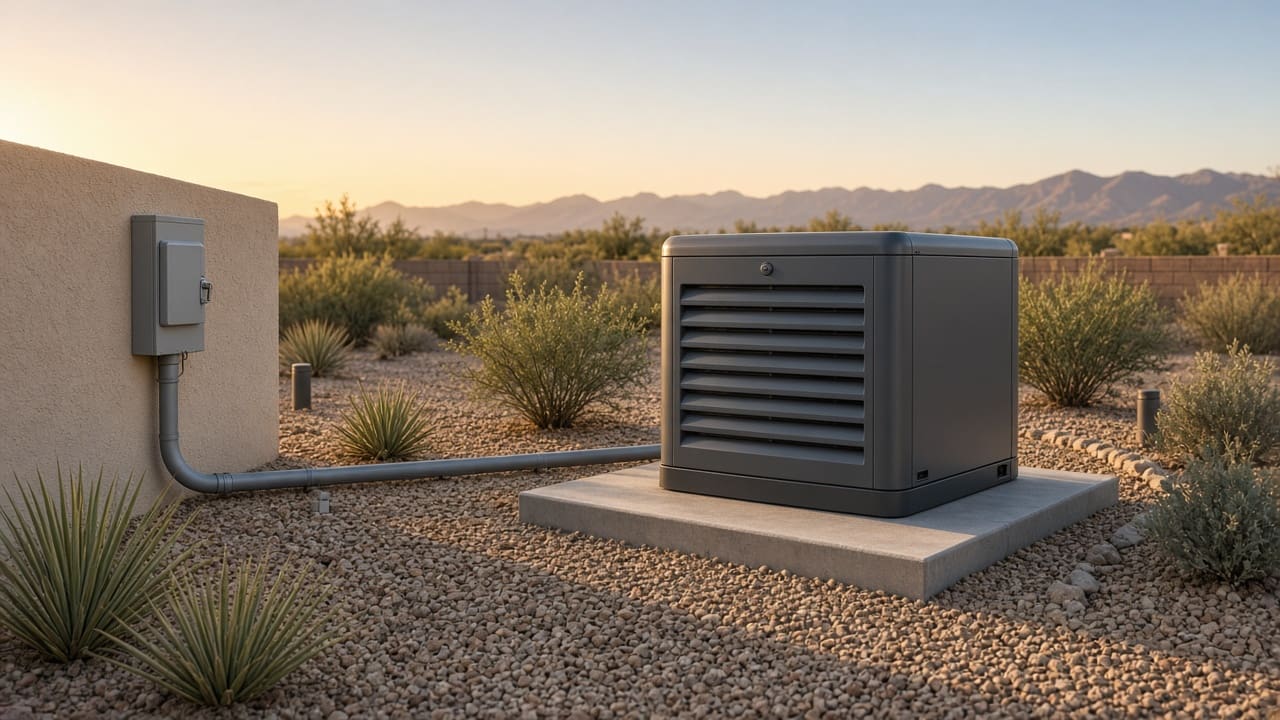
If you install standby generators around Phoenix, you already know the job is never just the generator. You set a pad in Gilbert, trench for conduit, and mount a transfer switch. Then you make the final connection to a panel that may be older than your truck. You do it again in July, when the pad burns skin and a monsoon cell is building over the Superstitions. Your insurance needs to fit that work, the Arizona license you hold, and the certificates your customers ask for. This guide walks through how we approach it.
Arizona Licenses the Business, and a Qualifying Party Backs It
In Arizona, the Registrar of Contractors licenses your company, not you personally. A qualifying party stands behind the classification. That person documents the trade experience and passes both the trade exam and the statutes and rules exam. They also answer for the work done under the license. For generator installers, the usual classifications are R-11 for residential and C-11 for commercial. CR-11 puts both under one license.
C-11 covers the installation, alteration, and repair of wiring and equipment that generates, transmits, or uses electrical energy under 600 volts. Most residential and light commercial standby projects fit inside that range. Your actual scope still needs to match what you tell the ROC and what you tell your carrier. If your crews set service equipment, wire controls, or do anything beyond the electrical classification, both applications should say so.
A few licensing details trip up growing shops. Any job that needs a permit, or any job over $1,000 in labor and materials, falls under the licensing rules. The small-job exemption is narrower than most people assume. License bond amounts scale with your classification and your expected gross volume, so a bond that fit two years ago may be short today. Residential contractors also pay into the Residential Contractors’ Recovery Fund or post a recovery bond in its place. None of this replaces general liability, and general liability does not satisfy any of it. You need both, and you need to keep the bond and revenue tier current as the business grows. The Arizona Registrar of Contractors is the place to confirm the current requirements.
What Each Coverage Actually Does
General liability is where every generator installer starts, and it is the policy your customers ask to see on a certificate. It responds when your work damages someone else’s property or injures someone who is not your employee. Think of a transfer switch wired wrong, a fire that starts at the connection, or a wall you opened and did not close properly. Pay close attention to the completed operations part of the policy. Most generator claims show up after your crew has left the pad, often months later, when the unit runs during its first real outage. Make sure the carrier rates you as a generator and electrical installer with trenching and mounting in the mix. A generic contractor class that happened to be cheaper will not hold up in a claim.
Workers compensation is required in Arizona once you have a single employee, and the employer pays for it. Generator work puts your people around energized systems, heavy equipment, concrete, and open trenches. Keep payroll separated by the type of work each employee does. Clean records make your annual audit shorter and give the carrier an accurate picture of the risk.
Commercial auto belongs on the list if your trucks carry generators, transfer switches, fuel components, ladders, or tools between jobs. That describes almost every installer. If employees ever use their own vehicles for a supply run, add hired and non-owned auto. Some general contractors will require it before they let you on site. Our business auto insurance page covers the vehicle side in more depth.
Inland marine covers the tools, meters, and equipment that live in your trucks and on job sites rather than at the shop. A generator sitting on a pad waiting for inspection is a classic inland marine question, and one worth settling before the first unit disappears overnight.
Professional liability enters the picture when you design the system, size the unit, specify equipment, or give advice a customer relies on. General liability will not pay to redo your own faulty work. It also will not cover a bad load calculation that leaves a customer dark in an outage. If any part of your business is design or consulting, ask us about it. The broader generator installer insurance guide explains those exposures in more detail. Our Arizona electrical contractor insurance article covers the electrical side of the trade.
Heat, Monsoon, and the Claims That Follow
Phoenix adds two risks that carriers in other markets rarely think about. The first is heat. Summer installations mean early starts, long stretches of lifting on exposed pads or rooftops, and more time around energized systems while workers are tired. Carriers ask about heat safety on the workers compensation application. A real answer, such as shaded breaks, hydration, and shifted start times, is worth more than a blank line.
The second is monsoon. An open trench in Queen Creek or Buckeye can fill in minutes, and wind can push unsecured material into a neighbor’s yard or through a window. Photograph the pad, the trench, the equipment, and the surrounding property before you start. Keep delivery records and serial numbers for every unit and transfer switch. When something goes wrong, those records separate damage to the customer’s property from damage to the equipment you were installing. They also show what was already there before you arrived.
The same habits protect you from theft. Generators and copper are easy targets while a site waits for final inspection. Know where units are stored overnight, whether the site is secured, and who has access. Those answers shape the property and inland marine portions of your quote. If you want a deeper look at the equipment and standards involved, NEMA publishes useful product information. Your application still needs your own revenue, payroll, subcontractor, and project details.
Keep Residential and Commercial Work Separate on Paper
A shop that installs residential transfer switches looks different to a carrier than one that delivers emergency-power packages to a medical office. Your application should show the split between residential and commercial revenue, the voltage range you work in, what your employees perform, and what you subcontract. Do not let a convenient class code hide a change in your operations. The time to find out your commercial work is excluded is not after a claim.
Fuel gas deserves its own line. If your crew runs gas lines, disclose it, and make sure your license and coverage extend that far. If a licensed sub does that work, collect a certificate of insurance first. Confirm the sub’s scope and limits before they set foot on the job. Take the same approach with concrete, excavation, plumbing, and controls. Every crew and every subcontractor should work inside the scope you have stated, and the records should stay current.
Many generator installers also do EV charger or solar work. Keep that revenue in its own file so it can be rated correctly. See Phoenix EV charging contractor insurance and Phoenix solar contractor insurance for those trades. Stored units, parts, and tools at your shop may need commercial property insurance. And if you manage entire construction projects rather than installing equipment on them, read Phoenix general contractor insurance instead of relying on an installer description.
What to Bring to a Phoenix Quote
A good quote starts with a clear description of the work. You will save time by gathering it before the first call. Bring your annual sales, the residential and commercial split, typical project size, and voltage range. Add payroll by type of work, employee count, subcontractor costs, vehicles, tools, and every state where you work. Include your largest contract and any additional-insured or certificate requirements that repeat across your customer base.
Then tell us who designs the system, who pulls permits, who makes the final connection, and whether you service and maintain units after installation. Carriers insure what they understand, and we can only place coverage that matches what you tell us. Accurate details up front will serve you better than a low quote built on the wrong classification.
Get a Phoenix Generator Installer Quote
Western Pacific Insurance is licensed in Arizona, and we place coverage for generator installers with carriers that understand the trade. Before anything is bound, we review your classification, completed operations wording, auto needs, tools, payroll, and certificate requirements. Start with an Arizona quote request. Our Arizona insurance page lists the other business coverage we offer in the state.


