
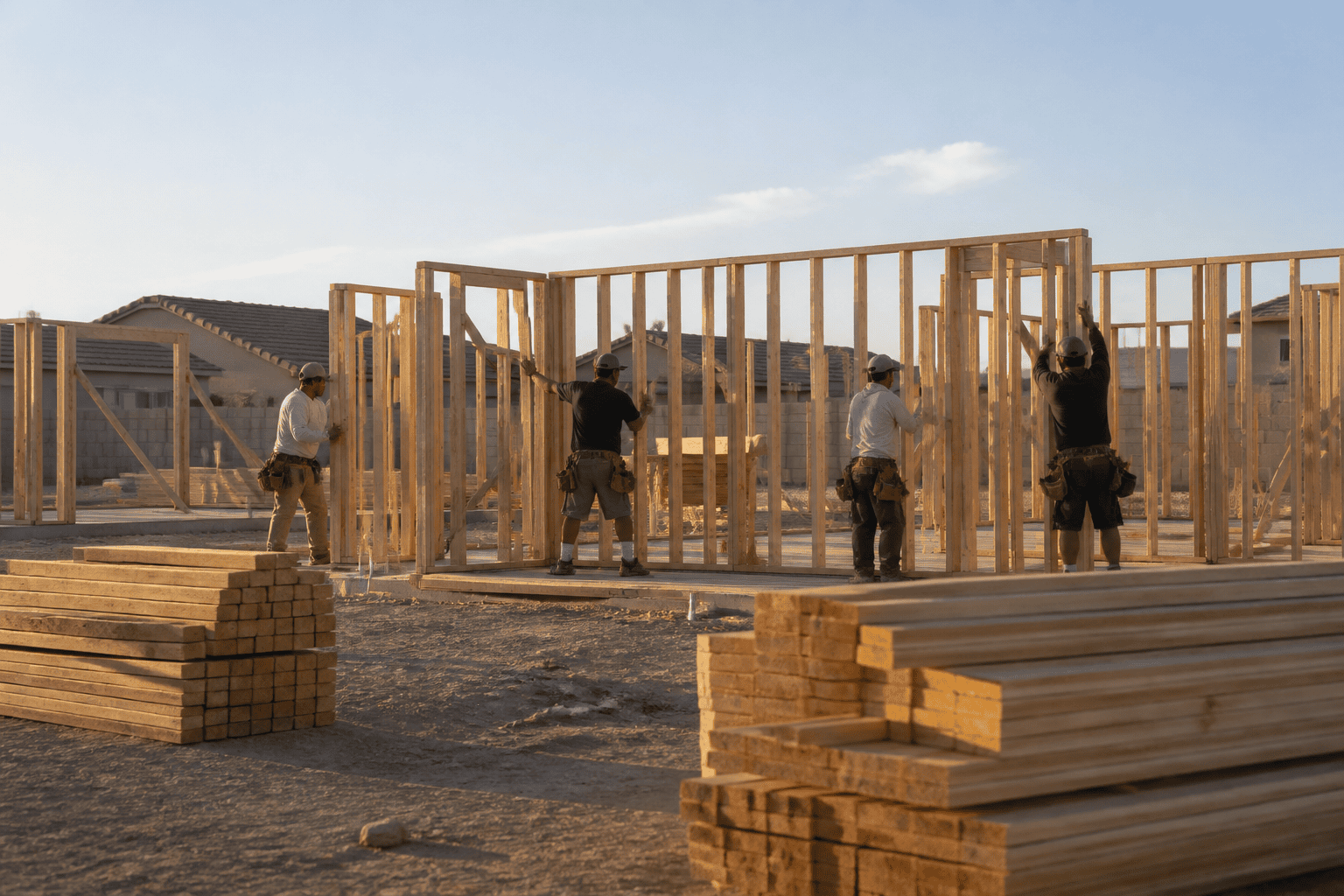
If you frame houses in Gilbert, Queen Creek, or San Tan Valley, your year runs on a production schedule. The builder releases lots, your crew stands walls at dawn, and the trusses go up before the next storm cell rolls in. Phoenix framing contractor insurance has to fit that pace, and it has to satisfy three audiences at once. The Registrar of Contractors cares about your license and bond. The builder cares about the certificate, and your carrier audits the payroll at year end. Most of the trouble we see starts with a policy that pleases one of them and quietly fails another.
Start With the Right License, Because Carriers Check It
Arizona has no license class called framing. Structural framing sits under the Carpentry classification, which the Registrar issues as R-7 for residential work, C-7 for commercial, and CR-7 for both. The Registrar’s classification list describes the scope as rough carpentry, finish carpentry, hardware, millwork, metal studs, metal doors and frames, and windows. Some online guides still send framers to C-9, but in Arizona C-9 is concrete. A builder’s compliance desk will catch that mismatch, and so will an underwriter.
Two neighboring classes cause the same kind of confusion. R-60 and C-60 cover finish carpentry only, which means cabinets, countertops, and door trim. R-61 covers remodels, additions, and repairs to existing structures, capped at $50,000 per project. New tract framing does not fit there at any dollar amount. If your work has moved from remodels into new construction, the license has to move with it. After a loss, an adjuster will confirm early whether you held the right class for the job.
The license belongs to your business entity, and a qualifying party has to stand behind it. That person documents four years of trade experience and passes both the trade exam and the statutes and rules exam. If your qualifier ever leaves, you have a limited window to replace them. Treat that role like the key position it is.
Bonds Are Not Insurance, and the Registrar Does Not Require Liability
Your license bond scales with your classification and your annual volume. A residential specialty contractor posts $4,250 under $375,000 in volume and $7,500 above it, while commercial specialty bonds run from $2,500 to $50,000. A CR-7 dual license carries both. Residential licensees also pay into the Residential Contractors’ Recovery Fund or post a separate $200,000 bond. The Registrar publishes the full bond schedule, and it is worth checking at every renewal. A strong year can push you into the next tier, and the bond has to follow.
A bond protects your customers, not you. If the surety pays a claim, it comes back to you for reimbursement. General liability is the coverage that actually stands between a claim and your bank account, and the Registrar does not require it. Do not read that as permission to skip it. Every production builder in the Valley will require liability before your crew steps on a lot. Treat the limit in the subcontract as a floor. One framing defect repeated across a phase of homes can outrun a minimum limit quickly. Nobody has ever regretted carrying more than the contract asked for.
What Phoenix Framing Contractor Insurance Should Include
General liability comes first, and for a tract framer the exclusions matter more than the price. Many contractor policies exclude new residential construction, tract homes, or work above a stated height. A policy like that produces a clean certificate and then denies the first claim from the subdivision you work in every day. Read the exclusions before you bind. Make sure the policy can add the builder as an additional insured for both ongoing and completed operations.
Completed operations deserves its own attention. Arizona’s statute of repose, A.R.S. 12-552, lets contract-based construction claims reach back eight years after substantial completion, and nine in some latent defect cases. The walls you stand this fall stay on your books for most of a decade. Keep your liability coverage continuous, and keep every old policy and certificate on file.
Workers’ compensation is mandatory in Arizona once you have employees, and you pay the full premium as the employer. Framing rates run high because of the height and the lifting, so clean payroll records pay off at audit. Collect a certificate from every piece-work crew you hire. If a sub turns out to be uninsured, the auditor adds that payroll to yours.
Commercial auto covers the trucks and trailers running between lots. An inland marine policy covers compressors, nailers, and lifts wherever they sit overnight. Ask about an installation floater too, since lumber on an open lot is an easy theft target.
One gap catches framers by surprise. If a builder rejects your work, liability will not pay to tear it out and redo it. Our framing contractor insurance guide walks through that workmanship gap in detail. If part of your revenue is trim and millwork, read our Arizona carpenter insurance guide as well. Carriers rate finish work differently than structural framing.
Heat and Monsoon: The Two Claims Phoenix Weather Writes
Heat illness is a workers’ compensation claim, and Arizona is watching it closely. In April 2026 the Industrial Commission of Arizona approved new workplace heat guidance and folded it into an updated Heat State Emphasis Program. The guidance calls for a written heat illness prevention plan that covers water, shade, rest, training, and acclimatization for new hires. Inspectors use the program to target active construction sites on heat warning days. Carriers follow the same thread, so expect questions about your summer start times and whether your heat plan exists on paper.
Monsoon wind is the other half of the story, and it raises a question worth settling before the season starts. When a storm flattens braced walls, who pays? If your materials damage a finished home next door, that is a liability claim. Damage to the house under construction usually belongs on the builder’s policy. That is why builders risk insurance in Phoenix matters to you even when you do not buy it. Ask each builder whether their policy covers your work in progress and your materials on site. Whatever the answer, photograph your bracing at the end of every day during storm season.
Walls, Floors, and Roofs: Tell the Carrier What You Actually Do
Underwriters price a crew that only stands walls differently from one that also sets trusses and sheathes roofs. The roof work carries more height exposure, and the rate reflects it. Describe your real revenue mix on the application, and tell your agent when that mix changes during the year.
Your payroll records matter here too. When your crew’s work falls into more than one workers’ compensation class, you can only split the payroll if your records separate it. Without that detail, the auditor can assign everything to the highest rated class. If you have grown into running the whole start, from slab to dry-in, you are no longer buying a framer’s policy. That is Phoenix general contractor insurance, and the policy should say so.
Get a Phoenix Quote
Western Pacific Insurance is licensed in Arizona, and we place coverage for framing contractors across the Valley. As an independent agency we shop multiple carriers, and we read the residential exclusions and completed operations language before you bind. Bring your subcontract, and we will check its insurance requirements against the policy line by line. Start with an Arizona quote request, or visit our Arizona insurance page to see everything we write in the state.


