
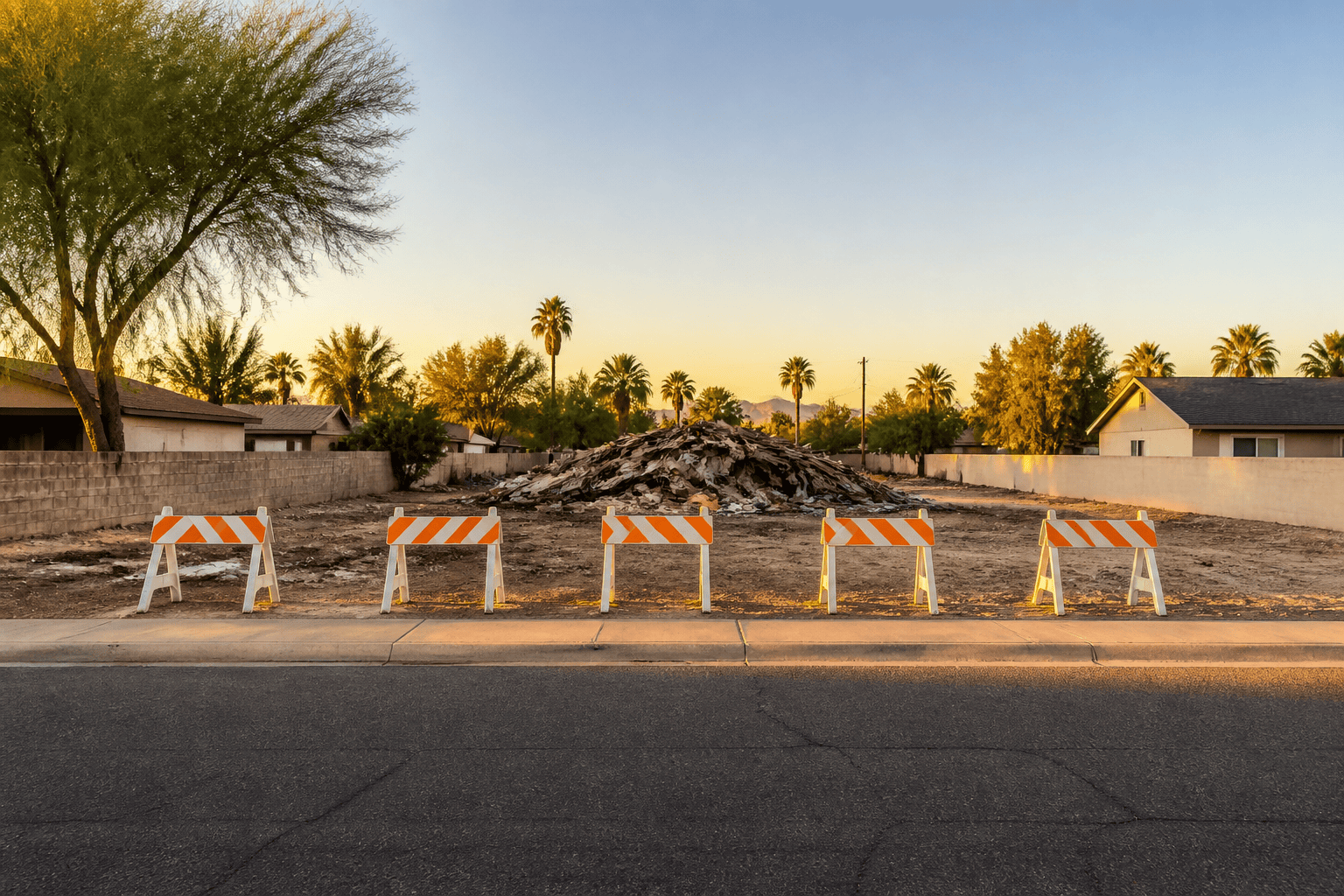
Most Phoenix tear-downs start with a house nobody wants on a lot somebody does. In Ahwatukee and Laveen, that means dropping a 1970s ranch so a builder can pour a new slab. In Arcadia and Desert Ridge, it means a selective strip-out where one wing comes down and the finished wing beside it has to survive untouched. Add the East Valley jobs in Mesa, Gilbert, Chandler, and Queen Creek that share the same trucks and the same crew, and you have a business that spends most of its year working in the heat and part of it working around monsoon storms. Phoenix demolition contractor insurance has to fit all of that, and it has to produce the certificate the owner or general contractor will actually accept.
Arizona Puts Wrecking on the 57 Card, Minus Explosives
The Arizona Registrar of Contractors licenses the business, not the person. Someone still has to stand behind that license as the qualifying party, meaning the individual who documents the trade experience and passes the exams. Structural tear-down work runs on the R-57 residential, C-57 commercial, or CR-57 dual Wrecking classification. Those classes let you demolish, dismantle, or remove structures not intended for reuse, and install the temporary ramps, barricades, and pedestrian walkways that work requires. None of them allow explosives. Blasting sits in a different license family entirely, so if a job ever moves from mechanical wrecking to charged work, tell your agent before you bid it. The official commercial scope language is in Arizona Administrative Code R4-9-102.
The registrar does not require general liability insurance to hold the license. It does require a license bond that scales with your classification and the annual volume you tell the ROC to expect, and the schedule is public on the ROC bond information page. Give the ROC a real number. Understating volume to land in a cheaper bond tier is a misrepresentation the registrar can act on. Licensing itself kicks in at $1,000 in labor and materials, or on any job that needs a permit, which in demolition is nearly every job. Once the structure is gone and you are moving dirt, you have left this page and landed on Phoenix excavation contractor insurance.
The County Wants Notice Before the First Wall Comes Down
The Maricopa County Air Quality Department regulates every demolition in the county. A NESHAP demolition notification is required for any project that takes down a full structure, a facility component, or a load-bearing element, whether or not asbestos is present, and it has to be filed at least ten business days before you start. Dust control permitting runs through the same department. The details live on the county's asbestos NESHAP page.
This matters for insurance, not just compliance. Standard general liability policies carry a pollution exclusion. Demolition disturbs asbestos, lead paint, and silica dust, and if that material drifts onto a neighbor's lot or into an occupied bay next door, the exclusion is the first thing the adjuster will read. If you touch buildings old enough to contain any of it, ask your agent about contractors pollution liability alongside the GL. If you perform the abatement yourself, that is separate work with its own coverage conversation.
What Phoenix Demolition Contractor Insurance Should Include
General liability is the foundation, and it is what every owner and GC asks for first. Read two exclusions before you bind. The policy excludes damage to your own work, and it excludes damage to property in your care, custody, or control. On a demolition job, the structure you are taking down can fall into both. What GL is built to pay is the neighbor's wall you cracked, the utility line you hit, and the pedestrian your barricade did not stop. Our demolition contractor insurance guide walks through completed operations and the your-work exclusion in more depth.
Workers compensation is required in Arizona as soon as you have one employee, and the employer pays the full premium. Demolition payroll rates high because the work involves height, collapse risk, and proximity to occupied space. Keep clean payroll records by class, because the audit is where this line gets expensive.
Commercial auto covers the trucks and trailers running the Loop 202 and US-60 between jobs, along with the debris loads they haul. That file lives on our business auto insurance page. An inland marine floater, often called a contractors equipment floater, covers the excavators, shears, processors, and hydraulic hammers that make up most of your balance sheet, whether they are on site, in transit, or parked. The yard where they sit overnight is a commercial property insurance question.
Commercial owners and general contractors in the East Valley routinely ask for additional insured status, primary and noncontributory wording, and a waiver of subrogation on the certificate. Many also want limits above what a base GL policy carries, which is where a commercial umbrella comes in. There is no penalty for carrying more limit than the contract requires. The only risk runs the other direction.
One thing none of these policies cover is a fight over scope. If an owner rejects a demolition sequence or argues about what was supposed to stay standing, that is a contract problem, and general liability will not touch it.
The Claims Phoenix Weather Writes
Phoenix crews start at dawn in summer for a reason. Heat illness is the injury carriers ask about most on a Valley demolition account, and those claims land on workers compensation. Underwriters want to know your start times, your shade and water plan, and the hottest month you still wreck structures. Have that answer ready before the application goes in.
Monsoon season writes a different claim. When a storm hits an open wall line in Ahwatukee before the debris is hauled and the site is buttoned up, water finds the finished room next door. Damage to that neighboring room is a property damage claim under GL. Damage to the structure you were already taking down is not, and that distinction is where the care, custody, or control exclusion earns its name. Photograph every shared wall before the first cut.
Residential Tear-Downs and Commercial Strip-Outs Are Two Books
A crew that only drops houses for builders in Laveen and Queen Creek sits in one classification conversation. The same company stripping a commercial bay next to open tenants in Gilbert sits in another. Both can live on one policy, but they need to be described separately on the application. Blending commercial wrecking revenue into a residential tract-home class, or the reverse, is how audits produce large additional premium bills. Tell your agent the real split, even if it changes year to year. If you are running the whole lot rather than just clearing it, you have moved into Phoenix general contractor insurance territory.
Get a Phoenix Quote
Western Pacific Insurance is licensed in Arizona and insures demolition contractors across the Valley. We are independent, so we shop your account to multiple carriers instead of one. We verify that your classification matches your actual mix of residential and commercial work, and we read the completed operations and pollution language before you bind. Start with an Arizona quote request, or visit our Arizona insurance page to see everything we write in the state.


