
Siding Contractor Insurance
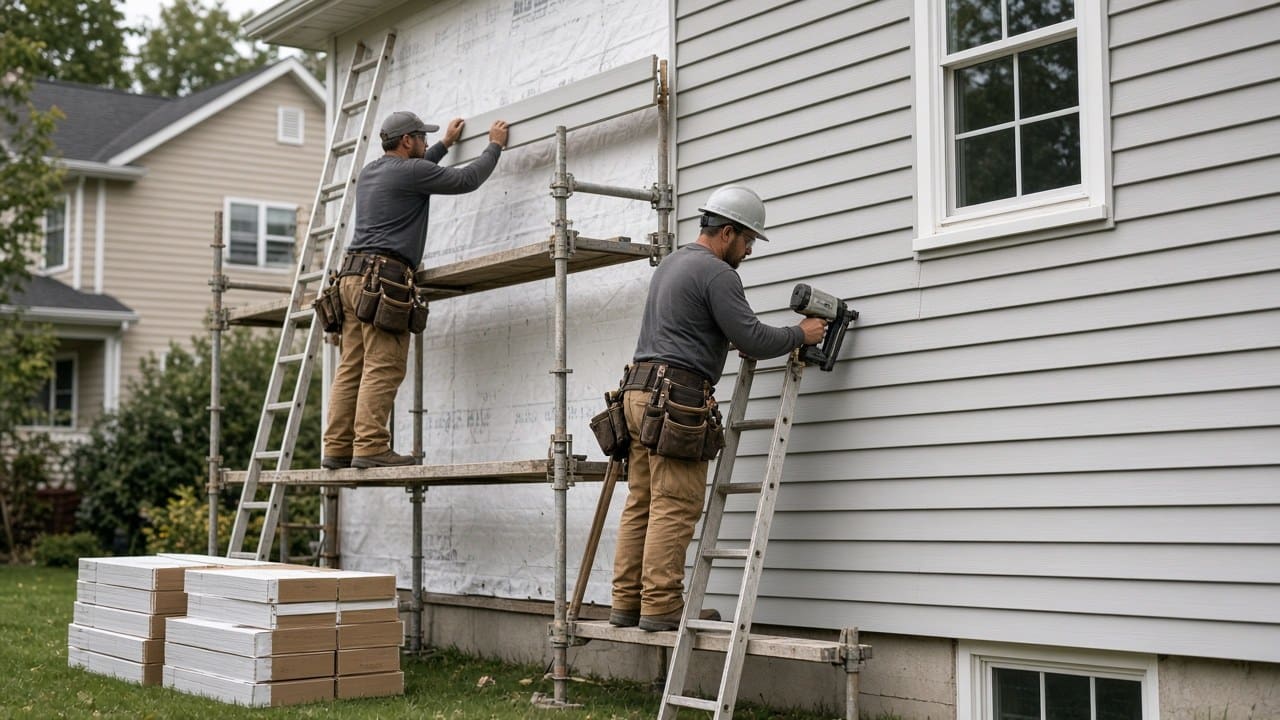
A gust catches a sheet of fiber cement halfway up the wall and swings a corner through the homeowner’s open patio slider. Or a pack of vinyl slides off the driveway pile and gouges the stucco beside the garage. Or someone on the staging takes a fall while hanging fascia. Those are three different claims, and each one lands on a different policy.
Siding contractor insurance is the group of policies a company needs to install exterior cladding: vinyl, fiber cement, wood, metal, and the soffit and fascia that finish the eaves. If vinyl is what you mostly hang, you may see it searched as vinyl siding contractor insurance, and the coverage is the same. General liability covers injury to other people and damage to property you don’t control, including the house you’re working on. Tools, staging, nailers, brakes, and uninstalled material that travel with the crew belong on inland marine. Commercial auto covers the truck, and workers compensation covers your crew. A homeowner policy or personal auto policy won’t respond to any of it.
Related trades have their own pages: painting contractor insurance, roofing contractor insurance, general contractor insurance for builders who self-perform the walls, and window and door contractor insurance. If your truck is still on a personal policy, start with personal vs. commercial auto insurance.
Damage to the house you’re working on
General liability is the policy homeowners, HOAs, and builders expect to see on your certificate. It’s the one that responds when a sheet clips a slider, a pack scars the stucco, your staging leans into a neighbor’s fence, or a passerby gets hurt under the plank. It also applies when a ladder walks out from the wall or a brake drops a course onto a parked car.
Most general liability forms limit coverage for property in your care, custody, or control, and for the specific part of a property you’re actively working on. That means the course you’re fastening, and the pack still sitting in the driveway, can fall into a gap even when the claim seems obvious. The glass next to it is a separate question. Your license classification doesn’t decide what gets paid. The policy wording does, so read it before you need it.
Tools and material
Coil nailers, brakes, staging, saws, and a week of vinyl or fiber-cement stock often add up to more than owners expect, and all of it rides in the truck instead of sitting in a shop. A commercial property policy is typically tied to one address. Inland marine, sometimes called an equipment floater, is written for property that moves. Tell the underwriter where the truck parks overnight, because a locked yard and a residential curb are very different theft risks. List uninstalled material separately from your tools.
The truck
A crew cab with a ladder rack and a brake in the bed is a business vehicle, and a personal auto policy isn’t built for it. Commercial auto covers vehicles the business owns or leases. Ask about hired and non-owned auto if an estimator uses a personal car to look at jobs, or if you rent a truck for a heavy week. Keep in mind that the truck’s liability coverage won’t pay for the patio slider. That claim belongs to your general liability policy.
The crew
Siding injuries tend to be specific: a plank shifts on uneven ground, a sheet catches the wind, or a back gives out carrying material up to a second-story course. Workers compensation is the policy for an employee hurt on the job. The rules for owners and for helpers you pay informally vary by state. A helper who rides with the truck most days will be hard to call an independent contractor after a fall. Don’t assume you’re exempt as an owner just because you hold a siding classification.
Certificates and higher limits
Builders, property managers, and HOAs write insurance requirements into the job, and additional insured status and a waiver of subrogation come up often. An umbrella policy is the usual way to raise limits above your primary coverage, and requirements differ from one community to the next. A certificate only reports what your policies already say. If an endorsement isn’t on the policy, the certificate can’t add it. Send the requirements to your agent before you price the job.
Licensing and insurance in Nevada, Arizona, California, and Utah
Each state describes siding work differently. A missing or mismatched classification is a licensing problem, and it doesn’t by itself void your coverage. Match your license to the cladding you actually install, then describe that work plainly to the underwriter.
- Nevada: The State Contractors Board covers siding under classification C-15, roofing and siding, in NAC 624.320. A C-15 licensee may do any work authorized under the C-15 subclassifications. Subclassification C-15b, Siding, covers installing, altering, and repairing siding in materials such as wood, aluminum, enameled steel, plastic, and glass to make a structure’s walls watertight and weatherproof. C-15a, Roofing, expressly does not authorize siding installation. Separately, NAC 624.210 lists siding within the carpentry and repairs scope of subclassification C-3a. That’s a carpentry route that happens to mention siding, and it’s no reason to overlook C-15b when the job is cladding. Pick the class that fits the work. The class alone won’t decide a claim.
- Arizona: The Registrar of Contractors classifications page lists commercial, residential, and dual scopes, and a full-text search of that list finds no classification titled for siding. R-7 and C-7 Carpentry cover rough and finish carpentry, hardware, millwork, metal studs, metal doors and frames, and windows. R-42 and C-42 Roofing cover weatherproofing and roof accessories, but they aren’t siding classes. Confirm with the Registrar which scope fits the work you sell, then describe that work to your underwriter. A missing title on the list is a licensing question and not, on its own, a coverage gap.
- California: The Contractors State License Board handles this work under limited specialty D-41, Siding and Decking. According to the Board’s D-41 classification detail, a siding and decking contractor applies or installs all types of exterior siding on new or existing buildings, including wood, wood products, vinyl, aluminum, and metal. The same class also covers building wooden decks and their handrails, but not covers or enclosures.
- Utah: Siding appears in specialty S230, Masonry, Siding, Stucco, Glass, and Rain Gutter, in the compiled R156-55a text (R156-55a-301af). A licensee may construct, fabricate, and install siding, along with other items in that scope. Under R156-55a-302d, an applicant must carry liability insurance of at least $1,000,000 per incident and $2,000,000 total, with the Division named as certificate holder, covering the scope of work for as long as the license is active. The DOPL contracting page states the same $1 million per occurrence and $2 million aggregate minimum. Those figures are the floor for your license file. They aren’t a premium quote, and a builder may ask for more. The same section also requires workers compensation naming the Division, or a Utah Labor Commission waiver if the applicant has no employees.
Local pages for this trade: Henderson, Phoenix, San Diego, and Lehi.
What to have ready for a quote
Gather your annual revenue, the split between vinyl, fiber cement, wood, and metal, how often you install soffit and fascia along with the wall, your trucks and where they park, the value of your tools and uninstalled material, your payroll, and any insurance language a builder or HOA has already sent you. Western Pacific Insurance is based in Henderson, Nevada, and places coverage for siding contractors in Nevada, Arizona, California, and Utah. Call 702-932-3105 or request a quote online.


