
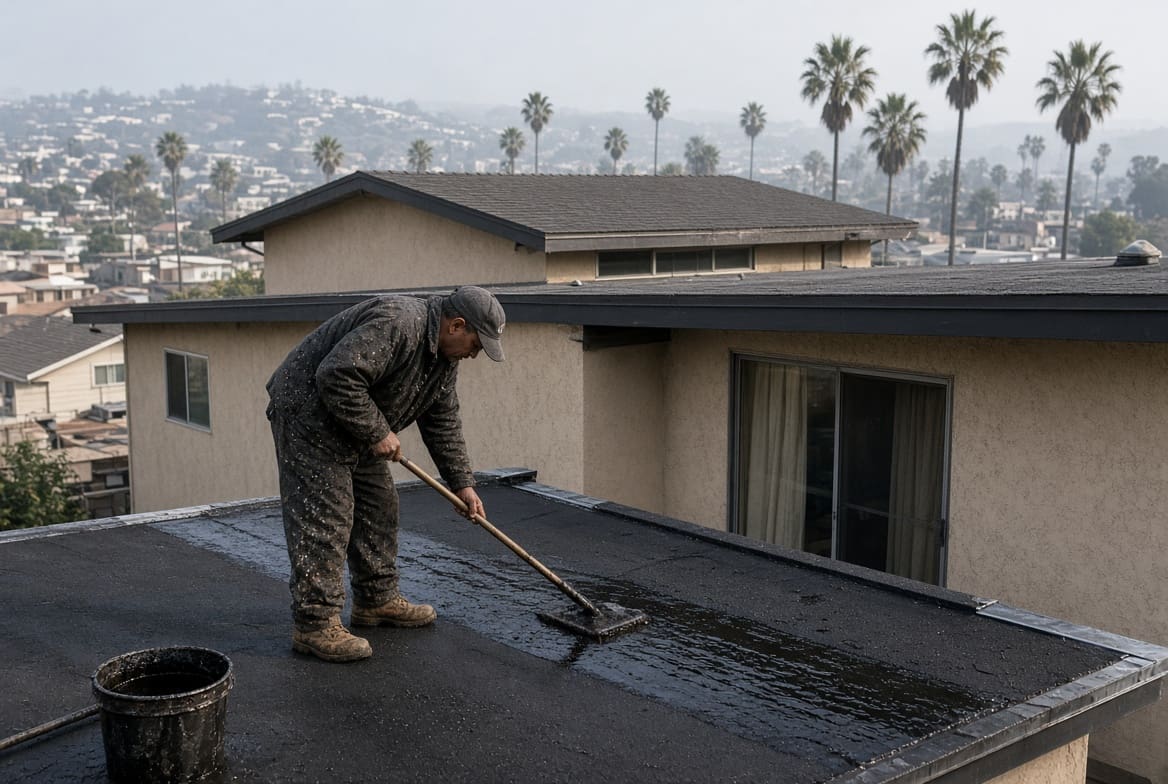
San Diego roofing contractor insurance starts with a rule that surprises nearly every owner operator who moves into the market. California requires C-39 roofing licensees to carry workers’ compensation insurance even with zero employees. Most California contractors get to wait until 2028 for a universal coverage mandate to arrive. Roofers sit on the short list of classifications where the requirement already applies today. Here’s how that rule and the rest of the San Diego market shape a roofing company’s insurance program.
The C-39 Workers’ Comp Rule Has No Exemption to Claim
The Contractors State License Board places roofing among the handful of license classes required to carry workers’ comp regardless of employee count. Concrete, HVAC, asbestos abatement, and tree service share the list. A solo San Diego roofer cannot file the exemption that a solo painter or flooring installer still can. The state’s Department of Industrial Relations even calls roofers out by name on its workers’ compensation employer page. A roofer with no employees still must carry coverage. Everyone else starts at the first employee.
The rest of the CSLB checklist includes a $25,000 contractor bond. LLCs add a $100,000 employee bond plus $1 million in liability coverage. Roofing payroll rates in California run among the highest of any classification, so payroll discipline matters here more than anywhere. Keep estimators and office staff out of the roofing class code. Report payroll accurately, and collect certificates from every sub, because audit season charges uninsured sub payments to your policy at your rate.
San Diego’s Housing Stock Is a Re-Roof Engine
Large stretches of the county were built between the 1950s and 1980s, from Clairemont and Allied Gardens through North Park and Chula Vista. Those roofs have cycled through replacements ever since. Coastal moisture finds every seam within a mile of the water. Clay and concrete tile outlives the paper underneath it. Wildfire hardening keeps pushing canyon and backcountry homeowners toward Class A assemblies. San Diego produces steady replacement work in every direction.
Steady work brings the trade’s standard exposures with it. Crews work at height above occupied homes. Torch and hot mop jobs cover the county’s many low slope additions. Open decks sit exposed when a marine layer turns into actual rain. Check your liability form for hot work exclusions before you run a torch. Check it for open roof conditions before you leave a deck overnight. Roofing policies commonly attach both, and carriers enforce them.
Construction Defect History Follows the Policy Forms
California’s construction defect litigation shaped the exclusions carriers attach to roofing liability in this state. Condominium, townhome, and new residential tract exclusions show up regularly. A roofer who takes a condo re-roof in Mission Valley under a policy that excludes condos is working that job bare. Read the residential exclusions every renewal, and match them against the actual bid list. Coverage that fit last year’s work can miss this year’s.
Building the Full San Diego Program
The complete stack for a San Diego roofing company runs general liability, the mandatory workers’ comp, commercial auto, and inland marine for tools and kettles. Umbrella limits cover commercial and public work. Height caps, torch exclusions, subcontractor conditions, and admitted versus surplus lines paper all deserve a careful read before binding. Our full roofing contractor insurance guide walks through every one of those decisions.
We’re an independent agency licensed in California, and we shop roofing programs across the whole market rather than a single carrier’s appetite. Start a California quote, or learn more about our California insurance services. We help businesses with their insurance needs all the time.


