
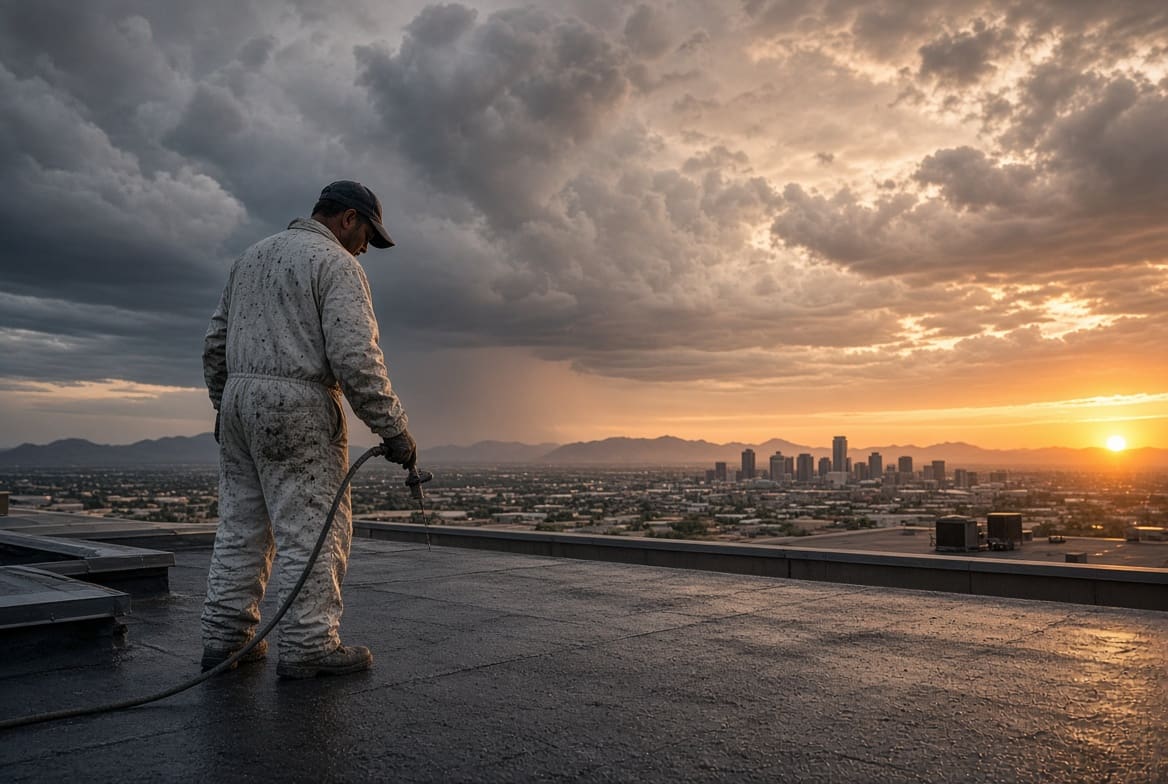
Phoenix roofing contractor insurance gets tested twice a year, on a schedule everyone in the valley knows. Summer heat pushes roof surface temperatures far past what crews in most states ever stand on. Then monsoon season arrives with microbursts and hail. Every roofing company’s phone turns into a storm hotline overnight. The insurance program behind a Phoenix roofing business has to fit both seasons, plus a licensing system that splits roofing three ways. Here’s how it all fits together.
Arizona Licenses Roofing Three Ways, and Scope Matters
The Arizona Registrar of Contractors issues roofing licenses as C-42 for commercial work, R-42 for residential, and CR-42 covering both. Current scopes live on the ROC’s license classifications page. Any roofing job of $1,000 or more in labor and materials requires an active license. Licensees post a bond scaled to classification and projected volume under ARS 32-1152. Residential licensees also participate in the Residential Contractors Recovery Fund.
One scope detail trips up crews mid job. The roofing classifications allow a licensee to replace up to 10 percent of the roof substrate when hidden problems surface after the contract is signed. Beyond that, the decking work has to go to a properly licensed contractor. Work performed outside your license scope invites board complaints. It also hands a liability carrier an argument at claim time. When a tear off exposes a rotted deck, subcontract the structural portion and paper the file.
Monsoon Season Is the Underwriting Story
From late June through September, microbursts and hail cells hit the valley in scattered, violent bursts. Roofing demand spikes behind every storm. Carriers watch how a roofing company rides that wave. An established Phoenix shop with year round re-roof volume reads differently than an operation that surges into hail zones behind catastrophe events. The application asks directly what share of revenue follows storms. Answer it precisely, because the application becomes part of the policy.
Storm season also concentrates the trade’s worst property exposure. A deck opened for tear off on a July afternoon can take on a monsoon cell before dry in. The resulting interior water claim is the signature large loss in this trade. Many roofing liability forms attach an open roof or protective safeguard condition. It requires the deck to be watertight or tarped at day’s end. During monsoon months, treat that condition as the most important sentence in your policy.
Heat, Foam, and the Rest of the Phoenix Risk Picture
Phoenix runs heavily on flat and low slope roofs. That keeps spray foam and coating work a major share of local volume, and elastomeric recoat cycles produce repeat customers on a schedule. Foam and hot applied systems draw underwriting attention of their own. Overspray claims drift onto neighboring cars, and hot work exclusions target torch applied membrane. Summer adds the human factor, since crews on reflective decks in 115 degree weather face genuine heat illness exposure. Early start times, hydration protocols, and documented safety training all show up in your loss history eventually. Underwriters price what the loss history shows.
Building the Full Phoenix Program
The complete stack for a valley roofing company includes general liability, workers’ comp once you have employees, and commercial auto for trucks running material across the metro. Inland marine covers equipment, and umbrella limits satisfy commercial contracts. Before binding, check the liability form for height caps, hot work exclusions, open roof conditions, and subcontractor certificate requirements. Our full roofing contractor insurance guide breaks down each of those checkpoints in detail.
We’re an independent agency licensed in Arizona. We shop roofing programs across standard and surplus lines markets to find the fit for how your company actually operates. Start an Arizona quote, or learn more about our Arizona insurance services. We help businesses with their insurance needs all the time.


