
Nevada Carpenter Insurance: What the C-3 License Actually Requires
Nevada hands carpenters one of the broadest specialty licenses in the country. Most carpenters holding it have never read what it covers. That matters for insurance, because your policy should match your license scope, not just last month’s work. Here is how carpenter insurance works in Nevada, from our office in Henderson.
The C-3 license reaches further than you think
Nevada licenses carpentry under classification C-3, Carpentry, Maintenance and Minor Repairs, defined in NAC 624.210. The subclassifications cover framing and rough carpentry, finish carpentry and millwork, insulation and weather stripping, overhead doors, and drywall. Read that list again. A Nevada C-3 contractor can legally frame a structure, hang and finish the drywall, insulate the walls, and install the garage door. The Board even amended the class in 2024, through regulation R030-24. That change confirmed that doors, windows, and studs under C-3a can be vinyl, aluminum, or formed sheet metal, not just wood. If your operations use the full scope, your insurance application needs to say so. A policy written for “finish carpentry” does not want to hear about your framing crew at claim time. Broad license, narrow policy is the most common Nevada carpenter gap we see.
What Nevada requires, and what it does not
The State Contractors Board does not mandate general liability insurance. It requires a license bond between $1,000 and $500,000, set at approval based on your monetary limit, finances, and experience. It also requires proof of workers compensation once you have employees. Two Nevada quirks deserve attention. Your license carries a monetary limit, and under NAC 624.640 a contract that exceeds it can be void. Growing carpenters should request a limit increase before bidding bigger jobs, not after. On residential work, the down payment cap is $1,000 or 10 percent unless you post a consumer protection bond. None of that makes coverage optional in practice. Every GC, every property manager, and most commercial clients in the Las Vegas valley want a certificate before you step on site. The Board sets the floor. The market sets the real requirement.
Building a carpenter program for Nevada work
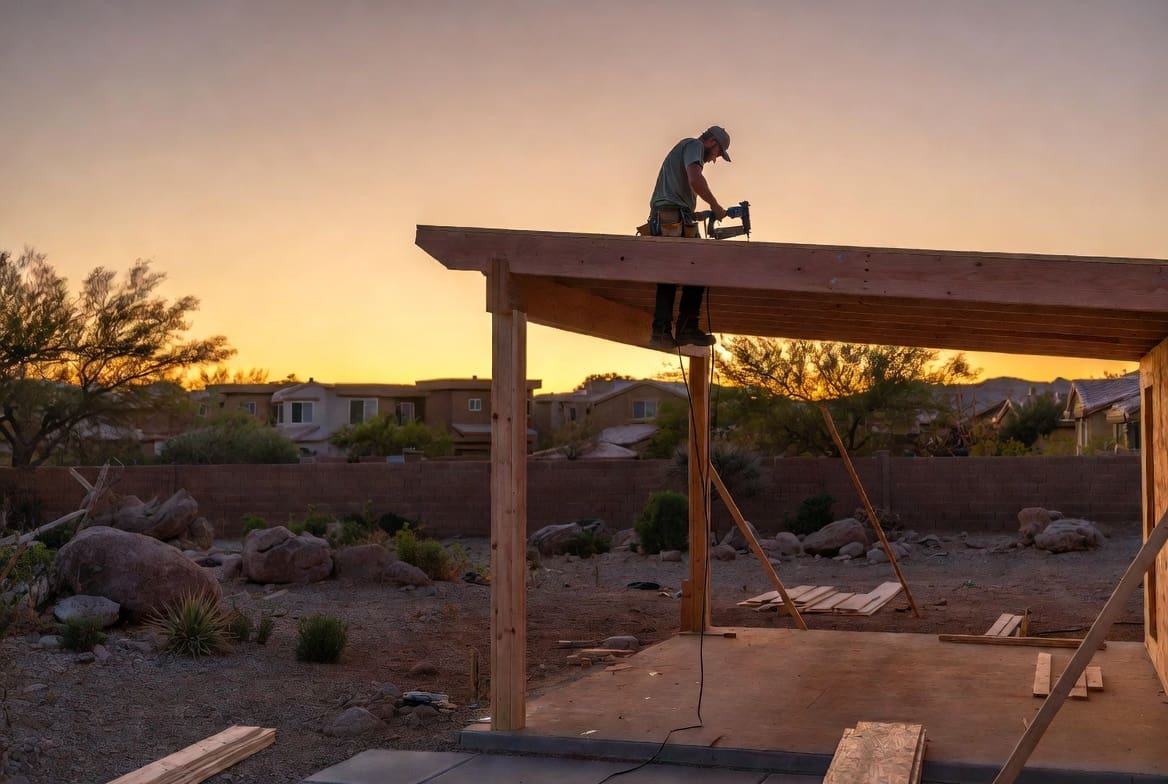
Vegas carpentry runs on production framing, tract punch lists, HOA repairs, and remodels of aging Summerlin and Henderson housing stock. Summer changes the risk picture. Crews start at dawn to beat the heat, and heat illness is a workers comp exposure carriers ask about here. Tool theft from trucks and open garages is constant in a metro this size. That makes a scheduled tools floater worth more in Las Vegas than in most markets. Patio covers and backyard structures are their own niche, and they generate completed operations claims when summer monsoon winds test the work. We typically build Nevada carpenters general liability at $1 million per occurrence, workers comp rated on clean payroll splits, commercial auto, and an inland marine floater sized to real replacement cost. Details on every coverage are in our full carpenter insurance guide.
Frequently asked questions
Does Nevada require general liability insurance for carpenters?
No. The Board requires a bond and workers comp with employees, per the licensing rules in NAC Chapter 624. General liability is required contractually by nearly every GC and commercial client, so licensed carpenters carry it anyway.
Can I do drywall and garage doors on my Nevada C-3 license?
Yes. The C-3 subclassifications include drywall and overhead doors. Just make sure your insurance application lists every operation you perform, or you risk a coverage fight when a claim lands.
If you hold a C-3 or you are applying for one, send us your scope and we will build the program around it. Start your Nevada quote here, or read more on our Nevada insurance page.


