
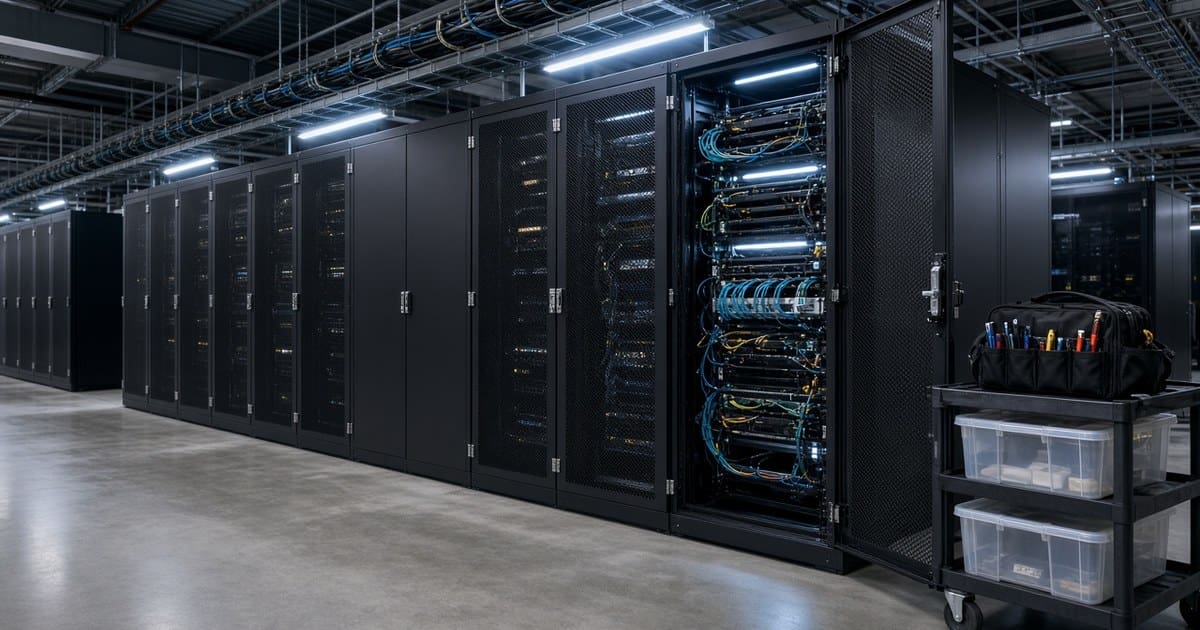
A San Diego low-voltage contractor can start the day dressing fiber in a Sorrento Valley rack, pull data through a UTC suite before lunch, and finish a Mission Valley tenant improvement while a general contractor asks for a certificate. The work looks specialized, but the insurance questions are practical: what happens if a cable run damages finished property, a tool disappears from a van, or a problem appears after turnover?
This guide explains the coverage San Diego cabling, AV, security, and communications contractors commonly review, along with the California licensing and contract requirements that can affect a bid. For the broader coverage discussion, see our low-voltage contractor insurance guide.
The core policies for San Diego low-voltage contractors
General liability
General liability responds when your work injures someone or damages someone else’s property. A visitor can trip over a temporary cable in a UTC office. A technician can damage finished drywall while fishing wire in Mission Valley. A ladder can nick glass during a camera installation near a downtown storefront. These are the kinds of third-party bodily injury and property damage claims that make general liability the first policy most GCs ask about.
Completed operations
Completed operations matters after you have left the job. A poorly sealed penetration may leak months after turnover, or a device fault may damage other property in a Sorrento Valley suite. The important distinction is that many liability forms limit or exclude the cost of redoing your own work. The policy may address damage your work causes to other property without paying to rebuild a failed installation. Ask how the actual form and endorsements handle that line before promising a client that a rebuild will be covered.
Workers’ compensation
California workers’ compensation requirements are significant once a contractor has employees. Cable pulling, ladder work, tight ceiling spaces, and lifting reels can all lead to injuries. Report payroll accurately by role and classification, including people you treat as independent contractors. Misclassification and an incorrect payroll estimate can create problems during an audit or claim.
Tools and equipment coverage
Inland marine coverage is designed for mobile property such as fusion splicers, cable certifiers, camera kits, lifts, and test equipment. A standard office or business policy may not follow those items to a jobsite or cover the same way when they are left in a vehicle. Carriers will ask about overnight parking, locked storage, and the values of tools and staged materials. Keep the equipment schedule current as the business adds expensive gear.
Commercial auto and hired and non-owned auto
Commercial auto covers vans and trailers owned by the business. If a technician uses a personal vehicle for a parts run, review hired and non-owned auto coverage. A personal auto policy may not respond the same way when the vehicle is being used for business. Tell your agent about the operating radius and how the vehicles are actually used.
Coverage that depends on the work you sell
Professional liability
A shop that installs to someone else’s plans is not the same risk as a firm that designs systems, selects devices, writes specifications, programs access control, or configures networks. If a client says a design or programming decision caused a financial or operational loss, the issue may fall under professional liability rather than general liability. Describe those services clearly on the application and ask whether an errors and omissions policy is appropriate.
Umbrella limits
Larger commercial projects may require limits above the standard general liability and auto policies. An umbrella can add limits over qualifying underlying policies, subject to its own terms and exclusions. Check the contract before the bid so the requested limits and underlying coverage can be addressed in time.
Installation floaters
An installation floater can be relevant when materials and equipment are in transit, staged at a jobsite, or waiting for installation and turnover. Do not assume general liability covers a stack of cable reels or camera equipment simply because it is being used on a covered project. Ask who is responsible for the materials and when that responsibility changes.
Bonds
California contractor licensing includes a license bond requirement, and public or larger private jobs may also call for bid, performance, or payment bonds. A bond is not liability insurance. Discuss surety requirements separately and send the contract language early.
California licensing: C-7 versus C-10
The California C-7 Low Voltage Systems classification is generally associated with installing, servicing, and maintaining energy-limited communication and low-voltage systems, including work such as telephone, sound, cable television, and closed-circuit video within the published classification. It is not a substitute for a C-10 Electrical classification when the work is power or utilization electrical.
That distinction is important for both licensing and insurance. A low-voltage contractor should not assume a C-7 permits unrestricted power wiring, EV charging, generator work, or other C-10 scopes. Fire-alarm work can involve additional licensing, code, and local authority requirements. Confirm the current CSLB classification language and the requirements of the authority having jurisdiction before advertising a scope or accepting a contract. Make sure the application, invoices, license, and actual work describe the same business.
What San Diego GCs may request
Commercial contracts commonly ask for some combination of:
- Additional insured status for the general contractor, owner, or both
- Primary and non-contributory wording
- Waiver of subrogation
- Minimum general liability limits, often with an umbrella for larger projects
- Workers’ compensation evidence, including information about subcontractors
- Certificates issued before mobilization
A small Mission Valley tenant improvement may have a short certificate checklist. A Sorrento Valley technology or life-sciences project may require more detailed endorsements and higher limits. Work around UTC, downtown, and the airport corridor can also come with tight scheduling. Send the insurance section of the contract to your agent before signing. A certificate summarizes coverage, but it does not create coverage by itself. The endorsements and policy terms control.
How the San Diego client mix affects the quote
Low-voltage work in San Diego can include technology and biotech suites in Sorrento Valley and UTC, office and retail tenant improvements in Mission Valley, hospitality work downtown, and camera or access-control installations across the county. Each project type changes the questions an underwriter asks. A multi-tenant building may require careful pathway labeling. A technology client may focus on access control and data pathways. A retailer may care most about camera uptime after a remodel.
Give the agent a realistic split between commercial and residential work, installation and design, and ordinary cabling and higher-hazard scopes such as fire alarm or access control. Identify whether one GC represents a large share of receipts. Customer concentration, operating radius, prior claims, and subcontracted labor can matter as much as total revenue.
Van, shop, and staged inventory
Many contractors begin with tools in a van and later add a shop or storage space near Mission Valley or Sorrento Valley. That change can affect how property and mobile equipment are scheduled. Be ready to explain where vans park overnight, how spare cameras and cable are locked up, and whether reels or other materials remain at open jobsites after hours. Update values when the business buys a new splicer, adds a lift, or stages a large order for a UTC buildout.
What to bring to a quote
A useful submission gives the carrier a clear picture of the business. Bring:
- Annual receipts and payroll by role
- Commercial and residential revenue splits
- The percentage of work involving fire alarm, access control, AV, or design
- Tool and equipment values, including typical staged-material values
- Shop address and operating radius in San Diego County
- Prior claims or loss runs
- Current license classifications and a description of the work shown on invoices
- Recent certificate requirements and a sample subcontract, if available
Keep as-built drawings, cable test results, turnover records, and photos of penetrations and firestopping in the job file. Those records cannot change a coverage exclusion, but they can make it easier to reconstruct and defend a claim. Revisit the insurance program when the company adds employees, vehicles, a second location, design services, healthcare work, or a large multi-location account.
Build the program around the work you actually do
Western Pacific Insurance is an independent agency. We place contractor coverage with carriers for low-voltage businesses in California, Nevada, Arizona, and Utah. The carrier and the policy form determine coverage, while our role is to help match the program to the work you sell and the contract requirements you receive.
Call 702-932-3105 or use our insurance quote form. Send the next certificate request or subcontract with your inquiry so the conversation starts with the work being done in UTC, Mission Valley, Sorrento Valley, and the surrounding San Diego market.


