
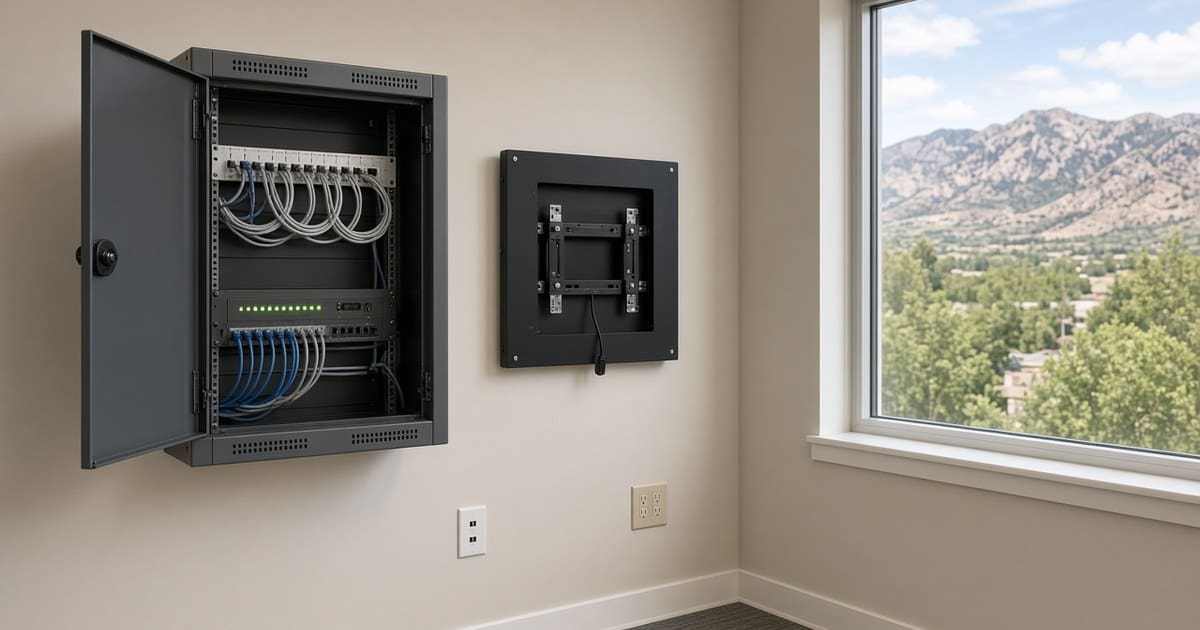
Most low-voltage contractors in Lehi hear about insurance the same way. A general contractor sends over a subcontract with a certificate requirement buried on page nine, and the job cannot start until the paperwork is right. It is usually additional insured wording, primary and noncontributory language, or an umbrella limit you did not know you needed.
Getting the right coverage before that email arrives is far easier than scrambling after it. Here is what a Lehi cabling, AV, or security contractor typically needs, and where the gaps tend to be.
Whether the work is near Thanksgiving Point, in Traverse Mountain, or in the Silicon Slopes corridor, the coverage questions are similar. If you work across the region, our main low-voltage contractor insurance guide covers Nevada, Arizona, Utah, and California. This page is written for Lehi and Utah County work.
The core coverages
General liability with completed operations. GL pays when your work injures someone or damages someone else’s property. Someone trips over a cable you left across a walkway. A tech damages finished drywall while fishing wire. A ladder cracks a lobby window.
Completed operations is the part contractors overlook. It covers claims that show up after you have left the job: a penetration you sealed badly starts leaking months later, or a device you installed fails and damages the tenant’s equipment. Read the policy on one point in particular. Many GL forms will not pay to redo your own faulty work, only the damage it caused to other property. Know where that line sits before you tell a customer you will make it right.
Workers compensation. Ladders, lifts, and heavy cable reels mean real injury exposure. In Utah, workers compensation generally applies once you have employees, with some statutory exceptions for owners and certain worker classifications. Confirm how your specific crew is classified.
Tools and equipment (inland marine). Your certifier, fusion splicer, and OTDR live in the van, and vans get broken into. Standard property coverage often does not follow equipment off your premises, so inland marine fills that gap. Carriers will ask where the van parks overnight and whether equipment is locked up or left visible.
Commercial auto, plus hired and non-owned. Owned vans need commercial auto. If an employee runs a parts errand in a personal vehicle and causes an accident, hired and non-owned auto coverage is what responds. Without it, the claim can land on the company with nothing behind it.
Professional liability (E&O). If you design systems, program access control, or configure networks rather than just install to someone else’s plans, a claim can allege the design or programming was wrong. That is an errors and omissions claim, and GL generally will not respond to it.
Depending on the job, you may also see requests for an installation floater, umbrella limits, or bonds.
What Lehi jobs actually ask for
Lehi’s commercial mix is unusual. A cabling job may be in a tech-park suite one day, then a retail tenant improvement, hospitality project, or professional office. The insurance ask changes with the client.
- Small tenant suites often need nothing more than a basic certificate showing liability limits.
- Larger campus and multi-building projects commonly require additional insured status, primary and noncontributory wording, waiver of subrogation, and umbrella limits before you can mobilize.
- Mixed-scope tickets are common. A data pull that also includes cameras and access control is different from a pure cabling job, and the application should say so.
That last point matters more than most contractors expect. If your subcontract covers cabling, AV, and access control but the application only mentions cabling, you have created a mismatch that can turn into a coverage dispute at exactly the wrong moment. Describe what you actually do.
If you also sell network consulting or managed IT alongside installation, keep those revenues separate in the conversation. That work may fit better under our technology firm insurance than a contractor policy.
Who pays when something goes wrong
| What happens | Where the claim starts |
|---|---|
| A visitor trips on a temporary cable during a pull | General liability |
| Finished ceiling damaged while fishing Cat6 | General liability |
| A penetration leaks months after turnover | GL, completed operations |
| Certifier stolen from the van overnight | Inland marine |
| Employee hurt lifting cable reels | Workers compensation |
| Employee in a personal car crashes on a parts run | Hired and non-owned auto |
| Client says your access-control programming was negligent | Professional liability (E&O) |
Keep your as-builts, test results, and photos of firestopped penetrations. They will not override a policy exclusion, but they are what you will want in hand when a claim gets argued.
Licensing: check before you market
Utah’s contractor licensing rules historically treat certain in-building communication cabling and NEC Class 2 and Class 3 power-limited circuits differently from line-voltage electrical work. That does not mean all low-voltage work is license-free. Power electrical work follows the electrical licensing classifications, and fire alarm and life-safety work can fall under separate rules, including fire marshal requirements.
The rules change, so check the current Utah DOPL administrative code for the specific services you sell before you advertise them. Also register your entity with the Utah Division of Corporations and Commercial Code, and check for Lehi city and Utah County business requirements. If you do broader electrical work, our Utah electrical contractor insurance guide covers that side.
Moving from van to shop
A lot of Lehi contractors start out of a van and eventually lease a small shop bay. That move changes your insurance. You now have a premises to insure, stored inventory, and a different answer on where equipment sits overnight. Expect questions about locked storage for spare cameras and whether staged cable reels ever sit on open job sites after hours. Update your equipment values when you buy new splicers or stage a large order for a big buildout.
Tell your agent, too, if one GC accounts for a big share of your revenue. Concentration matters to underwriters, and it matters even more if a dispute with that GC turns into a claim.
Getting a quote
To get an accurate quote, have these ready:
- Annual receipts
- Commercial versus residential mix
- Percentage of access-control or AV work
- Payroll
- Tool and equipment values
- Shop address, if you have one
- Utah County operating radius
- Prior claims
- Whether you design systems or install only to GC plans
We place low-voltage contractor coverage in Utah, Nevada, Arizona, and California. Call 702-932-3105 or use our quote form. Send along the next certificate request you have received so the program can be built around what the GC is actually asking for.


