
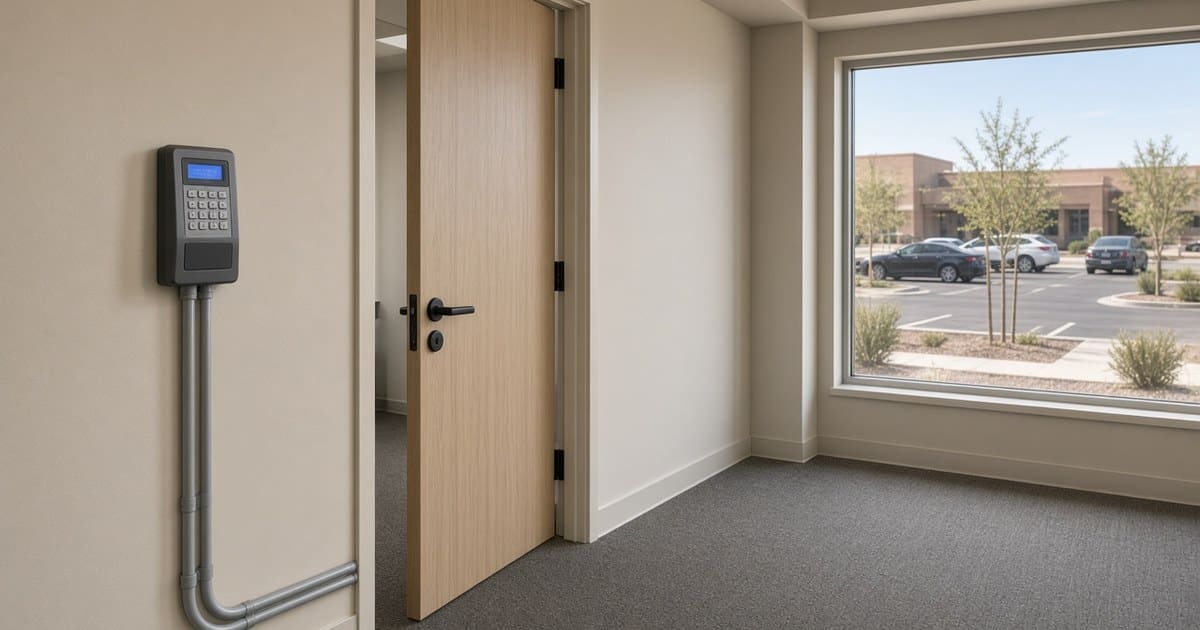
You pulled the cable, terminated it, tested it, and handed over the keys. Three months later the owner calls: there is a water stain under the spot where you ran conduit through the wall, and someone thinks your penetration is the reason.
Low-voltage work does not look risky from the parking lot. But your crews cut into finished ceilings, leave expensive gear in vans overnight, and work above people’s heads on ladders. Your name stays attached to the job long after you have left it. Insurance for this trade has to cover all of that.
In Henderson, that can mean a Cat6 pull in Green Valley, cameras at a Lake Las Vegas property, or a certificate request from a GC working in Anthem or one of the Henderson business parks. The local setting changes, but the coverage questions stay practical.
The short answer: what most low-voltage contractors carry
If you do structured cabling, fiber, CCTV, access control, AV, nurse-call, or building automation signal work, your program usually includes:
- General liability with completed operations, because most of your claims will be third-party damage or injury
- Tools and equipment coverage, also called inland marine, for splicers, certifiers, and everything else that lives in your vans
- Workers compensation once you have employees
- Commercial auto for company vehicles, plus hired and non-owned auto if staff drive personal cars on work errands
- An installation floater if you buy equipment that sits on site before the owner accepts the job
- An umbrella and bonds when a GC or public owner requires them
- Professional liability, or E&O, if you design systems, pick devices, or program access rules
Western Pacific Insurance is an independent agency in Henderson, Nevada. We place coverage for contractors in Nevada, Arizona, California, and Utah. What follows is how these pieces fit together for low-voltage work specifically.
Who this is written for
This guide fits firms that invoice for structured cabling, data pulls, CCTV, access control, AV and sound, nurse-call, or building automation, and, where your license allows, security and fire-alarm low-voltage scopes. Your work might be tenant improvements, small commercial buildouts, healthcare cabling, residential smart-home systems, or sub packages for GCs.
The single most useful thing you can do is tell your agent exactly what you sell. A crew that pulls Cat6 to someone else’s plans is a different risk than a firm that designs an access control system and programs the rules. If you also do power electrical, EV chargers, or generator pads, say so and put a number on it. Burying that revenue under “low voltage” is how claims get denied later. We have separate guides on related contractor risks, but this low-voltage contractor insurance guide is the broader four-state overview.
Use the same description of your work everywhere: the application, your quote request, your subcontracts, and your certificate requests. Mismatches between those documents cause more headaches than almost anything else.
General liability and completed operations
GL pays when your work injures someone or damages someone else’s property. In this trade that looks like a visitor tripping on a temporary cable in an IDF, a tech cracking a ceiling tile while fishing wire, or a ladder clipping a storefront window during a camera install.
Completed operations is the part that matters after you leave. It responds to claims that surface after turnover: a leak that traces back to a poorly sealed penetration, or a faulty device that damages other property weeks after punch list.
Here is the catch most contractors miss. GL generally does not pay to fix your own work. If a panel fails and the owner wants it rebuilt, expect the “your work” exclusion to come into play. GL covers the damage your work causes to other things, not the cost of redoing the work itself. Before you promise a client that “our liability insurance has you covered” for a workmanship dispute, check how your form actually reads.
GL also is not built for claims that say your design or programming was wrong when nothing was physically damaged. That is an E&O question, covered below.
Tools, equipment, and the installation floater
A fusion splicer, a cable certifier, and a few camera kits can add up to serious money, and they spend their nights in a van. Inland marine, or tools and equipment coverage, is built for mobile property like this. Look closely at limits, whether items must be scheduled, and any conditions about vehicles left unattended, since theft from vans is the classic claim here. Inventory that stays in your shop usually belongs on a commercial property or business owners policy instead.
An installation floater covers materials and equipment while in transit or staged at the job until the owner accepts the work. On bigger tenant improvement projects, the GC or owner may carry builders risk that covers some of this. Ask who is buying what before you assume your GL covers a stack of staged reels.
Workers comp and auto
Low-voltage work feels light until someone strains a shoulder hauling reels, slips on a raised floor tile, or falls from a ladder in an unfinished corridor. Workers comp covers job-related injuries to employees, and requirements differ across Nevada, Arizona, California, and Utah. Report your real payroll, including apprentices and anyone you treat as a 1099 contractor. Misclassification is a common audit problem.
If the company owns vans or trailers, you need commercial auto. If an employee occasionally uses a personal car for a parts run, look at hired and non-owned auto. Tell your agent how far your crews travel and how many stops they make in a day rather than assuming you are rated as a shop-only operation.
GC requirements: certificates, umbrellas, and bonds
General contractors, property managers, and healthcare or public owners often ask for higher limits, additional insured status, primary and non-contributory wording, and waiver of subrogation. An umbrella can add limits above your GL and auto when the underlying policies qualify. Bid, performance, and payment bonds show up on public and larger private jobs.
Two things to keep straight. A bond is not liability insurance. And a certificate of insurance does not create coverage by itself; the endorsements on the actual policy do. Send certificate requests to your agent before you mobilize, not the morning your crew is due on site.
E&O: when design and programming enter the picture
Plenty of low-voltage shops install to someone else’s plans. Others design systems, choose devices, program access rules, or advise on camera coverage. If a client says your advice or programming caused a financial or operational loss, a standard GL policy may treat that as a professional services claim and step aside.
Professional liability is priced and underwritten on its own, especially for fire-alarm design, nurse-call design, and access control programming. It is not something every cabling policy includes. If you also sell network consulting or managed services, describe that clearly rather than stretching a contractor application.
Which policy responds first
This is a starting map, not a coverage promise. Exclusions, limits, endorsements, and the facts of each claim decide the outcome.
| What happened | Policy that usually starts the conversation |
|---|---|
| Visitor trips on a temporary cable | General liability |
| Tech damages drywall or ceiling tile while fishing wire | General liability |
| Splicer or certifier stolen from a van overnight | Inland marine, tools and equipment |
| Employee hurt lifting reels or working from a ladder | Workers comp |
| Company van hits a parked car | Commercial auto |
| Employee in a personal car has an accident on a parts run | Hired and non-owned auto |
| Camera kit damaged in transit before owner acceptance | Installation floater |
| Leak or device fault damages other property after turnover | Completed operations on GL |
| Owner wants a failed panel rebuilt at your cost | Often excluded on GL; confirm before promising anything |
| Client claims your design or programming was negligent | E&O / professional liability |
| GC wants additional insured, primary wording, and umbrella before you start | Certificate and endorsement review |
Many of these disputes start as a labeling, penetration, or programming problem and only become an insurance problem once the client adds up repair costs or downtime. Keep as-builts, test results, and turnover photos on file so a claim does not turn into a contest of memories.
Licensing: NV, AZ, CA, and UT
Low-voltage is usually a specialty classification, not a license to do power electrical. Fire-alarm and life-safety work can bring extra rules even when the voltage is low. Treat this table as a starting point and confirm current rules with each state before you advertise a classification.
| State | Starting point | Watch the split |
|---|---|---|
| California | CSLB C-7 Low Voltage Systems covers communication and low-voltage systems not exceeding 91 volts, including telephone, sound, cable TV, closed-circuit video, and related systems. | C-10 Electrical is the power path. Confirm fire-alarm licensing separately. |
| Arizona | ROC R-67, C-67, and CR-67 Low Voltage Communication Systems commonly cover alarms, telephone, sound, intercom, PA, TV/video, and low-voltage signaling within published limits. | Electrical classifications are not interchangeable with low voltage. Confirm mixed scopes with ROC. |
| Nevada | NSCB C-2d Low Voltage Systems under NAC 624.200 covers fiber optic systems and systems not exceeding 91 volts, including telephone, sound, cable TV, CCTV, and networking. | Broader electrical and fire-protection paths can be separate. Confirm the current board text for the services sold. |
| Utah | DOPL has historically exempted certain in-building communication cable and NEC Class 2 and Class 3 power-limited circuit work from contractor licensing. Check the current administrative code. | Power electrical still requires the applicable electrical path, and fire-alarm and life-safety work can be regulated separately. Do not advertise a blanket “no license needed.” |
Local business licenses, permits, and employer requirements apply on top of the specialty class.
What moves your quote
A solo tech terminating outlets and a twenty-person shop designing nurse-call systems can both call themselves “low voltage,” but underwriters see very different risks. Expect questions about:
- Annual receipts and payroll
- Residential versus commercial mix
- Share of fire-alarm or access control work
- Ladder and height exposure, and whether you own or rent lifts
- Subcontracted labor
- Tool and staged-material values
- Operating radius
- Prior claims
- Whether you design systems or only install to GC plans
Separate pure data-pull revenue from design, monitoring, or power electrical work. If you handle after-hours cutovers on access systems or bid multi-state GC packages, say so up front. The best application mirrors the subcontracts you actually sign.
Getting ready for a quote
Bring your agent:
- A plain description of what you do, with receipts and a service breakdown
- Payroll by class, including apprentices
- Tool schedules and typical staged-material values
- Shop or office address and operating radius
- Loss runs or a summary of prior claims
- Certificate requirements from your last two or three GC packages
- A sample subcontract, and a recent as-built or test report if the carrier asks how you handle quality control
- The license you hold in each state where you bid, plus any fire-alarm or life-safety scopes that fall outside a generic low-voltage label
Your application should not imply a license you do not hold, and it should not leave out a service you invoice for.
Habits that help when a claim happens
These will not turn an excluded loss into a covered one, but they make claims easier to defend:
- Write scopes and change tickets before the work changes
- Photograph penetrations before they close
- Save cable test results and camera aiming notes in the job file
- Label pathways so the next tech does not cut your fiber
- Revisit your coverage when you add employees, open a second shop, start fire-alarm design, take on healthcare nurse-call, or land a large multi-location account. A policy written for a weekend AV side business will not fit a commercial IDF crew doing weekend cutovers.
Local guides
For the broader four-state overview, see our low-voltage contractor insurance guide.
Get your program built around the work you actually do
“Do you do low voltage?” is not the useful question. Better ones: which systems are on your invoices, do you design or just install, which license covers each scope, and what certificate language are your GCs already demanding? Answer those, and GL, completed operations, tools, workers comp, auto, umbrella, bonds, and E&O stop being a pile of separate policies and start working as one program.
Call us at 702-932-3105 or use the insurance quote form. Bring your next GC certificate request and a sample subcontract, and we can start from the work you really do.


