
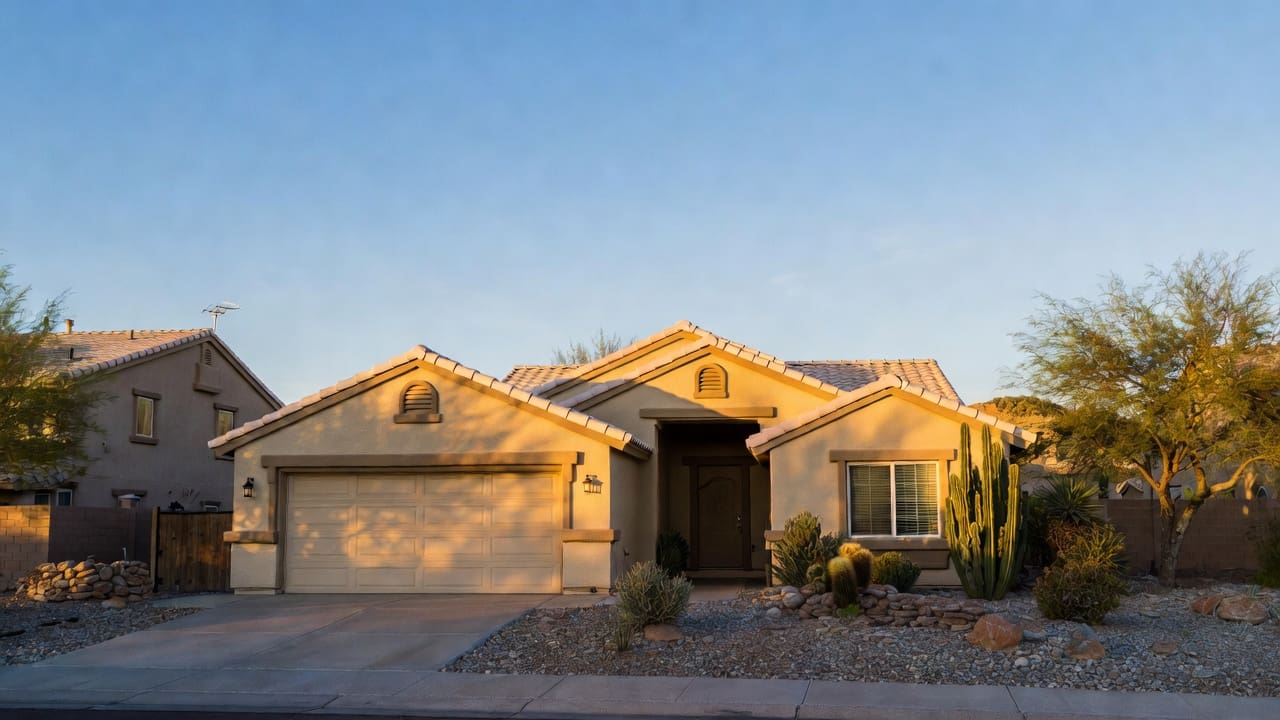
A standard Nevada homeowners policy covers the house, your belongings, liability, and loss of use. It does not cover flood. It does not cover earthquake. As of 2026, carriers may also exclude wildfire under Assembly Bill 376. If you own a home in Las Vegas, Henderson, or Reno, read your declarations page before you assume last year’s coverages still apply. This guide covers what an HO-3 includes, the 2026 wildfire change, endorsements worth adding, and what actually drives the rate.
We cover all of this — and more — in our companion video on our YouTube channel.
What Does a Standard Home Insurance Policy in Nevada Cover?
Most Nevada homeowners carry what’s called an HO-3 policy, which is the most common form of homeowners insurance in the United States. An HO-3 policy provides four main types of coverage:
Dwelling coverage protects the physical structure of your home — the walls, roof, foundation, and any permanently attached structures like a garage or deck. If your home is damaged or destroyed by a covered peril, dwelling coverage pays to repair or rebuild it. On an HO-3 policy, your dwelling is covered on an open-peril basis, which means it’s protected against all risks unless they’re specifically excluded in the policy language. This is an important distinction because it means you need to know what’s excluded, not just what’s covered.
Personal property coverage protects the contents of your home — furniture, electronics, clothing, appliances, and personal belongings. Unlike dwelling coverage, personal property on an HO-3 is covered on a named-peril basis. That means it’s only covered for the specific perils listed in your policy, such as fire, theft, vandalism, and certain types of water damage. If a peril isn’t named, it’s not covered for your belongings even if it would be covered for the structure itself.
Liability coverage protects you financially if someone is injured on your property or if you’re found legally responsible for damage to someone else’s property. In Nevada, where many homes have swimming pools, liability coverage is especially important. Medical payments to others — a sub-category of liability — can cover smaller injury claims without the injured party needing to file a lawsuit.
Loss of use coverage (also called Additional Living Expenses, or ALE) pays for temporary housing, meals, and other necessary expenses if your home is uninhabitable due to a covered loss. If a fire makes your home unlivable for six months while it’s being repaired, loss of use coverage pays for the hotel, the increased food costs, and other reasonable expenses during that period.
What Home Insurance in Nevada Does NOT Cover
Understanding what your Nevada homeowners policy excludes is just as important as knowing what it covers. Several major perils are not included in standard HO-3 policies, and each one is relevant to Nevada homeowners.
Flood Damage
Standard homeowners insurance does not cover flood damage — period. If water enters your home from an external source such as a flash flood, monsoon runoff, or a rising water table, your HO-3 will not pay the claim. Many Nevada homeowners, particularly in the Las Vegas valley, assume that because they live in the desert, flooding isn’t a concern. That assumption is wrong. Las Vegas experiences intense monsoon activity, and the valley’s geography funnels water through developed areas during heavy rain events. Flood insurance must be purchased separately, typically through the National Flood Insurance Program (NFIP) or a private flood insurer. If your home is in a FEMA-designated flood zone, your mortgage lender will require it. Even if you’re not in a flood zone, a separate policy is worth considering given the cost of flood damage relative to the relatively low premiums in most Nevada ZIP codes.
Earthquake Damage
Nevada sits on active fault lines, particularly in the western part of the state. The Reno-Carson City-Tahoe corridor has meaningful seismic activity, and the state has experienced several notable earthquakes in recent decades. Your standard homeowners policy excludes earthquake damage entirely. A separate earthquake endorsement or standalone policy is the only way to cover this risk. The cost varies based on your location, home construction type, and the age of the structure, but for homeowners in seismically active areas of Nevada, it’s a serious gap to leave unaddressed.
The 2026 Wildfire Coverage Change: Assembly Bill 376
This is the most significant change to Nevada home insurance in 2026 and one that every Nevada homeowner needs to understand. In June 2025, the Nevada Legislature passed Assembly Bill 376, which took effect on January 1, 2026. Under this new law, insurance companies in Nevada are now permitted to exclude wildfire coverage from standard homeowners policies. They may also offer wildfire-only coverage as a separate, standalone product.
Prior to this law, wildfire damage was included in your standard homeowners policy. If your home was damaged or destroyed by a wildfire, your insurer covered it as part of the basic policy. That is no longer guaranteed. While the law does not require any insurer to remove wildfire coverage — and many carriers may continue including it — the option is now legally available, and some carriers are expected to use it, particularly in higher-risk areas.
The areas most affected are Nevada’s wildland-urban interface (WUI) zones — communities where developed areas meet wildland vegetation. Between 1990 and 2020, the number of homes built in Nevada’s WUI grew by 208%, the fastest rate of WUI development in the country. The Reno-Tahoe region, Incline Village, Stateline, and parts of Douglas County are among the areas where insurers have already been declining to write or renew policies due to wildfire risk.
Critically, Nevada does not have a FAIR Plan — a state-run insurer of last resort — like California does. This means that if your carrier removes wildfire coverage and you cannot find a standalone wildfire policy at an affordable price, you may be left without any wildfire protection at all. Wildfire-related policy cancellations and non-renewals in Nevada increased by 82% in the year prior to the law taking effect, and insurer denials of coverage due to wildfire risk more than doubled.
What you should do right now: Review your current homeowners policy — specifically the declarations page — and confirm whether wildfire is still listed as a covered peril. If you’re unsure, contact your insurance agent and ask directly. Do not assume your policy covers what it covered last year. If you’re approaching renewal, pay close attention to any changes in your policy language. We discussed this topic in detail in our YouTube video on Nevada home insurance, but the key takeaway is this: check your policy now, not after a loss.
Replacement Cost vs. Actual Cash Value: Why This Matters
One of the most consequential decisions in your home insurance policy is whether your dwelling and personal property are covered at replacement cost or actual cash value (ACV).
Replacement cost coverage pays the full cost to repair or rebuild your home using materials of similar kind and quality at current market prices. Actual cash value pays replacement cost minus depreciation. The difference can be enormous. If your 15-year-old roof is destroyed in a covered event, replacement cost coverage pays for a new roof. ACV pays you what a 15-year-old roof is worth today — which may be a fraction of the replacement cost.
Beyond standard replacement cost, Nevada homeowners should consider extended replacement cost or guaranteed replacement cost endorsements. Extended replacement cost typically adds 20-50% above your dwelling coverage limit. Guaranteed replacement cost removes the cap entirely. These endorsements exist because construction costs can spike dramatically after a widespread event — a wildfire that destroys a neighborhood, a wind event that creates a regional surge in contractor demand. If your dwelling coverage is $400,000 and rebuilding costs $480,000 due to a construction cost surge, that $80,000 gap comes out of your pocket unless you have the extended or guaranteed endorsement.
On the personal property side, the same logic applies. Replacement cost coverage for your belongings means your insurer pays what it costs to buy new items of similar quality. ACV coverage means they depreciate your 5-year-old laptop, your 8-year-old furniture, and your 3-year-old appliances before paying out. The difference in annual premium between replacement cost and ACV on personal property is typically modest — often less than $100 per year — but the difference at claim time can be thousands of dollars.
Endorsements Nevada Homeowners Should Consider
Beyond the standard HO-3 policy, there are several endorsements — optional add-ons — that are particularly relevant for Nevada homeowners.
Sewer and drain backup coverage is one of the most commonly overlooked and most frequently needed endorsements. Your standard homeowners policy does not cover damage caused by a sewer or drain backing up into your home. The endorsement typically costs $20 to $40 per year and can cover $10,000 to $25,000 or more in damage. Given that sewer backup claims are among the most common homeowner claims in the country, this is an endorsement worth adding to virtually every policy.
Earthquake coverage, as discussed above, is excluded from standard policies and requires a separate endorsement or standalone policy. For homeowners in western Nevada especially, this is a meaningful gap.
Scheduled personal property coverage is important if you own high-value items such as jewelry, art, firearms, musical instruments, or collectibles. Your standard policy has sub-limits on these categories — often $1,500 to $2,500 for jewelry, for example — that are likely far below the actual value of your items. Scheduling these items individually ensures they’re covered at their full appraised value, typically with no deductible.
Pool liability considerations: Nevada has one of the highest rates of residential pool ownership in the country. Pools represent a significant liability exposure. If your home has a pool, review your liability limits carefully — the standard $100,000 in liability coverage that comes with many policies may not be adequate. Consider increasing your liability limits and, for broader protection, adding an umbrella insurance policy on top of your homeowners and auto coverage.
What Drives Your Home Insurance Rate in Nevada
Understanding the factors that influence your premium gives you the ability to manage your costs — and helps you understand why your rate may differ significantly from your neighbor’s.
Location: Your specific ZIP code is one of the biggest factors. Las Vegas homeowners generally pay more than those in Henderson, Reno, or rural Nevada. Your rate is influenced by local claims history, crime rates, proximity to fire departments and fire hydrants, and exposure to natural hazards. Even moving across town can change your rate.
Age and construction of your home: Newer homes built to current building codes generally cost less to insure. Older homes with outdated electrical wiring, plumbing, or roofing systems carry higher risk and higher premiums. If you’ve made updates to these systems, make sure your insurer is aware — documentation of a new roof, updated electrical panel, or modern plumbing can meaningfully reduce your rate.
Your roof: The age, material, and condition of your roof is one of the single biggest factors in your home insurance premium. A roof that’s 20 years old will cost significantly more to insure than one that’s 5 years old. In some cases, carriers will decline to write a policy at all if the roof is past a certain age threshold. Tile and metal roofs — common in Nevada — tend to perform better in terms of insurability and rate impact compared to composition shingle roofs of the same age.
Credit score: In Nevada, insurers are permitted to use your credit-based insurance score when calculating your premium. Depending on the source, homeowners with poor credit pay 50% to over 100% more than those with excellent credit. This is one of the largest premium differentials and one that many homeowners don’t realize is a factor. Improving your credit score can have a material impact on your home insurance costs.
Claims history: If you’ve filed claims in the last three to five years, expect higher premiums. One claim can increase your annual premium by several hundred dollars. Multiple claims can make it difficult to find coverage at standard rates. This is why many agents recommend against filing small claims that are close to your deductible — the short-term payout often isn’t worth the long-term rate impact.
Deductible: Your deductible and your premium are inversely related. A $2,500 deductible can save you 15-20% compared to a $1,000 deductible. But choose a deductible you can actually afford to pay out of pocket if you need to file a claim — don’t optimize for the lowest premium if it means you can’t cover your deductible when something happens.
How to Compare Home Insurance Policies in Nevada
If you’re shopping for home insurance in Nevada — whether for the first time or as part of a renewal review — here’s what we recommend to every client who sits down with us:
Get quotes from at least three carriers — but ensure you’re comparing identical coverage levels. A lower premium with lower dwelling limits or higher deductibles isn’t a better deal. It’s simply less protection at a lower price. Make sure dwelling coverage, personal property coverage, liability limits, and deductibles match across every quote you’re comparing.
Look beyond the premium. Claims handling matters. Check J.D. Power customer satisfaction scores and NAIC (National Association of Insurance Commissioners) complaint ratios. A policy that saves you $200 per year isn’t worth it if the company delays, disputes, or underpays your claim when you need them most.
Read your exclusions carefully. This has always been important, but it’s especially critical in 2026 given the wildfire law change. Don’t assume your renewed policy covers what your previous policy covered. Read the declarations page. Review the exclusions section. If anything is unclear, ask your agent.
Consider bundling — but evaluate it critically. Bundling home and auto insurance with the same carrier typically saves 15-25%. That’s meaningful. But if the bundled carrier has significantly worse claims handling or coverage options for home insurance, you may be better off splitting your policies between two carriers. The discount is a factor, not the decision.
Review your policy annually. Your home’s replacement cost changes as construction costs change. Your personal property inventory evolves. Your life situation shifts. At minimum, review your dwelling coverage limit, your personal property coverage amount, and your endorsements once a year. A policy that was appropriate two years ago may leave you underinsured today.
Location Matters: Las Vegas vs. Henderson vs. Reno
Where you live in Nevada has a meaningful impact on what you pay for home insurance. Las Vegas homeowners generally face higher premiums than the state average due to higher population density, higher crime rates in certain areas, increased claims frequency, and more uninsured drivers (which affects bundled auto/home rates). Henderson tends to be somewhat lower, with Reno and Sparks typically lower still. Rural Nevada generally sees the lowest average premiums, though access to fire services can affect rates in the most remote areas.
If you’ve recently moved within Nevada — even from one ZIP code to another within the same city — it’s worth re-quoting your home insurance. You may be paying a rate based on the risk profile of your previous address.
Get Help With Your Nevada Home Insurance
Home insurance in Nevada is not a commodity. The decisions you make about your coverage — your dwelling limit, your deductible, your endorsements, whether you have wildfire protection, whether you’re covered for earthquakes or floods — directly affect whether you can recover financially from a loss or whether you’re left with a gap you can’t afford to fill.
At Western Pacific Insurance, we’re an independent agency licensed in Nevada, California, Arizona, and Utah. We work with multiple home insurance carriers, which means we can compare options for you side by side and help you find coverage that actually fits your situation — not just the lowest number on a quote sheet. If you’d like to have your current policy reviewed or get a comparison quote, request a quote here or give us a call at 702-932-3105.
Frequently Asked Questions
What does home insurance in Henderson and Las Vegas typically cover?
Most homeowners in Henderson and Las Vegas carry an HO-3 policy, which covers your dwelling on an open-peril basis, your personal property on a named-peril basis, liability if someone is injured on your property, and loss of use if your home becomes uninhabitable. Flood damage, earthquake damage, and sewer backup are not included in a standard policy and require separate coverage.
How much does home insurance cost in Henderson and Las Vegas?
Rates vary significantly by ZIP code, home age, roof condition, credit score, and claims history. Las Vegas homeowners generally pay more than those in Henderson due to higher population density and claims frequency. The best way to get an accurate number is to compare quotes from multiple carriers with identical coverage levels.
What endorsements should I add to my Nevada homeowners policy?
Sewer and drain backup coverage is the most commonly overlooked endorsement and typically costs $20 to $40 per year. Earthquake coverage is important for homeowners in western Nevada. Scheduled personal property coverage protects high-value items like jewelry and firearms beyond the standard sub-limits. If you have a pool, review your liability limits and consider umbrella coverage.
Does Nevada home insurance cover earthquake damage?
No. Earthquake damage is excluded from standard HO-3 homeowners policies in Nevada. You need a separate earthquake endorsement or standalone earthquake policy. This is especially important for homeowners in the Reno-Carson City-Tahoe corridor, where seismic activity is most common.
Is flood insurance required in Nevada?
If your home is in a FEMA-designated flood zone, your mortgage lender will require it. Even if you are not in a flood zone, flood insurance is worth considering in the Las Vegas valley because of intense monsoon activity and flash flood risk. Flood damage is not covered by standard homeowners insurance and must be purchased separately.


