
Lehi Excavation Contractor Insurance: S310 and Utah’s GL Floor

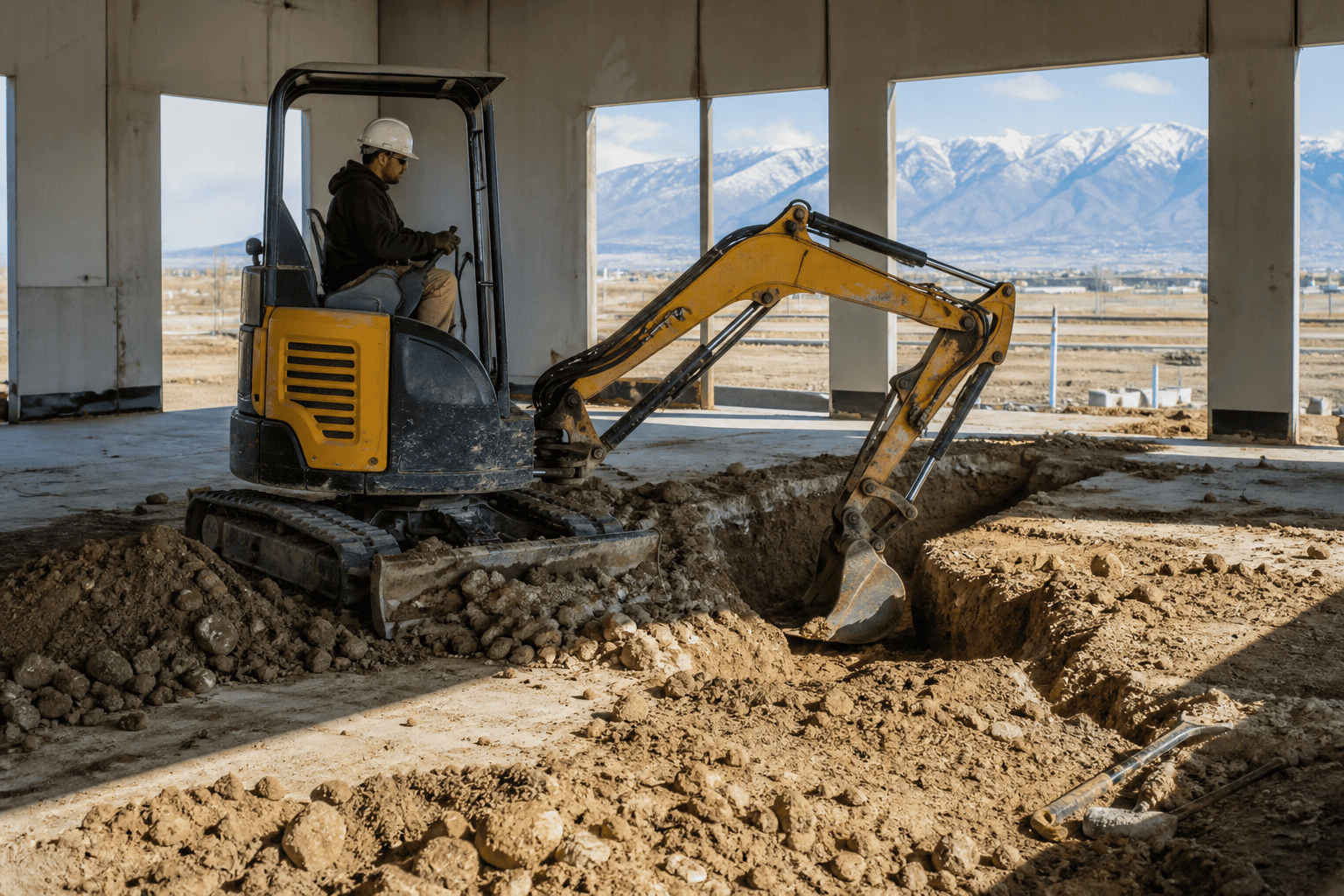
Traverse Mountain option sheets sell a rough grade as if it were landscaping prep. Silicon Slopes corridors behind them want utility trenches on a builder calendar, and those bid packets still quote stale limits. Lehi excavation contractor insurance has to carry the S310 class and the current Utah general liability floor. For the program page that already ranks for service intent, see our excavation contractor insurance service page.
If you run an excavation company in Lehi, you cut pads, open utility trenches, and backfill foundations for the builders working Traverse Mountain and the Silicon Slopes corridor. Utah licenses that work under S310, and the license now carries a general liability floor of around $1 million per occurrence and $2 million aggregate. Lehi excavation contractor insurance starts with that policy, then adds workers compensation, commercial auto, and equipment coverage around it. This guide covers the state requirement, the full coverage stack, and the two places where dirt crews tend to get surprised at claim time. For the program overview, visit our excavation contractor insurance service page.
The Utah Division of Professional Licensing requires a general liability certificate before it issues or renews a contractor license. The floor now sits around $1 million per occurrence and $2 million aggregate, and it applies to every classification. Your certificate also has to list the division as certificate holder, which your agent can arrange at binding.
You will run into other numbers when you search. Many pages still print the old $100,000 and $300,000 minimums from before the 2026 change. Some March 2026 application PDFs still print $1 million and $3 million, because the forms have lagged behind the rule. None of that should worry you as long as your limits sit at or above the current floor. Carrying more than the state asks for creates no licensing risk, and the only real exposure is carrying less. If your policy still shows the old limits, raise them before your renewal date arrives. Most builders along the corridor ask for at least those limits anyway, and many want an umbrella above them.
S310 is Utah’s Foundation, Excavation, and Demolition classification. The scope covers cut, fill, excavation, grading, trenching, backfilling, smashing, and crushing, with hand tools, power equipment, or explosives. It also reaches excavation for piers, piles, footings, and foundations, along with raising, underpinning, moving, and removing structures. The state folded the older S460 and S480 classifications into S310 in 2019, so one license now handles work that once took three.
Because S310 is a specialty license, you take a 25-hour pre-license course from an approved provider before you apply. You also register the business, file the general liability certificate, and show workers compensation or a waiver. Utah does not ask every S310 applicant for a license bond. The division can require one when an applicant cannot show financial responsibility, and the specialty minimum is $15,000. Crews that only grade for landscaping generally work under S330, so match your classification to the work you bid.
General liability satisfies the state, and the rest of the program protects the business. Here is how the core policies line up for a Utah County dirt crew.
| Coverage | What it does for your operation |
|---|---|
| General liability | Pays for injury or property damage your work causes to others, and meets the state license requirement |
| Workers compensation | Covers an operator or laborer hurt in a cave-in, a rollover, or a crush injury |
| Commercial auto | Covers the dump trucks and lowboys running Pioneer Crossing and I-15 between jobs |
| Inland marine | Covers excavators, skid steers, and trench boxes on the lot, in the yard, and in transit |
| Commercial umbrella | Adds limits above general liability and auto when a builder’s contract asks for more |
| Pollution liability | Responds to diesel and hydraulic spills that general liability commonly excludes |
Workers compensation applies as soon as you have employees. If you truly have none, Utah still wants a Workers Compensation Coverage Waiver from the Labor Commission on file. Equipment coverage matters more than most owners expect on multi-lot new construction, because machines move between houses all week and sit on open sites overnight. Schedule your excavators, skid steers, and trench boxes on an inland marine policy, since commercial auto will not cover a machine riding on the trailer.
Builders around Traverse Mountain and Thanksgiving Point often sell site prep with the home. The package usually includes rough grade, utility trenches, and a pad that has to survive its first Wasatch winter. When a builder rejects your grade, the cost to regrade it is a workmanship issue, and general liability excludes the cost of redoing your own work. Completed operations coverage can respond when a failed pad damages other property, such as a foundation that cracks.
The second gap involves how the carrier classifies your work. S310 allows deep trenching on the license, but your policy only covers the operations it describes. A policy rated for residential grading may not respond to a utility trench claim, even when the license allowed it. Some contractor policies also exclude or sublimit underground utility damage, so check for that before you take trench work. Our excavation contractor insurance guide explains both issues in more detail. Tell your agent the deepest trench you dig and the largest job you take, so the class on the policy fits the work in the field.
Underground work adds two pieces of paperwork that affect your insurance. The first is the locate request through Blue Stakes of Utah 811, the state’s one-call center. A ticket stays valid for 14 calendar days, and Blue Stakes asks you to hand dig within 24 inches on either side of the marks. Keep the ticket number and photos of the marks in the job file, because that record shapes how a utility strike claim plays out.
The second is the city. Lehi’s Development Code has its own grading permit chapter, which covers grading, filling, and excavation work inside city limits. Some work under a valid building permit is exempt, so confirm the requirement with the city before you mobilize. Your state license does not replace that local permit or its inspections.
General contractors along the corridor prequalify their excavation subs, and the certificate is usually the first document they check. They look for current policy dates, limits at or above their contract minimum, and additional insured status for the builder. Many also ask for a waiver of subrogation and primary and noncontributory wording. Those terms have to exist as endorsements on the policy, since a certificate cannot grant coverage the policy lacks. We turn certificate requests around the same day for our contractor clients, which helps when a bid deadline is close. It also helps to tell your agent how your work splits between residential pads and commercial trenching, because carriers price those two books differently.
Western Pacific Insurance is an independent agency that works with excavation contractors across Utah County and the Wasatch Front. We take your operation to multiple carriers and match the classification to the work you really do. We also make sure your limits satisfy both the state and the builders who hire you. Start with a Utah quote request, or call us at (801) 955-3755. You can see everything we write in the state on our Utah insurance page. For the program itself, visit our excavation contractor insurance service page.


