
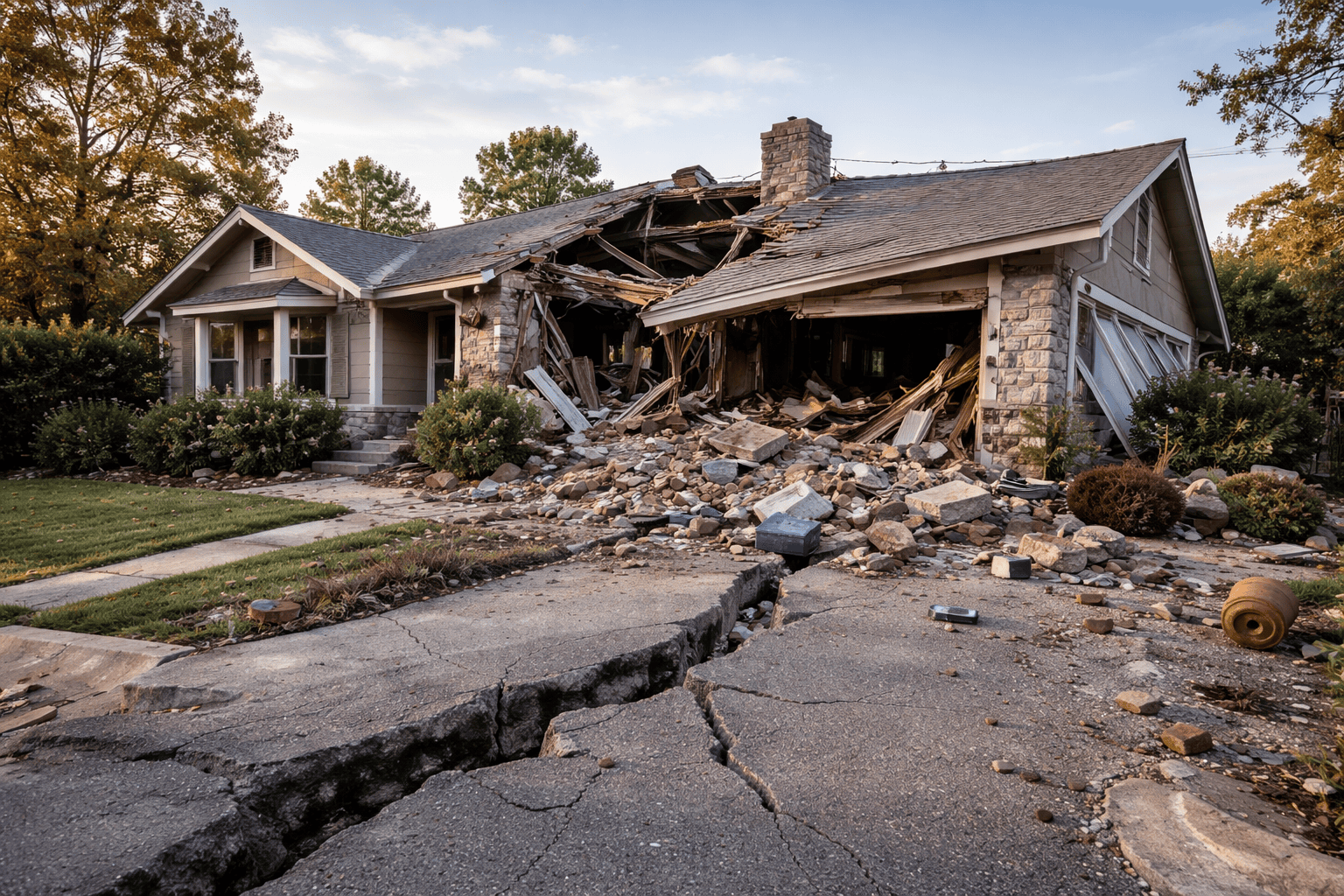
A 10% earthquake deductible is 10% of the coverage limit, not 10% of the damage. On a $400,000 dwelling that is $40,000 you pay before the policy pays a dollar. Other structures and personal property often have their own percentage deductibles in the same event. Standard homeowners insurance does not include earthquake. Use this page to turn the percentage on your declarations page into real dollars, with homeowner and renter examples.
This post complements my YouTube video, “Earthquake Deductibles Explained in Plain English.” If you want the quick version, watch the video first—then use this page as your reference guide when you pull out your declarations page and do the math.
Earthquake coverage isn’t automatic
One of the biggest misunderstandings I run into is assuming a standard homeowners policy automatically covers earthquake damage. In most cases, it does not—earthquake coverage typically must be added either:
- as an endorsement on your homeowners policy, or
- as a separate earthquake policy.
The takeaway is simple: if earthquake coverage isn’t specifically included, a standard homeowners policy generally won’t pay for earthquake damage. So before you even talk deductibles, make sure you know whether you actually have earthquake coverage in place.
Why earthquake deductibles feel “weird”
Most people hear the word deductible and think “flat dollar amount.” Like $1,000 or $2,500. Earthquake deductibles usually don’t work like that.
Earthquake deductibles are commonly stated as a percentage—often something like 10%, 15%, or higher. And here’s the most important clarification:
The deductible percentage is applied to the coverage limit (the amount insured), not the damage amount.
10% of what? A simple homeowner example
Let’s use one clear example and keep it literal. Suppose your earthquake coverage includes:
- Dwelling coverage limit: $400,000
- Other structures coverage limit: $40,000
- Personal property coverage limit: $50,000
And let’s say your earthquake deductible is 10% and applies separately to each coverage. Here’s what that means:
Step 1: Calculate each deductible
- Dwelling deductible: 10% of $400,000 = $40,000
- Other structures deductible: 10% of $40,000 = $4,000
- Personal property deductible: 10% of $50,000 = $5,000
Step 2: Understand the “combined” number
This is where people get tripped up: there isn’t one single “$49,000 deductible.” There are three separate deductibles. If one earthquake damages all three coverage buckets, all three deductibles can apply in that same event.
So your total out-of-pocket deductible exposure in that event would be: $40,000 + $4,000 + $5,000 = $49,000.
How the deductible interacts with your claim
Another common confusion is thinking the deductible is compared to one repair bill at a time. In practice, the deductible is applied to the overall covered loss for each coverage.
Example: dwelling coverage only
Using the same example above, your dwelling deductible is $40,000.
- If covered dwelling damage totals $30,000, it doesn’t exceed the $40,000 dwelling deductible, so the earthquake coverage would pay $0 on the dwelling portion.
- If covered dwelling damage totals $150,000, the first $40,000 is your responsibility, and earthquake coverage can respond above that on the dwelling portion.
That’s the reason earthquake insurance often doesn’t feel helpful for moderate damage—it’s designed primarily for serious losses.
Why policies are structured this way
Earthquake risk is different from many everyday claims: when a severe earthquake hits, it can affect a large area at once, and repairs can be complex, slow, and expensive. Percentage deductibles are one way the insurance world shares that risk—keeping catastrophic coverage available while setting a clear threshold for when the policy starts paying.
Renter example: earthquake deductible on personal property
This isn’t just a homeowner topic. Renters can also have earthquake coverage—often focused on personal property. Here’s one straightforward renter example:
- Personal property coverage limit: $50,000
- Earthquake deductible: 10%
Ten percent of $50,000 is $5,000. That means you’re responsible for the first $5,000 of covered personal property loss before earthquake coverage pays anything.
- If covered damage to your belongings totals $3,000, coverage pays $0.
- If covered damage totals $20,000, coverage can respond above $5,000.
Cash flow matters after an earthquake
Even with earthquake coverage, you can still have a period where money goes out before insurance money comes in: temporary housing needs, inspections, structural evaluations, and the reality that contractors and materials may be harder to schedule after a major regional event. The policy can help prevent a financial cliff—but it doesn’t remove all the friction in the early days.
A quick checklist: what to pull from your declarations page
To understand your own earthquake deductible, gather these items:
- Do you have earthquake coverage as an endorsement or a separate policy?
- What are the coverage limits for dwelling, other structures, and personal property?
- What is the earthquake deductible percentage for each coverage?
- Does the deductible apply separately by coverage (often yes)?
- Convert each deductible percentage into a dollar amount and add them together to see your potential out-of-pocket threshold in a single event.
Frequently Asked Questions About Earthquake Deductibles
Is the earthquake deductible a percent of the damage?
Typically, no. It’s commonly a percentage of the coverage limit. Always verify on your policy forms, but that’s the structure most people encounter.
Do I pay the deductible once or multiple times?
Often, earthquake deductibles apply per coverage. If one earthquake damages multiple coverage buckets (dwelling, other structures, personal property), your total out-of-pocket deductible in that event can be the sum of the separate deductibles.
Does this mean earthquake insurance isn’t worth it?
Not necessarily. Earthquake insurance is usually about catastrophic protection, not small repairs. It can be valuable precisely because it can limit the financial impact of a severe event. Whether it makes sense depends on your property, your location, your budget, and how much risk you’re comfortable carrying yourself.
Where can I learn more about earthquake risk in my area?
A good educational resource is the U.S. Geological Survey’s earthquake site. You can start here: earthquake.usgs.gov
Want help translating your deductible percentage into real dollars?
If you’d like, send us your declarations page and we can walk through the earthquake deductible math with you so you know what your realistic out-of-pocket threshold looks like. (This article is educational and not a guarantee of coverage—always refer to your specific policy wording.)


