
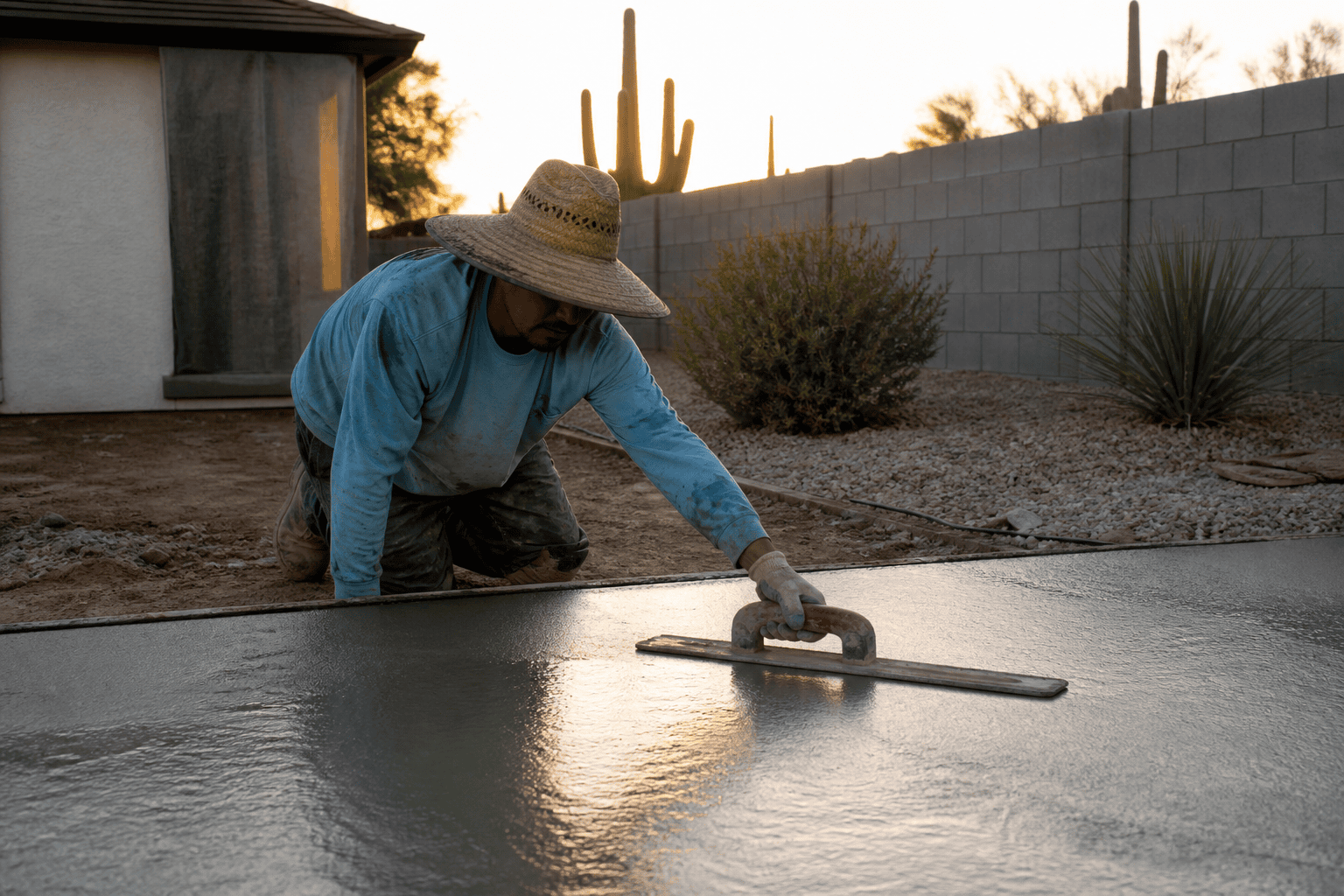
If you pour driveways, patios, footings, or commercial flatwork around the Valley, your insurance has to fit three things. Those are the license classification you hold, the heat you pour into, and the certificate your customer wants before your truck shows up. Phoenix concrete contractor insurance usually starts with general liability, workers’ compensation, and commercial auto. Equipment coverage and an umbrella follow as the jobs get bigger. This guide covers how Arizona licenses the work, where Valley claims come from, and how to build a policy around your actual jobs.
How Arizona Licenses Concrete and Masonry Work
The Arizona Registrar of Contractors treats concrete and masonry as separate trades, each with its own residential, commercial, and dual classification. That split matters more than many owners expect, because a lot of East Valley work combines the two on the same lot.
| Trade | Residential | Commercial | Dual |
|---|---|---|---|
| Concrete (slabs, flatwork, footings, driveways) | R-9 | C-9 | CR-9 |
| Masonry (block, brick, stone, adobe) | R-31 | C-31 | CR-31 |
A crew that pours a driveway and then stacks a CMU privacy wall on a new footing is doing two scopes of work. You can only bid both if both classifications sit on your license. The ROC publishes the full scope of each class, so check it before you quote a combined job.
Your license bond also depends on classification and volume. According to the ROC’s bond schedule, residential specialty contractors carry a $4,250 bond below $375,000 in annual volume and $7,500 above it. Commercial specialty bonds start at $2,500 for $150,000 or less and step up as your volume grows. Because the bond is based on the volume you report, raise it before you outgrow your tier rather than after.
A license is generally required once a job tops $1,000 in labor and materials or needs a building permit. Splitting one large pour into several small contracts does not get around that threshold. Our main concrete contractor insurance guide goes deeper on how license scope and policy classification connect.
Workers’ Compensation Starts With Your First Employee
Arizona requires workers’ compensation as soon as you have one employee, and the employer pays the full premium. You cannot deduct any part of it from a worker’s wages.
Premium is driven by payroll and by the class code that payroll falls under. Concrete work and masonry work rate differently, so a company that does both should split payroll by the work each crew actually performs. When a flatwork crew gets coded as masonry, or the reverse, the difference usually shows up at the year-end audit. Clean time records by job and by trade are the simplest way to keep that audit predictable.
Where Valley Concrete Claims Come From
Heat is the first problem. In July, a pour that starts mid-morning can set before your finishers are ready. The result may be cracking, scaling, or a surface the customer rejects. The National Ready Mixed Concrete Association publishes hot weather guidance that many crews and underwriters use as a reference. It helps to know that general liability is written for damage your work causes to other people’s property. It is not designed to pay for tearing out and repouring your own slab.
Monsoon season brings a different kind of loss. A sudden cell can wash out a fresh surface or send slurry across a neighbor’s finished patio. Damage to the neighbor’s property is the kind of claim liability coverage is meant to handle. Damage to the slab you were finishing falls closer to the workmanship gap. Depending on the form, an installation floater or builders risk policy may respond to physical loss on work in progress. Photograph the site before you start, and tell your agent the hottest months you still pour.
Desert landscaping adds a local twist. Many Valley lots include mature saguaros, ironwoods, and other plants covered by the Arizona Native Plant Law, and replacing one is rarely cheap. General liability often excludes property in your care, custody, or control, so ask how your policy treats damage to plants on a lot you are actively forming.
Building Phoenix Concrete Contractor Insurance Around Your Work Mix
Most Valley concrete operations carry a core set of policies, then add layers as they take on commercial or HOA work:
- General liability for property damage and injuries to others, including completed operations after the job is done.
- Workers’ compensation once you have employees, with payroll split between concrete and masonry codes.
- Commercial auto for mixers, pickups, and trailers moving between jobs across the 202 and the 60.
- Contractors equipment (inland marine) for forms, screeds, power trowels, and saws that live on the truck or the jobsite.
- Umbrella or excess liability for commercial, HOA, and municipal contracts that ask for higher limits.
Property managers and general contractors often list required limits in the contract. Treat those numbers as a floor. A single serious injury or a failed commercial slab can outrun a basic limit quickly. There is far more risk in carrying too little than too much. Our general contractor insurance guide explains the additional insured and waiver of subrogation requests you will see in those contracts.
Getting a Phoenix Concrete Insurance Quote
Western Pacific Insurance is licensed in Arizona and works with multiple carriers that write concrete and masonry contractors. We compare how those carriers classify your work and review the completed operations language before you bind. We also make sure your certificates match what your contracts require.
When you are ready, start an Arizona quote request. You can also visit our Arizona insurance page to see everything we place in the state.


