
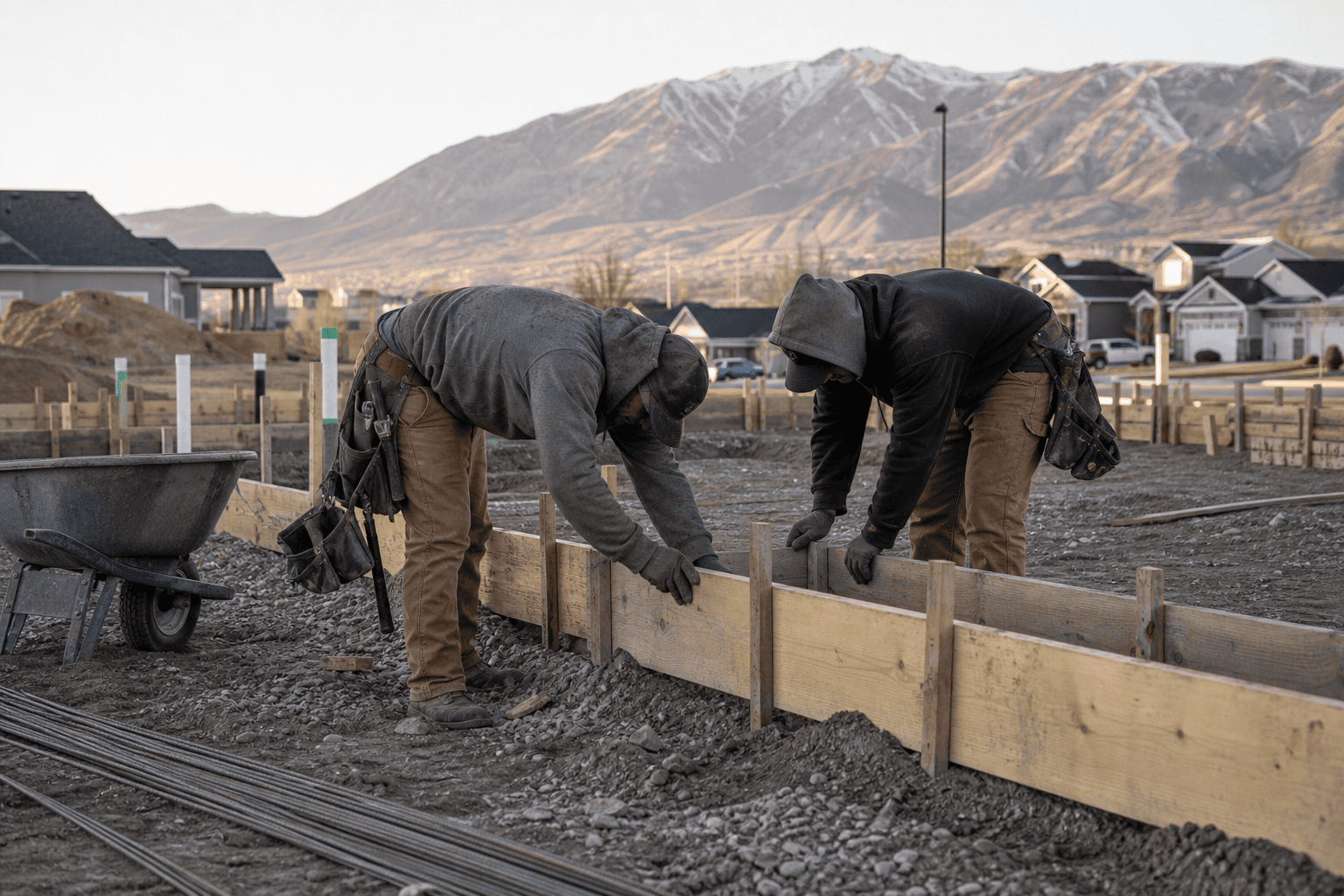
Lehi keeps concrete crews busy. New neighborhoods around Traverse Mountain and Pioneer Crossing need footings, foundation walls, and garage slabs poured on a builder’s schedule. Office and warehouse projects along Silicon Slopes call for larger slabs and tilt-up pads. If you run one of those crews, your Lehi concrete contractor insurance has two audiences: the State of Utah, which sets a liability floor for your license, and the general contractors who decide whether you make their bid list. This guide covers what each one expects and how to build a program that holds up when a pour goes wrong.
Utah’s 2026 General Liability Requirement
Utah raised its contractor general liability requirement in 2026. Every license classification, including S260, now needs around $1 million per occurrence and $2 million aggregate, with the Division of Professional Licensing (DOPL) listed as certificate holder. That’s a steep climb from the old $100,000 and $300,000 minimums, which many pages online still print. You may also run into a $1 million and $3 million figure, which came from an earlier proposal and still shows up on some application forms. Because the paperwork tends to lag the rule, confirm the current figure with DOPL when you renew.
Treat the state number as a starting point. Builders on larger projects often write higher limits into their subcontracts, and an umbrella policy is the usual way to get there without rewriting your whole program.
Which License Covers Your Concrete Work
Utah places concrete work under S260 Asphalt and Concrete, and it places block and brick under S230. The Utah Office of Administrative Rules publishes the current scopes in R156-55a.
| Type of work | License classification |
|---|---|
| Footings, foundations, slabs, driveways, flatwork | S260 Asphalt and Concrete |
| CMU block walls, brick, stone veneer | S230 Masonry, Siding, Stucco, Glass, and Rain Gutter |
| Pouring a footing and laying block on it | Both S260 and S230 |
Getting either specialty license involves a 25-hour pre-license course from an approved provider, business registration, and proof of the general liability coverage above. The split between the two classifications matters on the insurance side too. Carriers rate your policy by class code, and a policy written only for concrete work may exclude masonry through a classification limitation. If you pour a footing and then lay a block stem wall on top of it, your license and your policy should both reflect that.
Building the Rest of Your Coverage
General liability gets you licensed, but most concrete contractors need a fuller program to protect the business.
| Coverage | What it handles | Who needs it |
|---|---|---|
| General liability | Third-party injury and property damage, including completed work | Every Utah license holder |
| Workers’ compensation | Injuries to your employees | Required once you have employees; owners without employees file a Labor Commission waiver |
| Commercial auto | Pickups, mixers, trailers, and other business vehicles | Any crew driving to job sites |
| Contractors equipment (inland marine) | Forms, screeds, power trowels, saws, and other tools | Crews moving equipment between lots |
| Umbrella | Extra limits above your liability, auto, and employer’s liability | Contractors bidding larger commercial work |
It helps to know where general liability stops. It generally won’t pay to tear out and repour your own work if a builder rejects the finish or the grade. That cost usually lands on you. General liability responds when your work causes damage to other property or injures someone, such as a failed footing that cracks the framing above it after the job wraps. Our concrete contractor insurance guide covers these gaps in more detail. See our general liability page and business auto page for how each policy works.
Certificates and the Builder Bid List
Builders putting up homes at Traverse Mountain and Pioneer Crossing prequalify their pour crews, and the certificate of insurance is often the first thing they check. A lapsed policy or limits below their subcontract can end your bid before anyone looks at your price. Most builders ask for additional insured status for both ongoing and completed operations, primary and noncontributory wording, and a waiver of subrogation. Those protections come from endorsements on the policy itself, so make sure your policy carries them before the certificate goes out. Our general contractor insurance guide explains what builders are looking for from their side.
Commercial work near Thanksgiving Point and along Silicon Slopes usually brings higher limits and stricter contract wording than residential foundations. Let your agent know which kinds of jobs you bid. Carriers price residential foundation work and commercial slab work differently, and your policy should match the work you actually do.
Get a Lehi Quote
Western Pacific Insurance is an independent agency serving concrete and masonry contractors across Utah County and the Wasatch Front. We compare coverage from multiple carriers and place your program with one that fits your classification, your work mix, and the limits your builders require. Start with a Utah quote request or call (801) 955-3755. You can also visit our Utah insurance page to see everything we write in the state.


