
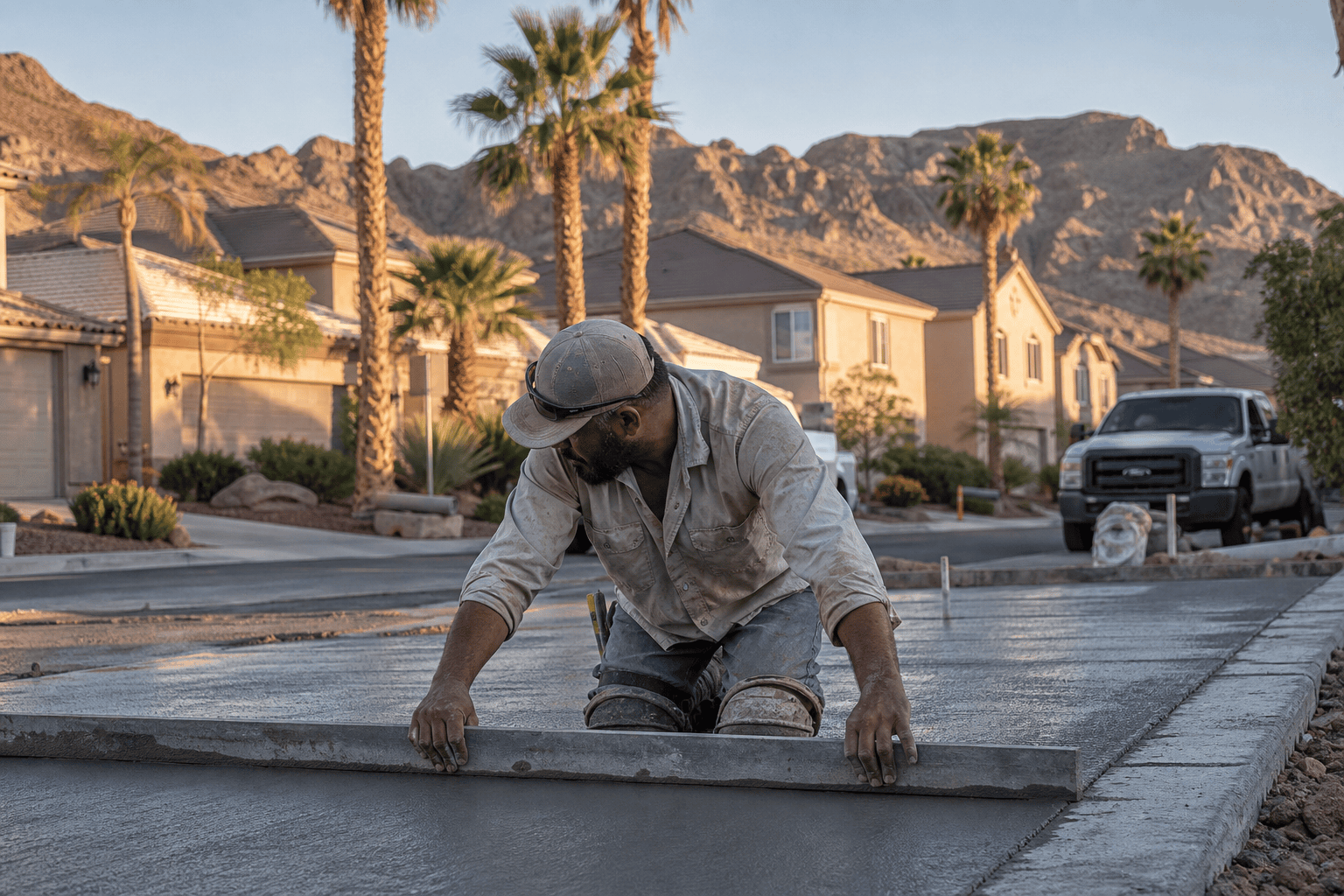
Henderson concrete contractor insurance has to fit the way concrete work actually runs in Southern Nevada. You pour before sunrise to beat the heat, and in a single week you may work production tracts, custom hillside lots, and commercial pads. Your trailer also carries equipment that would be expensive to replace on short notice. This guide covers the policies a Henderson concrete contractor typically carries, how Nevada licensing shapes that program, and where claims tend to come from locally.
The Core Coverage for a Concrete Contractor
Most concrete contractors build their insurance program around the same handful of policies. What changes from one company to the next is the limits, the endorsements your contracts require, and how the carrier classifies your work.
| Coverage | What it does for you | Henderson example |
|---|---|---|
| General liability | Pays for injury or property damage you cause to others, including after the job is finished | Slurry runoff stains a neighbor’s pavers on a Cadence driveway pour |
| Workers’ compensation | Covers medical bills and lost wages when an employee is hurt on the job | A finisher strains his back running a screed on a garage slab |
| Commercial auto | Covers the trucks you own plus hired and non-owned vehicles | Your truck and trailer rear-end another car on I-215 |
| Contractor’s equipment (inland marine) | Covers tools and equipment on job sites, in transit, and in storage | A power trowel disappears from a trailer staged overnight |
| Umbrella or excess liability | Adds limits above your GL, auto, and employer’s liability | A builder contract calls for more liability than your primary policy carries |
| Surety bonds | Satisfies the license bond and any performance or payment bonds a job requires | A commercial GC asks for a performance bond on a warehouse slab |
General liability is the policy builders and general contractors ask for first. The completed operations part of it deserves special attention in concrete work. Cracking, settlement, and drainage complaints often surface months or years after you pour. Nevada’s construction defect law (NRS Chapter 40) gives property owners a long window to bring those claims, so keep completed operations coverage in force for as long as your past work could come back to you. You can read more on the policy itself on our general liability insurance page.
When Your Own Work Is the Problem
One point surprises a lot of concrete contractors. General liability policies generally exclude the cost of repairing your own finished work. If a patio deck you poured cracks and has to come out, the tear-out and repour usually falls on you.
The policy can still respond to what that failure damages. Stucco you scar, landscaping you destroy, a neighbor’s block wall that shifts, or a person who trips on a heaved section may all fall within the coverage. That is why documentation matters. Photograph the work area before you start, note any existing damage, and keep your pour records. Clean records make a claim easier to sort out when the owner blames the slab for everything nearby.
Nevada Licensing: C-5, C-18, and Your Monetary Limit
The Nevada State Contractors Board licenses concrete work under classification C-5. According to NAC 624.230, a C-5 license covers preparing the surface, placing reinforcement, building forms, pouring and finishing concrete, applying sealants, and sawing, cutting, or coring concrete.
Masonry sits under a separate license. A C-18 license covers laying brick, stone, and precast block, with or without mortar. That distinction matters in Henderson because a driveway job often grows into a CMU privacy wall or a block retaining wall. If the wall is block, you need C-18 authority to build it.
The stakes are real. Under NAC 624.640, a bid or contract is void if it exceeds the scope of your license or your monetary limit. Every Nevada license carries a monetary limit that caps the size of any single contract. If a larger commercial slab comes along, you can apply to the board to raise your limit for that one project. The board also sets your license bond, which can range from $1,000 to $500,000 based on your limit and finances. If you do residential work, you’ll also pay into the Residential Recovery Fund.
Licensing also shapes your insurance. Carriers rate concrete and masonry under different classifications, often at different rates. Tell your agent about every type of work you do and roughly how much payroll goes into each. Work that never made it onto the application tends to show up at audit, and it can raise coverage questions at the worst possible time.
What Henderson Builders and GCs Will Ask For
Production builders in Cadence and Inspirada, and commercial GCs working the I-215 and St. Rose Parkway corridors, all send contracts with insurance requirements attached. Common asks include:
- Additional insured status for both ongoing and completed operations
- Primary and noncontributory wording, so your policy pays before theirs
- A waiver of subrogation in their favor
- Minimum limits for general liability, auto, and umbrella coverage
A certificate alone rarely satisfies these requirements. The endorsements have to exist on your actual policy. Send the insurance section of a contract to your agent before you sign it, so the endorsements are in place before your crew shows up.
Treat a contract’s limits as a floor. A single serious injury or a large property claim can exceed a $1 million limit quickly. An umbrella policy is usually an inexpensive way to raise your protection well beyond what the contract demands.
Heat, Silica, and Workers’ Compensation
Nevada requires workers’ compensation once you have employees, and concrete work gives it plenty to do. Summer pours start in the dark because concrete sets fast in desert heat, so heat illness and fatigue are real exposures. Sawing, grinding, and coring concrete also create silica dust. The OSHA silica standard for construction requires employers to control that dust through water, vacuums, or respirators.
Your comp premium follows your payroll and the classification of the work your people do. As your company grows, your claims history feeds into an experience modification factor that can raise or lower what you pay. A written safety program, hydration and rest breaks, and proper dust controls protect your crew and help keep that factor in check.
Equipment, Trailers, and Washout
Your commercial auto policy covers the truck, but it generally won’t pay for the tools inside it. Contractor’s equipment coverage fills that gap. It protects power trowels, screeds, saws, mixers, and forms whether they sit on a job site, in a trailer, or in your yard.
Schedule your major pieces at what it would cost to replace them today, and update those values when you buy new equipment. Underinsuring equipment only shows up when you try to replace it. Let your agent know if you stage equipment overnight on an open lot in Inspirada or Cadence. Carriers view overnight job site storage differently from a locked yard.
Concrete washout is another exposure worth raising. Standard general liability policies carry pollution exclusions, and high-pH washout water or spilled sealants can fall into that gray area. If you handle washout on site, ask your agent whether contractors pollution liability makes sense for your operation.
Get a Henderson Concrete Contractor Quote
Western Pacific Insurance is headquartered in Henderson, and we help concrete and masonry contractors across the valley put the right coverage in place. As an independent agency, we shop your operation with multiple carriers and match the classification to the work you actually do, whether that’s C-5, C-18, or both.
Start with a Nevada quote request, or explore our Nevada insurance page to see everything we write in the state. For a broader look at the trade, read our concrete contractor insurance guide, or see how coverage works across a full project in our general contractor insurance guide.


