
Phoenix rode the industrial boom harder than almost any metro in the country. Warehouses, distribution centers, and manufacturing space spread across the West Valley growth corridors. Much of it carries debt that’s now maturing. Nationally, 23 percent of industrial property loan balances come due in 2026, per the Mortgage Bankers Association’s maturity survey. Maybe you’re refinancing a Deer Valley warehouse. Maybe you’re buying your first building in Tempe. Either way, the lender’s insurance requirements decide whether your closing happens on schedule. The full framework lives in our commercial real estate loan insurance requirements guide. Here’s what’s specific to Phoenix commercial loan insurance.
The Phoenix Angle: Flood Rules in a Desert That Floods
Phoenix buyers get blindsided by the flood requirement all the time. Maricopa County holds extensive FEMA-mapped Special Flood Hazard Areas. They run along the Salt River, the Agua Fria, and dozens of washes threading through the industrial corridors. When the flood zone determination comes back positive, federal law kicks in. The lender must mandate flood coverage for the life of the loan. The Federal Reserve’s Consumer Compliance Outlook walks through how lenders calculate the required amount. It’s the lesser of three numbers: the loan balance, the maximum NFIP coverage available, or the building’s insurable value, meaning replacement cost without the land.
The same publication flags the trap that bites Phoenix industrial deals specifically: contents. Suppose your loan pledges the equipment, racking, or inventory inside a flood-zone building. The lender must then require contents coverage too. Regulators’ guidance says a lender can’t waive it, even where it took the security interest out of an abundance of caution. NFIP nonresidential coverage caps at $500,000 for the building and $500,000 for contents. A modern distribution facility blows past those numbers instantly. Excess or private flood is the norm here rather than the exception.
Monsoon Season and the Roof File
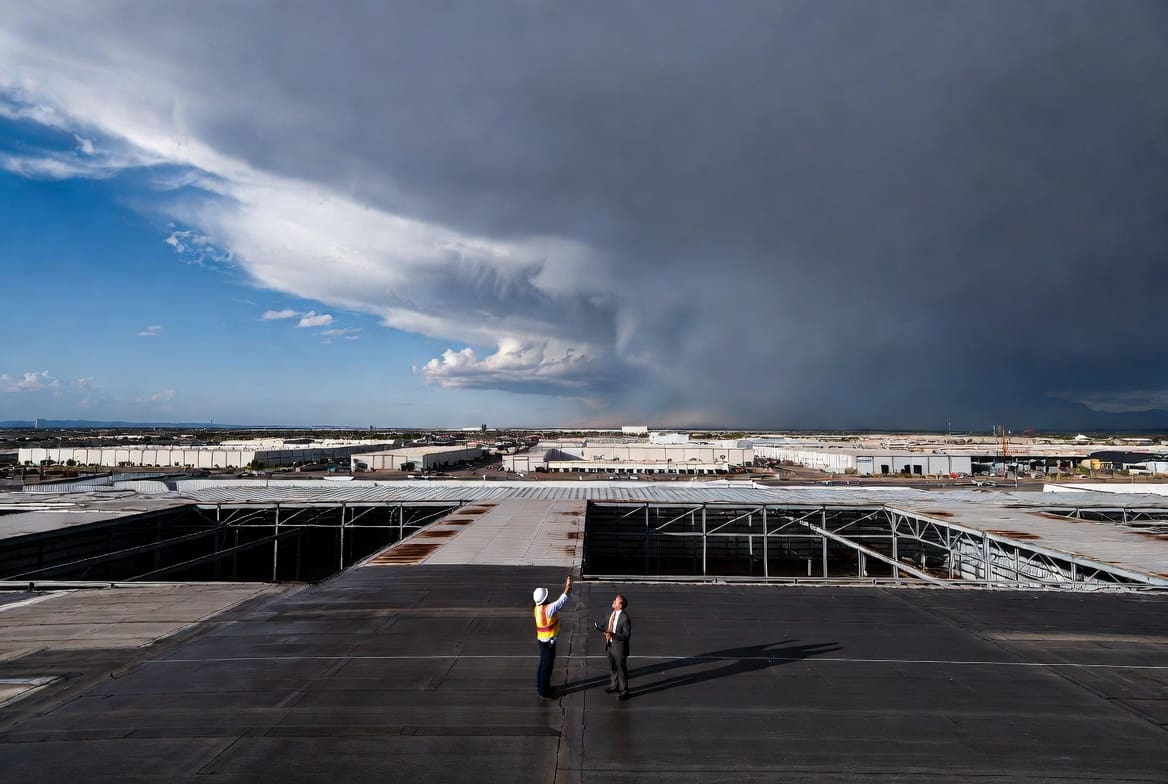
Monsoon microbursts drop straight-line winds onto huge flat roofs. Carriers have responded by underwriting Phoenix roofs hard. Age, membrane type, drainage, and inspection history all get a close look, and lenders follow the carriers. A refinance on a building with a 20 year old roof can stall in underwriting. A roof exclusion or a steep wind deductible can then fail the lender’s maximum deductible requirement. Pull your roof documentation together before you apply. If the roof is near end of life, price the replacement into the deal. Discovering the problem in closing week costs far more.
Replacement Cost After the Boom
Construction costs in the valley climbed steeply through the boom years. Limits set at origination in 2019 or 2021 frequently fail a 2026 replacement cost review. An inadequate limit also triggers the coinsurance penalty on partial losses. Have the rebuild number rerun before your lender’s consultant reruns it for you. An agreed value endorsement settles the valuation question in writing.
Phoenix Commercial Loan Insurance: Getting Your Program Ready for Closing
On a Phoenix deal, the flood zone determination is the item to settle first, because it decides how much of the rest of the program you even need. Size building and contents coverage against the NFIP caps once the zone is known. Get the mortgagee and lender’s loss payable wording onto the policy exactly, pull the roof documentation together so it supports clean terms, and set business income to the months the lender requires. An independent agent can shop the full market and get the endorsements worded the way the closer expects, which keeps a flood-zone industrial file from stalling at the last review.
Phoenix FAQ
My building is in flood zone AO with shallow flooding. Does the requirement still apply?
Yes. Zone AO is a Special Flood Hazard Area. The federal purchase requirement applies just as it does in deeper-water zones. Shallow desert flooding produces real losses. The mapped designation, rather than water depth, triggers the lender’s obligation.
Can I use private flood coverage instead of an NFIP policy?
Lenders can accept private flood coverage that meets the regulatory standards for an acceptable policy. Many private and excess flood options work well for Phoenix industrial buildings, especially above the NFIP caps. The key is getting the lender’s sign-off on the specific form before closing week.
Financing commercial property in the Phoenix metro? Request an Arizona quote, visit our Arizona insurance page, or read the full lender insurance requirements guide.


