
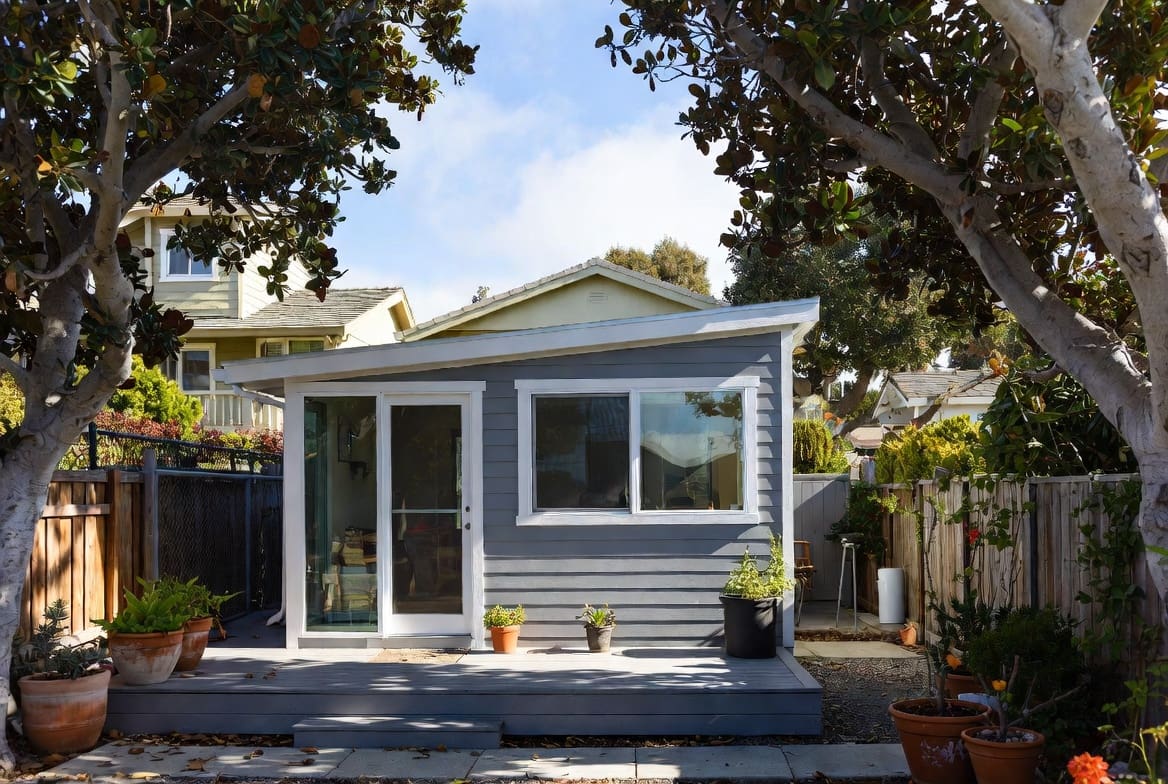
California ADU Insurance: The Step Most Owners Skip
California ADU insurance is the last item on a long project list, and most owners never get to it. The permits close out, the unit gets finished, and the policy still describes the property as it was before. A detached backyard unit sits under other structures, often about 10 percent of dwelling coverage. On a home insured for $900,000 that default is roughly $90,000, shared with the fence and shed. Nothing raises it automatically. Below we cover attached versus detached, garage conversions, wildfire and earthquake, and what to do when the unit is already finished.
California has led the country on accessory dwelling units for years. State law requires cities to approve them. Garage conversions and backyard units are common across the state.
That volume means a large number of California policies are out of date.
Attached or detached decides everything
Your homeowners policy sorts the project by one physical fact. Is the new space attached to the house?
A detached backyard unit is a separate structure. It falls under other structures coverage. A converted attached garage remains part of the dwelling. It stays under dwelling coverage.
Those are different coverage parts with different limits.
Other structures is a shared, defaulted limit
Other structures coverage protects buildings on your property that are not connected to the house. Progressive notes the limit is typically set at ten percent of your dwelling coverage, though it varies by insurer.
On a home insured for $900,000, that default is roughly $90,000. It covers your fence, your shed, and your ADU together.
California construction costs make that gap wide. A detached unit in the Bay Area or Los Angeles routinely exceeds the default.
The limit can be raised. Nothing raises it automatically.
A garage conversion changes your dwelling limit
Converted attached garages stay under dwelling coverage. The rebuild cost still changed.
Your dwelling limit is built on what it would take to rebuild your home as it currently exists. A garage is a slab, framing, and a door. A finished unit adds insulation, surfaces, electrical, plumbing, and climate control.
If your carrier still values that space as parking, the limit reflects a house that is gone.
Wildfire and earthquake still apply
California owners have a second layer to check.
Earth movement and flood exclusions run across a standard homeowners policy. They apply to other structures too. A detached ADU is not separately protected from those perils.
Wildfire exposure also affects whether a carrier will write or keep the risk at all. Adding a second dwelling to a lot in a higher-risk area is a conversation worth having before the build.
Renting the unit is a different question
Many California ADUs are built as rentals. That changes the classification.
Standard other structures coverage does not extend to structures rented or held for rental to someone who is not a tenant of the dwelling. Renting the unit may move it out of that coverage part entirely.
Some carriers endorse the policy. Some require a different form. For a detached unit with separate utilities operating as a rental, a landlord or dwelling fire policy is sometimes the better fit.
Tenants carry their own coverage
Your policy protects your property. A tenant’s belongings are their responsibility.
Anyone renting your ADU should carry a renters policy.
What to do
Call your agent before construction starts. Ask what the finished unit does to your limits and whether your carrier will keep the risk.
If the unit is finished, call now. The update is routine.
Our guide to casita and garage conversion insurance covers both paths in full.
Western Pacific Insurance is an independent agency serving California homeowners. We shop multiple carriers to find the right fit.
Get a California quote or learn more about our California coverage.


