
Coverage for every member of the family.
Pet Insurance Quote Request
As an independent agency, we are here to help you find the right coverage.
Pet insurance secured with Western Pacific Insurance.
Your dog just tore her ACL. The vet says surgery will run between four and six thousand dollars. Pet insurance takes that decision off the table – you say yes, your dog gets the surgery, and the policy reimburses you for most of the bill.
What pet insurance actually is.
Pet insurance is a health insurance policy for your dog or cat. You pay a monthly premium, and when your pet needs medical care, the policy reimburses you for a percentage of the vet bill.
Unlike human health insurance, you do not show a card and have the provider bill the carrier. Pet insurance works on a reimbursement model. You pay the vet at the time of service, submit the claim with the invoice and medical records, and the carrier sends you a check or direct deposit for the covered portion.
You can use any licensed veterinarian in the country. There are no networks. That includes specialists, emergency clinics, and veterinary hospitals. Wherever your pet gets treated, the policy can reimburse the visit as long as it is a covered expense.
What pet insurance covers.
There are two main coverage tiers, and most carriers offer both.

Accident and illness coverage is the core of pet insurance. It covers things like ACL tears, broken bones, cancer, infections, allergies, diabetes, digestive issues, and emergency surgery. If your dog eats something it should not have and needs surgery to remove it, that is a covered accident. If your cat develops kidney disease, that is a covered illness. Hereditary and congenital conditions may be eligible for coverage too, as long as they are not pre-existing.
Wellness coverage is an add-on that covers routine and preventive care. Annual exams, vaccinations, dental cleanings, flea and tick prevention, and heartworm testing are all included. These are the visits you are already paying for every year. Wellness coverage reimburses you on a fixed schedule for those routine services.
Not every pet owner needs the wellness add-on. Some people would rather pay for routine care out of pocket and keep the premium lower. The accident and illness coverage is where the real financial protection lives, because that is where the large, unexpected bills come from.
Pet insurance vs. homeowners liability.
One thing worth clarifying. Your homeowners insurance does have liability coverage for your pet, but that is a completely different thing. If your dog bites someone and they sue you, your homeowners policy may cover the liability claim. That has nothing to do with your dog’s medical care. Homeowners liability protects you from claims by other people. Pet insurance covers your pet’s vet bills. Those are two separate exposures.
What pet insurance does not cover.
Pre-existing conditions are the biggest exclusion across the entire pet insurance industry. If your pet has a condition before the policy starts, or if a condition shows up during the waiting period, it is not covered. That is true for every carrier. Some carriers will reconsider a curable condition if the pet has been symptom-free and treatment-free for a certain period, often six months. But chronic conditions or conditions that require ongoing management are generally excluded permanently.
Cosmetic procedures are excluded. Ear cropping, claw removal, and tail docking are not covered. Breeding costs and pregnancy expenses are excluded. Elective procedures are excluded.
Waiting period claims can also catch people off guard. Anything that happens during the waiting period may be classified as pre-existing, even though you already bought the policy. The waiting period is the window between when your coverage starts and when the carrier will actually begin paying claims. That window exists to prevent someone from buying a policy after their pet is already sick and filing a claim the next day.
Before you buy, check whether exam fees, diagnostics, medications, and follow-up visits are included or handled separately. Not every plan treats those the same way.
How the money works.
There are three numbers that determine what you pay and what the carrier pays.
The deductible is the amount you pay out of pocket before the policy starts reimbursing. Most pet insurance uses an annual deductible, meaning once you hit that number for the year, every covered claim after that gets reimbursed. Deductible options typically range from around two hundred fifty dollars up to a thousand dollars or more. A higher deductible means a lower monthly premium, and a lower deductible means a higher monthly premium.
The reimbursement percentage is the share of the covered bill the carrier pays after the deductible is met. Common options are seventy, eighty, or ninety percent. If you choose eighty percent reimbursement and you have a four thousand dollar surgery after you have met your deductible, the carrier reimburses thirty-two hundred dollars and you pay eight hundred.
The annual maximum is the most the carrier will pay out in a single policy year. The options depend on who is writing the policy and what plan you choose.
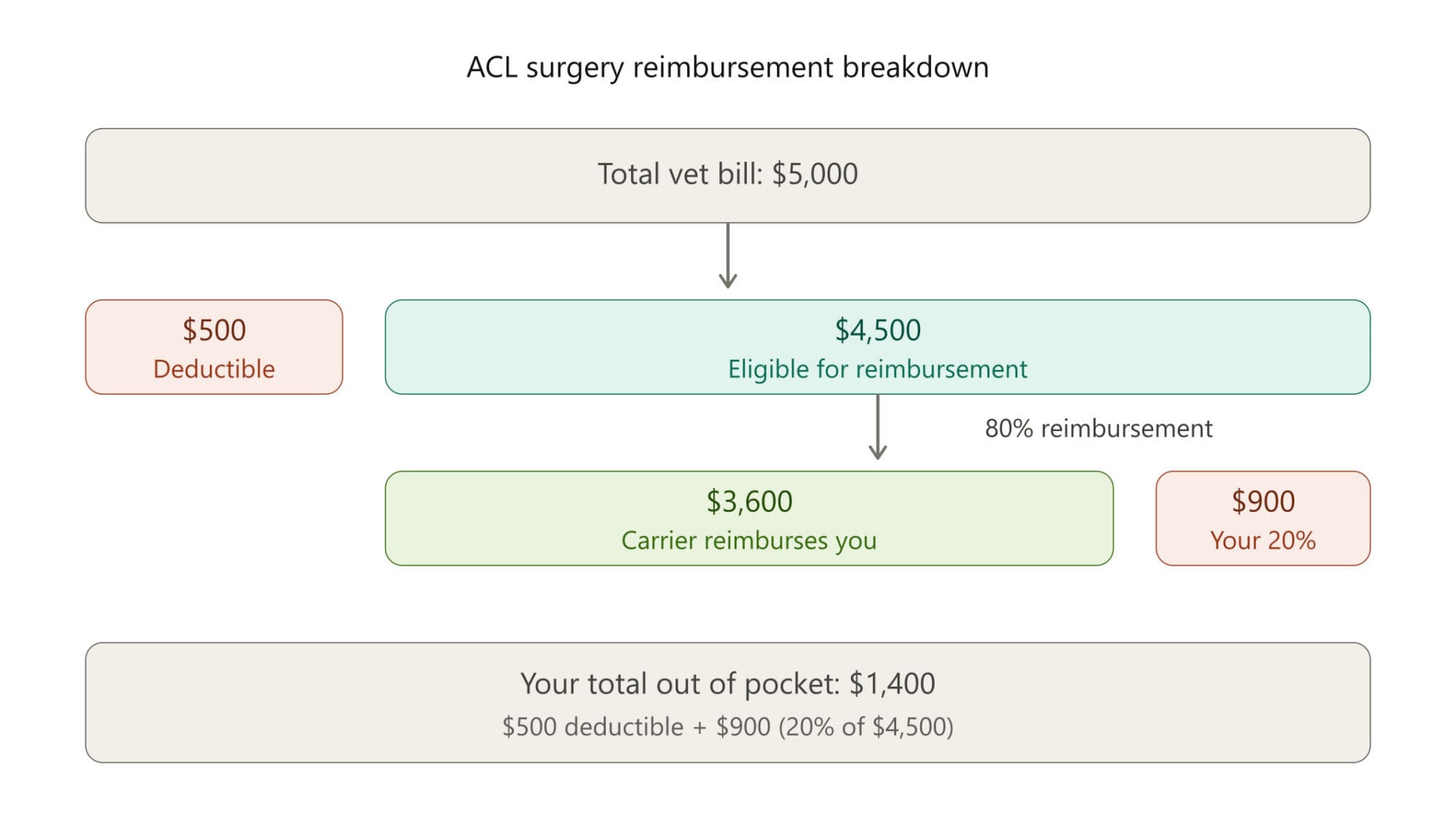
Here is a real-world example. Say the ACL surgery costs five thousand dollars. You have a five hundred dollar annual deductible and eighty percent reimbursement. The first five hundred is yours. The remaining forty-five hundred gets reimbursed at eighty percent, so the carrier sends you thirty-six hundred dollars. Your total out of pocket on a five thousand dollar surgery is fourteen hundred dollars. Without the policy, the entire five thousand is yours.
Your monthly premium is determined by the combination of those three choices plus your pet’s age, breed, and where you live. Veterinary costs vary by region, and some breeds are more expensive to insure because they are prone to certain conditions.
Waiting periods.
Every pet insurance policy has waiting periods. For many carriers, that window is around fourteen days for both accidents and illnesses. Some carriers handle it differently and may have shorter waiting periods for accidents or longer waiting periods for certain orthopedic conditions. Waiting periods may also vary by state, so check your policy documents.
If your pet gets hurt or sick during the waiting period, the carrier is not going to cover it. And that condition may be classified as pre-existing going forward. This is one of the reasons getting pet insurance early matters. The younger and healthier the pet is when the policy starts, the fewer conditions are excluded.
The best time to get pet insurance.
The best time to get pet insurance is when your pet is young and healthy. Every month you wait is a month where something could happen that becomes a pre-existing condition on a future policy.
If your dog tears an ACL before you have a policy, the surgery is not covered. And depending on the carrier, future knee and ligament conditions on that leg may not be covered either, even after the policy is in place. The whole point of insurance is to have it before you need it. That applies to pet insurance the same way it applies to every other kind of coverage we write.
How to get pet insurance through our agency.
We write pet insurance through Safeco, which is part of Liberty Mutual. It is a standalone policy, separate from your home or auto. You can customize the deductible, the reimbursement percentage, and the annual maximum. Safeco offers both accident and illness coverage and an optional wellness add-on. There are age limits for new enrollment, and once your pet is enrolled, renewals are not subject to age limits as long as coverage stays continuous. Discounts are available for multiple pets, multiple Safeco policies, and military status.
We offer pet insurance in Nevada, Arizona, California, and Utah. We can walk you through the options, show you what the premium looks like for your specific pet, and help you figure out whether it makes sense for your situation.
Does pet insurance make sense for you?
Pet insurance is not for everybody. If you have the financial ability to absorb a five or ten thousand dollar vet bill without it affecting your household, you may not need it. Some people prefer to self-insure and set money aside in a savings account for pet emergencies.
But for a lot of families, the premium is manageable and the emergency bill is not. If a monthly premium fits your budget but a major surgery, cancer treatment, emergency hospitalization, or specialist visit would create a financial crisis, that is where pet insurance makes sense.
The peace of mind is real. Knowing that the financial part is handled means you can focus on what actually matters, which is getting your pet the care it needs.
Contact us today to find out more about insuring your pet.

Get Started Today
As an independent agency, we are here to help you find the right Pet Insurance coverage.
(702) 932-3105
Get a Quote
It only takes a minute to get started.
- Fill out the form, we'll be in touch.
- Review options with an agent.
- Get the coverage you need.


